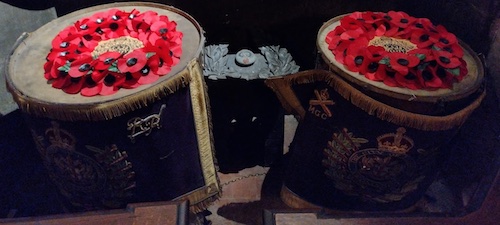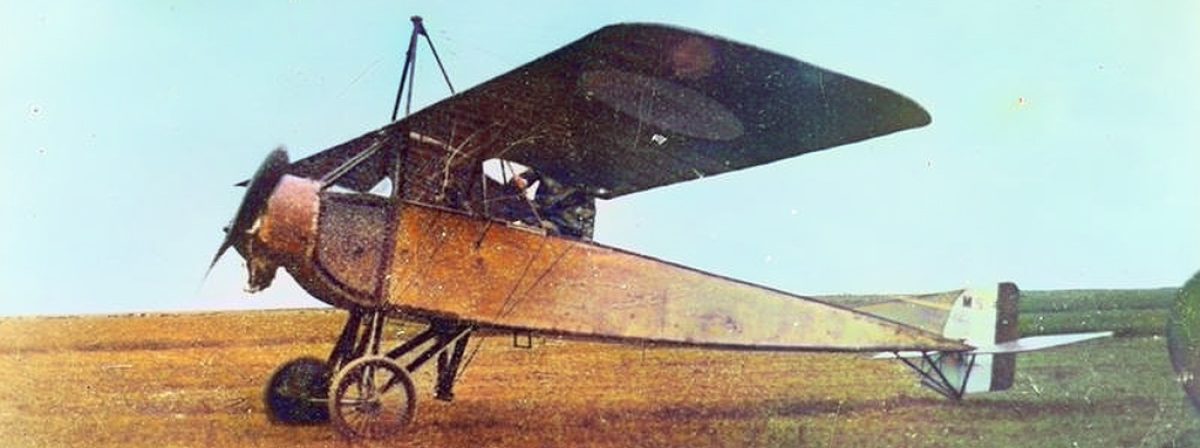
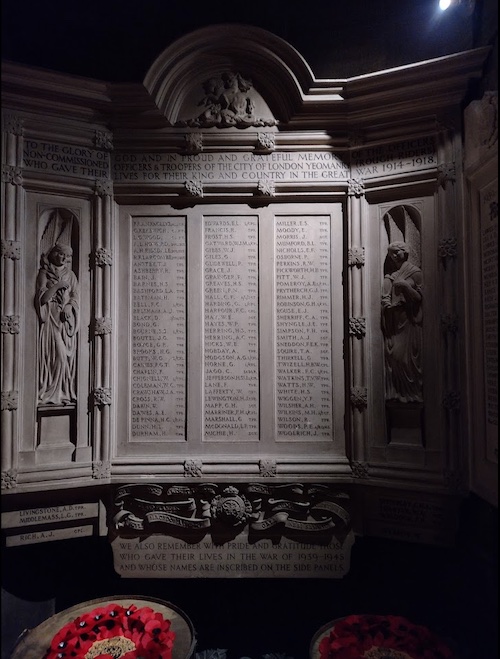
Whilst in London recently we were passing through Smithfield on our way to St Paul’s, when I came across a hidden church: St Bartholomew the Great. It was open so we couldn’t resist going in for a nosey around and I’m very glad we did. It was especially atmospheric as it had some lighting on (it was going dark outside), a choir was practising for a concert and I’m sure there was a lingering smell of incense. With a long history – founded in 1123 – there is much of interest inside, but the item that especially caught my eye was comparatively recent: a memorial to the fallen of the City of London Yeomanry (Rough Riders) in the world wars.
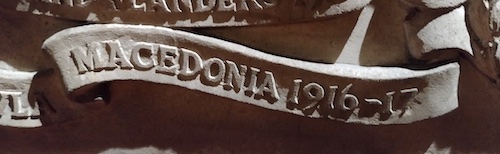
One of the Regiment’s battle honours is ‘Macedonia 1916-17’.
1/1st City of London Yeomanry (Rough Riders) arrived in Salonika from Egypt – having earlier been in Gallipoli – in November 1916 as part of 8th Mounted Brigade. Its sojourn in Macedonia was relatively brief and the Brigade returned to Egypt in June 1917, where it became part of the Yeomanry Mounted Division which took part in the campaign in Palestine. In mid-1918 the Regiment moved to France as part of the Machine Gun Corps.
These are most of the dead from the First World War – several more are on a side panels:

According to the CWGC website, just five are buried in Greece. All are described as ‘died’, which suggests to me that the cause was disease or accident, but I know that’s not conclusive. From the dates of death, just one of the casualties is from the time the Regiment spent in Macedonia:
Two are casualties from the Gallipoli campaign, buried on the island of Lemnos
- 24 October 1915 – 2240 Private Horatio Cortissos De Pinna, aged 27; buried at East Mudros Military Cemetery (III.C.67);
- 1 December 1915 – 2824 Private Y F Wiggen; buried at Portianos Military Cemetery (V.A.83).
Just one is from the regiment’s time in Macedonia:
- 4 March 1917 – 3178 Private Thomas Victor Wilmott Watkins, aged 29; buried at Salonika (Lembet Road) Cemetery (937).
The other two died after the regiment left for Egypt, so stayed on in Macedonia for some reason:
- 13 October 1917 – 41436 Private W R S Wybrow, aged 45 (possibly a victim of influenza); buried at Kirechkoi-Hortakoi Military Cemetery (21);
- 15 March 1918 – 7436 Private W Laffeaty, aged 36; buried at Mikra British Cemetery, Kalamaria (232).

To find out more, please visit:
- The Yeomanry pages on The Long, Long Trail website
- The Inns of Court and City Yeomanry website (which includes the museum)