The summer edition of the Society’s occasional newsletter has just been published and sent to almost 600 subscribers – both members and non-members of the Society. This, and past editions, can be read here.
New Balkan News Summer 2026
If you haven’t already, you can subscribe to the newsletter here.
One of the most frustrating things about researching Salonika records at the National Archives is that they haven’t been digitised for easy online reading and text searching. It would make life so much easier if records – such as company war diaries – were digitised and readily available online.
As things stand, the only way to read the documents you need is to:
Order them in advance.
Make the trip to Kew.
Photograph the pages yourself.
Admittedly, it’s not an unpleasant experience. The staff at Kew are unfailingly friendly, helpful, and efficient, and it’s a lovely place to spend a day. However, once you get those photos home, they aren’t always easy to read on a screen and searching the text for key terms is impossible. Your only alternative is the hard graft of spending long, tedious hours decoding the handwriting and typing it up manually. That is a real slog. But this is where artificial intelligence can, possibly, lend a hand.
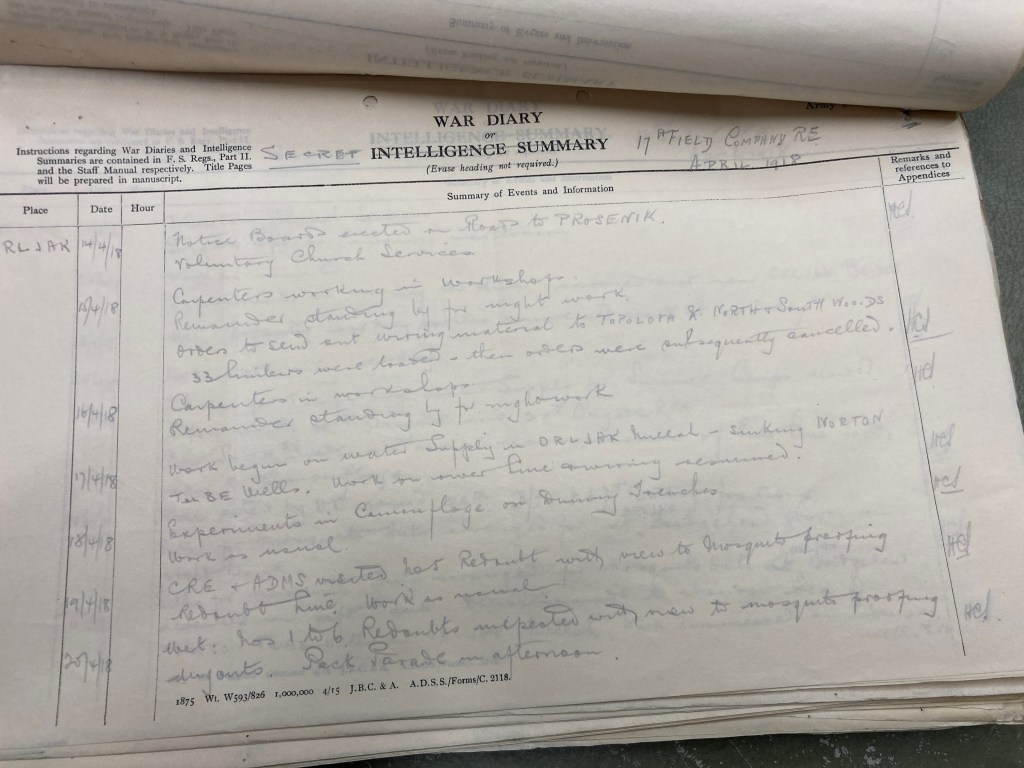
Earlier this year, I travelled to Kew to view the war diaries of the 17th Field Company, Royal Engineers. I photographed each page on my phone -a task that took about an hour – leaving me with dozens of images of tricky handwriting that my computer couldn’t search.
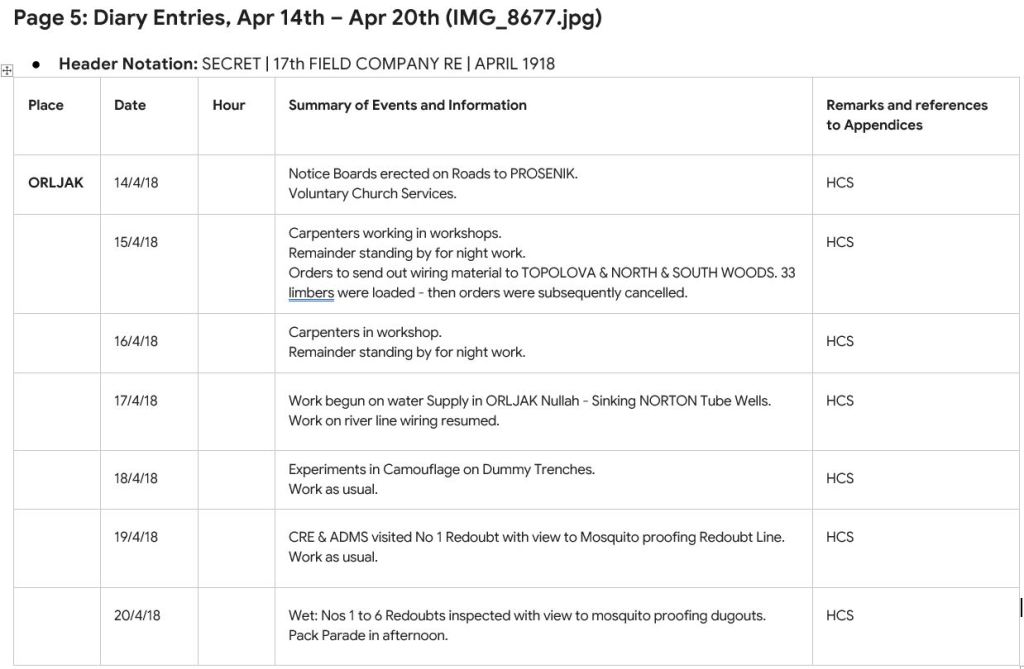
Rather than transcribing everything by hand, I uploaded the images to Google Gemini and asked it to extract the text while preserving the tabulated format. What would normally have taken days took roughly two hours instead. While not the most thrilling task, it was a huge timesaver compared to manual entry.
On the whole, the results were impressive. In several cases, the AI managed to read handwriting I’d found completely impenetrable. Yes, it did make the occasional mistake and, like me, it struggled with some decoding. At a guess, I’d say it was about 95% accurate.
iPhone photo of a page from the War Diary April 1918 17 Field Co, RE The (unedited) text that Gemini AI transcribed and formatted in Google Docs – in seconds
It’s not a complete solution as there’s still time needed for checking the transcription but, if you are facing a similarly laborious task, using AI to transcribe photographed records could be an effective and time-saving way to work.
With so much talk in the media about the possible impact of Artificial Intelligence (AI), I thought I’d see what AI could produce on the Salonika Campaign. So, I visited ChatGPT and gave it the following prompt:
“Write a short introduction to the Salonika Campaign of 1915-1918 where British forces were involved. Explain the political background, the reasons for British involvement, the initial and ongoing difficulties, successes, and failures of the campaign.”
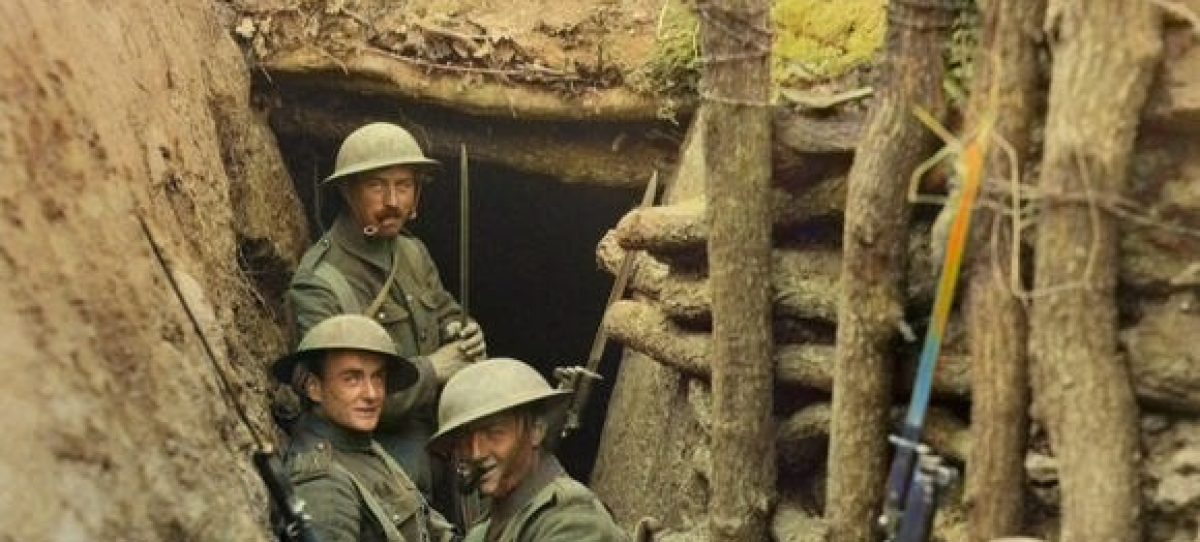
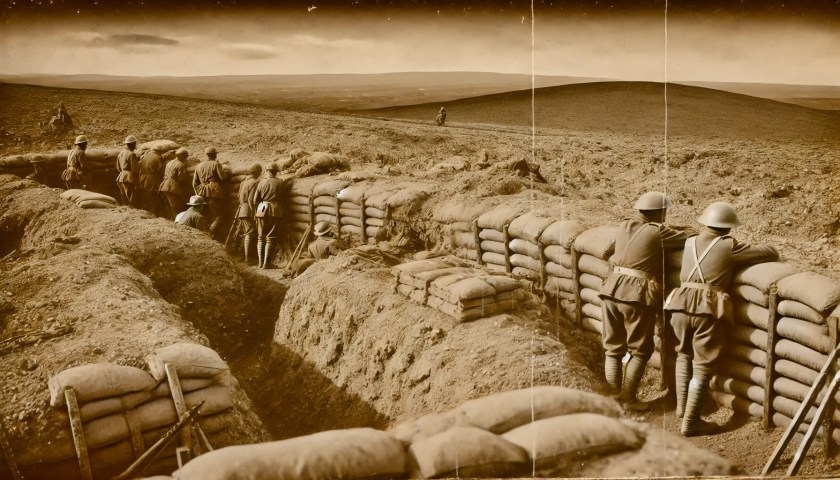
And, within seconds, the AI had produced the text (in blue) below and, after a little more prompting, the accompanying image. What do you think? How would you mark this AI homework?
The Salonika Campaign (1915–1918)
The Salonika Campaign (1915–1918), part of the broader Balkan theater [sic] of World War I, was a politically contentious and strategically complex operation involving British and Allied forces. It originated against the backdrop of the collapse of Serbia, a key Allied power in the Balkans, and the desire to contain Central Powers’ influence in the region.
ChatGPT describes the image it has created thus, “Here is a refined sepia-tinted image of the Salonika Campaign during World War I. The focus is on a single trench with fewer soldiers, enhancing the sense of isolation and authenticity as if it were a genuine photograph from the time.”
Political Background and British Involvement
The campaign was driven by a mix of strategic necessity and political considerations. Following Bulgaria’s entry into the war on the side of the Central Powers in 1915, Serbia was invaded and overrun by a combined Austro-Hungarian, German, and Bulgarian force. This development alarmed the Allies, who sought to stabilize the region and prevent further Central Powers’ advances into Greece and the eastern Mediterranean.
British involvement was spurred by a combination of commitments to its Entente allies—particularly France—and the need to secure the strategic link between the Mediterranean and the Near East, including the Suez Canal. However, British Prime Minister Herbert Asquith’s cabinet was divided on the campaign, with many seeing it as a diversion of resources from the more critical Western Front.
Initial and Ongoing Difficulties
From the outset, the Salonika Campaign faced severe challenges. The Allied forces, including British troops, landed in Salonika (modern Thessaloniki) in October 1915 to provide relief to Serbia, but the rapid fall of Serbia and the harsh Balkan winter forced a retreat into Greece. The ensuing stalemate in the region mirrored the trench warfare of the Western Front but was compounded by mountainous terrain, inadequate infrastructure, and endemic diseases such as malaria, which significantly weakened troop effectiveness.
The political situation in Greece further complicated matters. Greek neutrality was contested, with pro-Allied and pro-Central Powers factions vying for control. A coup in 1917 finally brought Greece into the war on the Allied side, but this delay hindered effective coordination and progress.
Successes and Failures
Despite its challenges, the Salonika Campaign achieved some notable successes. Allied forces eventually went on the offensive in 1918, spearheading operations that led to the decisive Vardar Offensive. This contributed to the capitulation of Bulgaria in September 1918, the first of the Central Powers to surrender, and helped to secure an Allied victory in the Balkans.
However, the campaign is often criticized for its high costs relative to its limited strategic impact. It tied down large numbers of troops and resources that some argued could have been better used on the Western Front. The campaign’s slow pace and significant casualties, largely due to disease, also fueled skepticism about its value.
In hindsight, the Salonika Campaign highlights the interplay of military strategy, political maneuvering, and the complexities of coalition warfare in a volatile region. While its immediate successes were limited, its role in destabilizing the Central Powers’ position in the Balkans and hastening the end of the war was significant.
In Episode 68 of Tales from the Battlefields (see previous post) the podcast starts with part of a song by Irish musician Jimmy Crowley. I was intrigued to find out more about the tune…
According to an article in The Irish Examiner the song was popular around the time of the First World War but had fallen out of use in later decades before being discovered by Crowley, “The jaunty ballad is sung from two different female perspectives — the first, a woman whose husband has enlisted in World War I, the title referring to the Greek city of Thessaloniki, which was home to a British military base. These women were known as ‘seperas’ as they were paid separation allowance by the British government when their husbands went off to fight. The other woman in the song is the wife of a ‘slacker’, the term given to men who did not join the army. The women in the song swap jibes and sprinkled through the song are references to Cork locations such as the Coliseum and characters including Dicky Glue, a well-known pawnbroker… It would have been popular as a street ballad up to the time of the Second World War. It is a tremendous song because it gives an insight into the lives of women around the time of the First World War. It kind of died out later, when ballads became uncool, because they were associated with the poor and uneducated. They would have started coming back into vogue with the rise of folk music in the 1960s.”
The song has since been recorded by ‘The Dubliners’ and even appeared on Later with Jools Holland in 2015 played by ‘Lynched’:
Lynched – Salonika – Later… with Jools Holland – BBC Two
Wishing all our members, friends, their families and loved ones all the very best for a happy and healthy 2024!
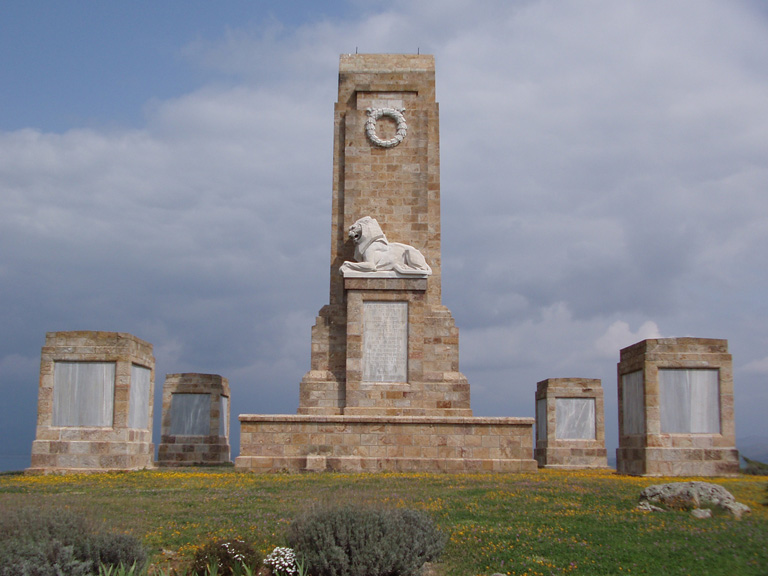
Of course, for our Scottish members and friends, this is an extra special time of year. And thoughts of Scotland reminded me that in November (last year!) The Scotsman published an article Remembrance: The Scots-style memorial on a Greek hillside in which the author during a visit to the memorial at Doiran considers that, “If there was an intense feeling of Scotland on this walled-off Greek hill as we pushed open a wrought iron gate, it was because the site was designed by Sir Robert Lorimer (1864-1929). Lorimer had also designed the Scottish National War Memorial at Edinburgh Castle (commissioned in 1919 and opened in 1927) and many more worldwide.”
… to all our members, friends and visitors. We thank you for your support over the year and look forward to you joining us for more online Salonika stories, faces and news.
The Western Front Association has a series of webinar talks in December. These are free and open to all. The webinars are all on Monday evenings at 8pm UK time.
‘Tank Corps operations during the German Spring Offensive of 1918’ – 6th December, Geoffrey Vesey Holt
Some 204 tired Mark IV tanks and the 36 new Medium ‘A’ Whippet tanks, manned by just converted crews, would, given their number alone, not be able to make a decisive contribution to the defences during the German offensive in the spring of 1918. Nevertheless, as this talk will show, and thanks to the surprisingly good Tank Corps records, they did play a useful role. To register for this event please click here: Tank Corps operations
‘The Christmas Day Truce of 1914’. – 13th December, Gordon Corrigan
On Christmas Day all along the Western Front there were sporadic instances of carol singing by both sides, leading to meetings in no-man’s-land, fraternisation, exchange of gifts and even at least one football match. This talk explains what really happened and not only what its affects were, but what they were thought to be. To register for this event please click here: The Christmas Day Truce
‘Big Hands, Little Maps’: Operational Art and its genesis on the Western Front. – Monday 20th December, Lt Col Simon Shepard
This presentation sees the return of Lt Col Simon Shepard who will be exploring the development of the Operational Level of War and in particular the term now known as Operational Art. Simon will trace its development on the Western Front via the BEF and latterly via the combined conduct of the Allied Armies during later stages of 1918. To register for this event please click here: Big Hands, Little Maps
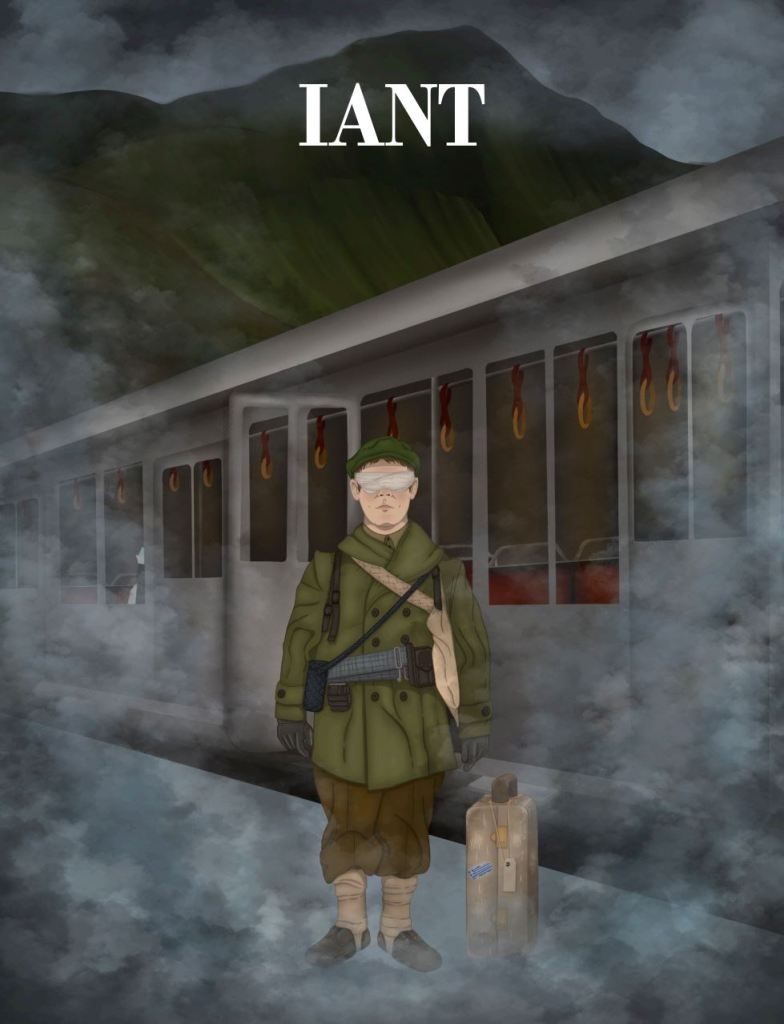
Author Steve Blandford got in touch with the society recently to share news of his new novel, Iant. Much of the novel is set in Salonika and is based on his grandfather’s experiences. As I haven’t read it (yet), it’s best to leave the introduction to Steve himself:
Iant – a novel by Steve Blandford
“My recently published novel Iant was inspired by my grandfather, David Owen, who died in 1956, aged 59. I knew little about him as I was two when he died, but the few stories I was told stayed with me and I finally got around to weaving some of these into a novel.
Some of what I was told concerned his service in and around Salonika during the later part of the First World War.
I am not a historian of course, though I have tried to base what I have written on some credible writing about the Salonika Campaign. If I have made errors then I apologise, though it is important to reiterate that Iant is a work of fiction.
What became clear to me as I began to write this section of the book was how little is known about this part of the war, at least by the wider public. I was finishing a new draft of Iant during the celebrations of 2018 and little was made of the Salonika Campaign in the wider media. I felt pleased therefore that I had perhaps made a very small contribution at least to a wider sense of a fascinating time and place where so many died and suffered.
The story of Iant Evans is only partly a story of a young man sent to fight of course. I was also very interested in the impact of such experiences on men and women who returned to the small places from which they came. How did they try and remake their lives and relationships?
In the case of my grandfather, one thing he coped with was the terror of temporary blindness, though in the novel this leads him to a very different set of experiences. His blindness became the inspiration for the cover of the book which was produced by my daughter, Beth Blandford, an illustrator whose work can be found via @blandoodles. The book therefore provides a thread across three generations.”
I’ve often wondered about the emotional and physical impact of the campaign on my own grandfather, a 16 year-old enlistee from rural Gloucestershire, who returned home in December 1918 seriously ill with malaria , so I very much look forward to reading Steve’s exploration of Iant’s war service and post-war life.
The book can be purchased from Cambria Books or as a paperback or e-book from Amazon.
A final thought from Steve: “I am so glad to have been put in touch with the Salonika Campaign Society. The scope of what it seems to have achieved looks remarkable. If anyone would like to contact me about Iant please do get in touch.”
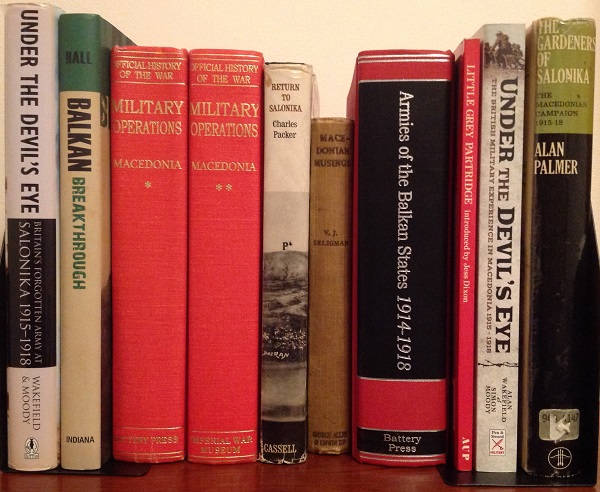
In keeping with our intention to publish occasional updates to the bibliography, as close as possible to the anniversary of the Bulgarian Armistice in late September 1918, we are very pleased to announce the arrival of a new and updated version of the comprehensive bibliography for the Salonika campaign.
You can find out more and download, free of charge, the updated bibliography here.