
warm, sunny, with a faint breeze. German guns shelled French and Canadian trenches throughout the morning but fell silent in the afternoon. The brief period of peace suddenly ended at 4:00pm when the Germans unleashed a violent bombardment, first on the salient and then gradually extending to nearby roads and Ypres, turning the town into a flaming inferno and causing its citizens to flee.
An hour later an ominous greenish-yellow wall of fumes was seen drifting slowly across no-man’s land toward the French line. “At first we thought it was just the intense musketry creating the yellow haze,” recalled Canadian Lt. Ian Sinclair whose battalion (13th), lay next to the French 45th Division.
This is how George H. Cassar describes the gas attack which opened the Second Battle of Ypres – 1915’s longest and bloodiest engagement on the western front – in his book Trail By Gas: The British Army at the Second Battle of Ypres (Potomac Books, 2014; p33).
In the battle, which lasted for a little over a month, the Allies suffered an estimated 70,000 casualties – including French and Belgians – and the Germans, 35,000 (figures from John Dixon’s Magnificent But Not War, Pen & Sword, 2003; pp350-352).
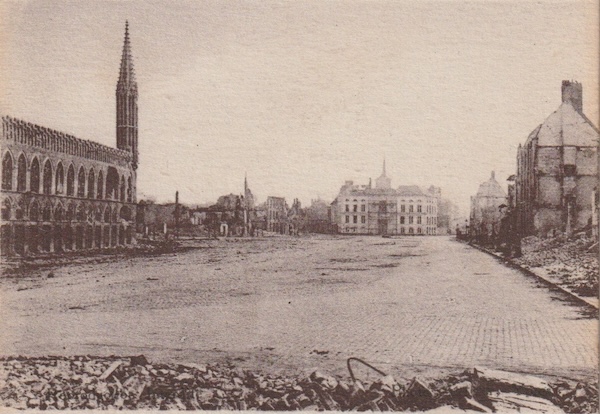
The Grande Place of Ypres after the German bombardment (photo from a postcard in the author’s collection, by Anthony d’Ypres).
With Salonika some 1500 miles (2400 km) away and the city not even a twinkle in any general’s eye, you may wonder what the connection is. Of the British divisions that fought in the battle, two – the 27th and 28th (Regular) Divisions – would become part of the British Salonika Force later in 1915, spending most of their time in the very different surroundings of the malarial Struma valley. Of these, it was the 28th Division which suffered the heaviest casualties of all the British divisions, even more that the Canadians who held the line in the wake of the initial gas attack.
George H. Cassar sums up the battle in these terms (Trial by Gas, p260):
… it is obvious that the British had escaped disaster because of the stellar conduct of the common soldier at the front … It was the infantry that had stood in the firing line for thirty-three days … [who] considered it a sacred duty to hold on, no matter what the cost to themselves … Their heroic stand had denied the Germans a significant victory, one that might have turned the tide of war to their advantage.
Discover more from Salonika Campaign Society, 1915-1918
Subscribe to get the latest posts sent to your email.

