It is 108 years since the signing of the Armistice of Salonica at 10:50pm on 29 September 1918 between Bulgaria and the Allied Powers at the General Headquarters of the Allied Army of the Orient.
And, in keeping with our intention to publish updates to the bibliography on the anniversary of the Armistice, we are very pleased to announce the publication of a new and updated version of the comprehensive bibliography of the Salonika Campaign.
The Salonika Campaign Bibliography, researched and compiled by SCS Member Keith Roberts, is a fantastic resource for those researching or delving deeper into the campaign. Now in its sixth edition, it lists over 480 entries from a variety of sources. Interestingly, these sources also include novels and literature. Although literature isn’t usually a source for historically accurate facts, it has a role in helping to understand, to some degree, the experience and attitudes of others in other times.
With that in mind, and having recently been reading about the service of nurses in the campaign, two novelists from Keith’s list piqued my interest: Bessie Marchant and May Wynne the authors, respectively, of A V.A.D. in Salonika and An English Girl in Serbia – both novels written primarily for a young audience.
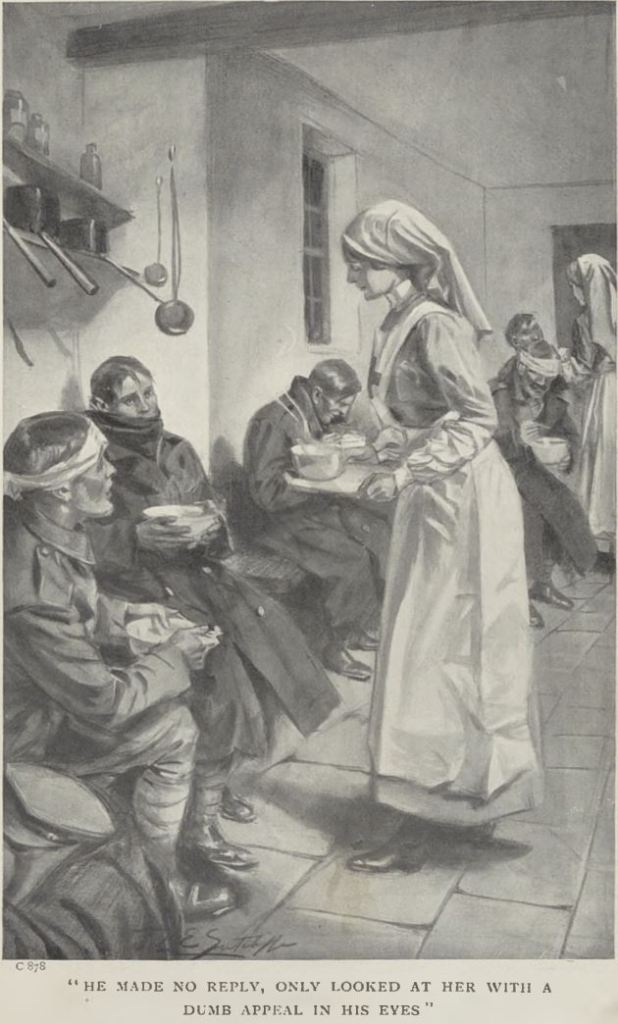
A V.A.D. in Salonika (1917) follows a young British woman, Joan Haysome, who volunteers to serve as a V.A.D. (Voluntary Aid Detachment) nurse in Salonika. The plot is full of unlikely coincidences as Joan, determined to prove her worth, and atone for a past mistake, attempts to stop a German spy within the Allied ranks. It is a novel of its time, and for that reason, interesting in the way it reflects diffierent contemporary attitudes towards women volunteering in the war effort.
The inspector bowed, looking properly impressed, but he had his private opinion all the same as to the use of young ladies in V.A.D. work. To his way of thinking, if one of the leisured classes set about trying to do something useful, it meant that a servant of some sort was necessary to do the work over again. Rich folks had their place in the scheme of creation, but their place was mainly to provide honest employment for other people.
Joan is not a passive or submissive figure. Marchant frequently describes Joan’s thought processes as she struggles to overcome doubts and crises of confidence to show courage, resourcefulness, and responsibility for others.
From A V.A.D. in Salonika
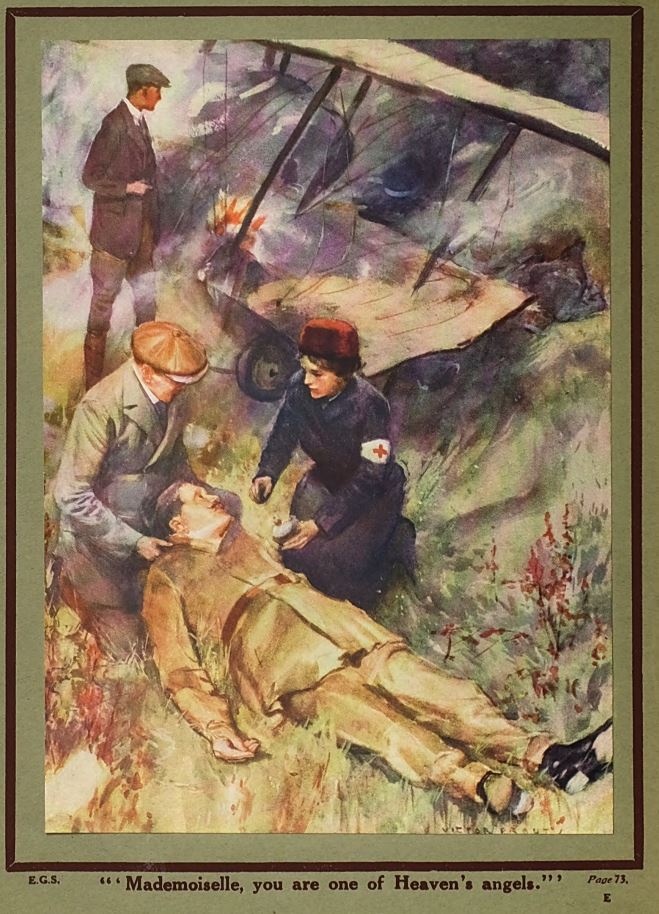
In An English Girl in Serbia(1916), two 16-year-old twins, Nancy and Tom Allerson, become caught up the turmoil of wartime Serbia. This is more of a “ripping yarn” involving danger and dramatic adventure. There is a little more detail about the war than in Marchant’s novel, with a depiction of the Serbian retreat from the Bulgars. Nancy has far less introspective reflection than Joan but the story does paint Nancy as an active, resourceful survivor determined to see the ordeal through.
From An English Girl in Serbia
Both novels follow a tradition of daring adventure stories for boys but in these the focus shifts to central female characters and, particularly in A V.A.D. in Salonika, contemporary attitudes to women in war,
“But don’t you think that the girls want to do their bit as well as the boys? The harder the work the greater the patriotism. A girl should have her opportunity, and she may be trusted to rise to it.”
I quite enjoyed reading the two books, which are fast-paced and easy to read. In these ‘enlightened’ times, An English Girl in Serbia would probably come with a trigger warning regarding some of its language and attitudes! It is, perhaps, more interesting from a historical point of view with its references to the Serbian retreat and comitadji. And, although the plot in A V.A.D. in Salonika relies too heavily on coincidence, the novel is more thoughtful. Joan is a much more interesting and developed character and, as such, the book may be seen as part of the wider body of literature that helped shape British public opinion about the role of women in war.
My thanks go to Keith for adding these titles to the SCS Bibliography:)
Once again, the Society extends its sincere thanks to SCS member Keith Roberts for the compilation and dedicated annual updates of the only comprehensive bibliography of English-language publications related to the Salonika Campaign.
The bibliography is freely available for members and non-members alike. We only ask that, if it is shared with others, credit is given to the Salonika Campaign Society. The bibliography is available in a variety of formats here.
The bibliography is updated and released each year on this significant day – September 29th – which today marks 107 years since the signing of the Armistice of Salonica. The armistice brought Bulgaria’s involvement in World War I to an end.
Listing 430 titles, Version 5 of the Salonika Campaign bibliography is now published and freely available here. As in the past, the bibliography has been compiled for the Salonika Campaign Society by SCS member Keith Roberts.
If you haven’t taken a look at the bibliography in the past, why not do so now? Keith helpfully lists links to texts that can be viewed online. For example, one item listed is Salonika Again, which Keith describes as an “interesting pamphlet telling of a return visit paid by two veterans of the campaign, and their visits to a school funded by the SCS and a village adopted by them. According to the Mosquito, the two veterans were Billy Reeves and G E Willis.”
Our thanks to Keith for his continued patience and persistence in this Herculean task.
The Salonika Campaign Bibliography (with thanks as ever to Keith Roberts) is a valuable resource for anyone interested in the campaign or researching an aspect of it. It’s freely available for members and non-members alike.
Each year we aim to publish an update to the bibliography, as close as possible to the anniversary of the Bulgarian Armistice in late September 1918. And so, we are very pleased to announce the arrival of Version 4! You can find it here.
Many thanks to Society member Keith Roberts for the following reviews:
As a result of working on the SCS bibliography I have arguably parted with too much money purchasing books about the campaign for myself. Some, in fact most, of the books published in the aftermath of the Great War are now both rare and expensive. Only a limited number have been reprinted but quite a few are available to download free of charge from the ‘Internet Archive‘, and a few at modest cost, as Kindle ebooks, but I’m still happier with a real book in my hands. Not long ago I came upon a couple of closely related privately-published items…
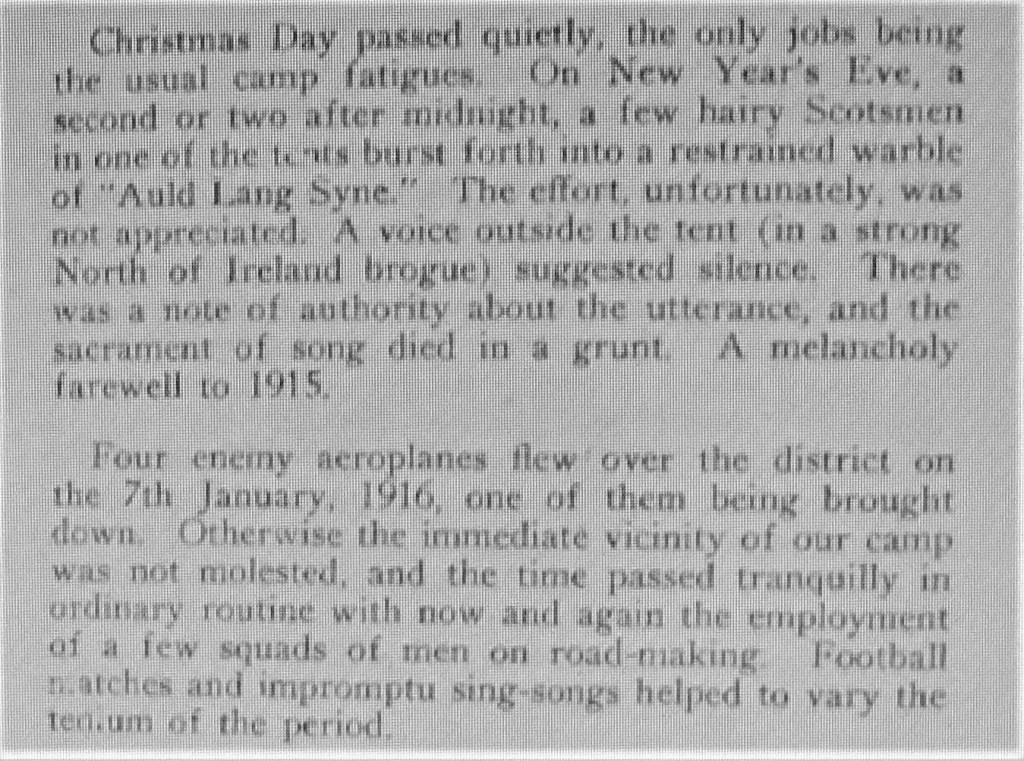
1914-1919 Memoirs of the 32nd Field Ambulance, 10th Irish Division
The first item was 1914-1919 Memoirs of the 32nd Field Ambulance, 10th Irish Division by C, (Charles), Midwinter who was a sergeant in that unit. The booklet was published in 1933 and described his time in the unit from the outbreak of war to November 1918 by which time the unit was in Palestine. The only copies that I have been able to trace are in the libraries of The Imperial War Museum, and Leeds University.
The content is a well-written narrative describing the unit’s experiences, from formation, via Gallipoli and Macedonia to Palestine. After the introductory pages and the unit’s experience of the Gallipoli campaign, the author describes their part in the Salonika Campaign in pages 40-56.The text names some members of the unit, and draws frequently upon the recollections of Sgt Midwinter. 32 FA, a Territorial unit, landed in Salonika on 10 October 1915 and, after a short interval, deployed behind the positions held by part of the 10th Irish Division at Kosturino. Subsequently they occupied a number of locations during the remainder of their time in Salonika, before moving to Egypt and Palestine in late 1917. Written by a soldier rather than a medically qualified individual the narrative has little to say about the medical part of the unit’s work, describing rather their movements, and locations.
An extract from Memoirs of the 32nd Field Ambulance, 10th Irish Division December 1915/January 1916
The Badge of Honour
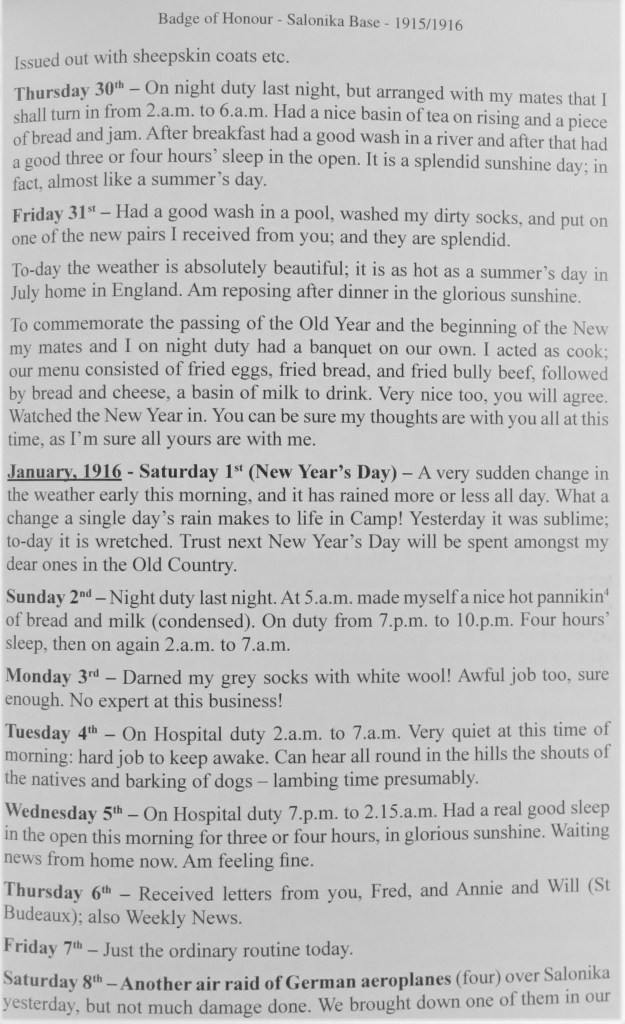
The second booklet, which I stumbled upon more recently, is The Badge of Honour edited by Godfrey A Gill, who published three other booklets on Cornish subjects. This is another privately published work, printed in 2015. It is well presented with a small number of photographs. This book is very different, and is built entirely around a transcription of the diary kept by a Plymouth man, Private Tom Wherly describing his personal experience of service in 32nd. Field Ambulance.
The style is quite different, being a record of his diary entries (with some gaps), from his enlistment until 11 September 1918. It records some of his experience at various locations, the weather, his ailments and his food, the things that he thought his family might like to know about as it is made clear that he wrote these comments for the benefit of his family. They were identified in this new century by a family member and after some time this volume emerged in 2015. There are few comments about military events as a result of which the editor inserted several appendices in which he addressed the background and current events of the time. The editor is not a military historian, but his comments are generally well founded, apart from referring to the ‘Field Ambulance Corps’ rather than to the Royal Army Medical Corps.
The descriptions of Tom Wherly’s life, especially while serving in the Salonika theatre of war give an interesting perspective of the thoughts and experience of a man serving in a non-combat role in a very human way, describing the aspects of his military life that he thought would give the best description of his experience. As such it is a very human document, and enables the reader to get a sense of the daily life of one of the many members of the BSF whose service was essential, but entirely behind the front lines.
An extract from Badge of Honour also December 1915-January 1916
The Badge of Honour is nicely printed with stiff card boards and glossy paper and a small number of photographs. There are 106 pages but the editor is responsible for a number with his explanatory appendices and notes. I have discovered that just 18 original copies of The Badge of Honour are still available at the original price of £7.95 plus postage. I plan to purchase a small number for friends I will be meeting either during our next tour in September, or at the AGM October 2023. The remainder can be purchased from The Mayflower Studio, Fore Street, East Looe PL13 1AE, email at mayflower.looe@btconnect.com
Two tales of two men
Both men received the 1915 Star, in addition to the Victory and the British War Medal. Beyond his medal record almost all we know about Charles Midwinter is that he started the war as a private, and ended a sergeant.
We know quite a lot more about Samuel Thomas Pawley Wherly, because this diary was in the hands of his descendants, and some of his army records survived the 1940 bombing of Arnside Street. Like Charles Midwinter, he joined up at the beginning of the war, and his service was continuous from 28 October 1914 until 13 May 1919 when he was discharged as no longer fit for war service. His attestation form states that he has four years previous experience as a volunteer with the Devon Royal Garrison Artillery. Like many others he was issued with the (Silver) War Badge and the few surviving pages of his service record show that he served for four years and 198 days before his discharge in 1919, and that he was discharged with a 50% degree of disability on the grounds of Melancholia with a pension of 13s 9d weekly to be reviewed after 52 weeks. His role in the RAMC is described as “Nursing Duty Orderly”.
You may recall that back in September I alerted you to the promised publication of a new book about the Macedonian campaign, written by Jon Lewis and published by Helion & Company. I am pleased to say that, since then, I have been in touch with Jon who is a member of the Society. Jon tells me that the book is being released today. We congratulate him on the culmination of many years of research and hard work and wish him well with the book.
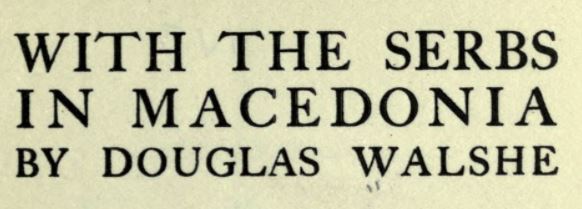
Many thanks to Society member Keith Roberts for information about this book, With the Serbs in Macedonia.
Its author, Douglas Walshe, was an officer in one of the British Army Service Corps Mechanical Transport Companies sent to drive small Ford trucks with equipment, food and ammunition to the Serbian army. The book can be found in digital format on the SCS map disk, and is also free of charge to download on the Internet Archive.
Keith recently took delivery of a printed edition complete with an intact dustjacket. Now rather ‘grubby’, the book is the original 1920 edition and amazingly, says Keith, the “book has never been read. How can I tell? The pages have not been cut.” Says Keith, “it is easy reading, and surely worth an hour or two of anybody’s time.”
I agree with that, having just started it myself. Something of the tone of the writing can be heard in the opening pages, “Here, as far as our men are concerned, there are no records of days and nights in waterlogged trenches under concentrated shell-fire, and no pulse-stirring descriptions of hand-to-hand encounters and bayonet charges. We never fired a shot at anything more exciting than a petrol tin for revolver practice, or a wild goose or duck for a dinner that usually remained in the air. But we did our job, and we saw a little of the Balkans. Mainly married and mostly of inferior physique, we ‘carried on’ – when there was any carrying on to be done.”
The online version of With the Serbs in Macedonia can be found here.
I am grateful to society member Harry Fecitt for bringing to members’ attention this MA dissertation, Triumph in the Balkans. Anglo-French Co-operation in Macedonia during the First World War.
The work has four chapters: Chapter I. The origins of the Salonika Expedition; Chapter II. In the shadow of Sarrail; Chapter III. Guillaumat’s groundwork for success; and Chapter IV. The year of victory. It has comprehensive notes and appendices, and many illustrations.
The dissertation is free to download but an email address is required to sign up to Academia.edu. It can be found here.
Readers will be very grateful to SCS member Keith Roberts, and Great War Forum member ‘maureenE’, for pointing out the online availability of two major texts related to the Salonika Campaign.
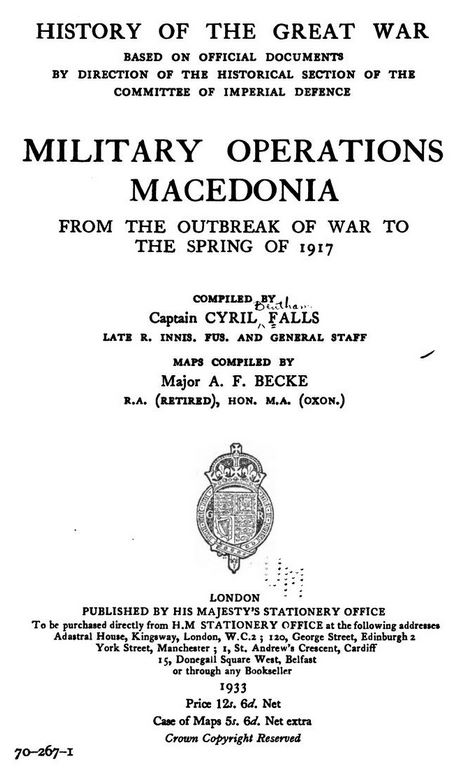
Military Operations MacedoniaVolumes One and Two, by Captain Cyril Falls* were part of the series History of the Great War and based on official documents. Free, immediate, and online access to these texts is a wonderful benefit to anyone interested in the Salonika Campaign.
The digital versions of Volume 1 (1933) From the Outbreak of War to the Spring of 1917, and Volume 2 (1935) From the Spring of 1917 to the End of the War both contain the full text. However, both volumes are missing the maps which were originally in separate cases. Many of these maps are, however, available from the society here, albeit for a relatively small charge.
Both volumes are available on two sites: Internet Archive and Google Books. My preference is to use Google Books, I find the search tool a little easier to use, but that’s a personal choice. Either way, it’s a great that we now have these texts online for all.
*Author Cyril Bentham Falls CBE was a British army officer turned military historian and journalist. After completing his military service, he began writing military histories. From 1923 to the outbreak of war in 1939 he researched and wrote several volumes of the British Government’s ‘Official History of the War’, including the two-volume history of the Macedonian campaign. https://en.wikipedia.org/wiki/Cyril_Falls