It is 108 years since the signing of the Armistice of Salonica at 10:50pm on 29 September 1918 between Bulgaria and the Allied Powers at the General Headquarters of the Allied Army of the Orient.
And, in keeping with our intention to publish updates to the bibliography on the anniversary of the Armistice, we are very pleased to announce the publication of a new and updated version of the comprehensive bibliography of the Salonika Campaign.
One of the most frustrating things about researching Salonika records at the National Archives is that they haven’t been digitised for easy online reading and text searching. It would make life so much easier if records – such as company war diaries – were digitised and readily available online.
As things stand, the only way to read the documents you need is to:
Order them in advance.
Make the trip to Kew.
Photograph the pages yourself.
Admittedly, it’s not an unpleasant experience. The staff at Kew are unfailingly friendly, helpful, and efficient, and it’s a lovely place to spend a day. However, once you get those photos home, they aren’t always easy to read on a screen and searching the text for key terms is impossible. Your only alternative is the hard graft of spending long, tedious hours decoding the handwriting and typing it up manually. That is a real slog. But this is where artificial intelligence can, possibly, lend a hand.
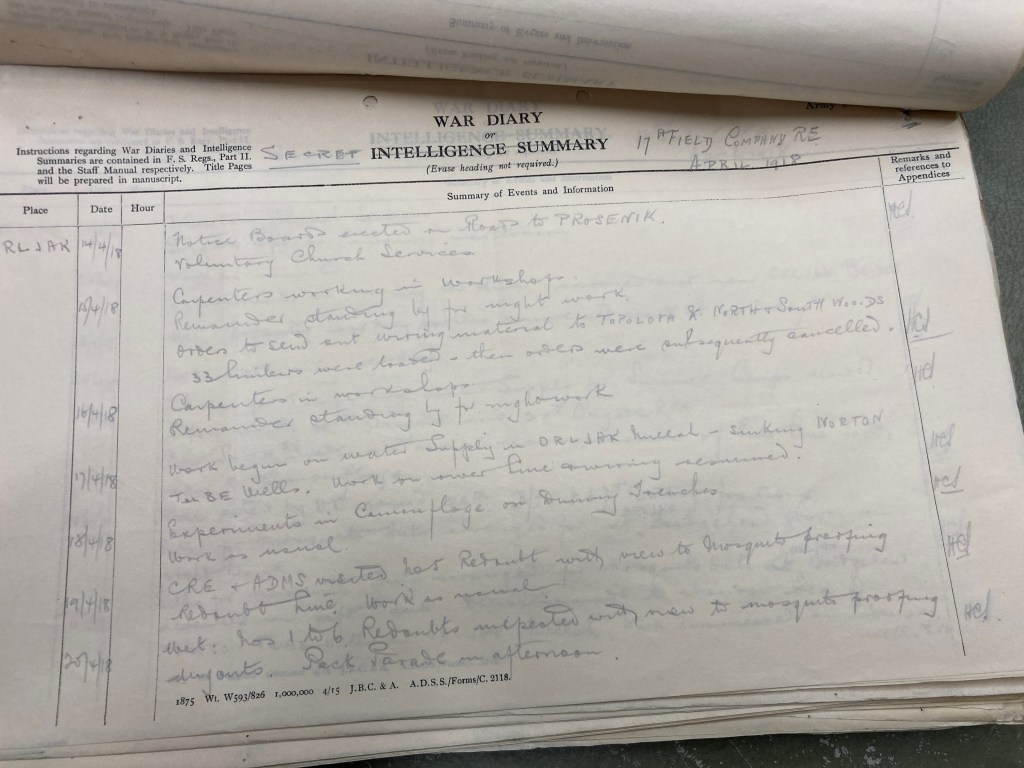
Earlier this year, I travelled to Kew to view the war diaries of the 17th Field Company, Royal Engineers. I photographed each page on my phone -a task that took about an hour – leaving me with dozens of images of tricky handwriting that my computer couldn’t search.
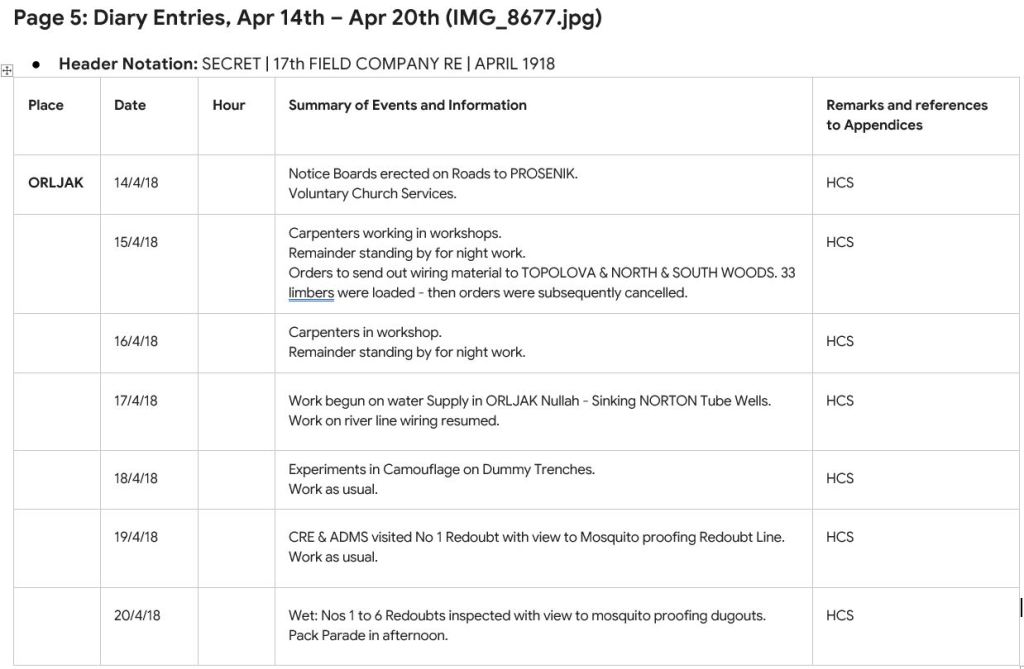
Rather than transcribing everything by hand, I uploaded the images to Google Gemini and asked it to extract the text while preserving the tabulated format. What would normally have taken days took roughly two hours instead. While not the most thrilling task, it was a huge timesaver compared to manual entry.
On the whole, the results were impressive. In several cases, the AI managed to read handwriting I’d found completely impenetrable. Yes, it did make the occasional mistake and, like me, it struggled with some decoding. At a guess, I’d say it was about 95% accurate.
iPhone photo of a page from the War Diary April 1918 17 Field Co, RE The (unedited) text that Gemini AI transcribed and formatted in Google Docs – in seconds
It’s not a complete solution as there’s still time needed for checking the transcription but, if you are facing a similarly laborious task, using AI to transcribe photographed records could be an effective and time-saving way to work.
In April 2025 I described my exploration of another possible family connection (albeit by marriage) with the Salonika campaign. This concerned Lt George Clark who was the Medical Officer of 7/Royal Munster Fusiliers. His medal index card and the Battalion war diary (WO 95/4296) conclusively place him in Gallipoli but, to see what happened next, required a visit to The National Archives at Kew to look at the next part of the war diary which, of course, has not been digitised. I can now share the next stage of my investigations and, whilst I don’t expect you to be especially interested in my family history, what I found out about 7/RMF may be of wider interest.
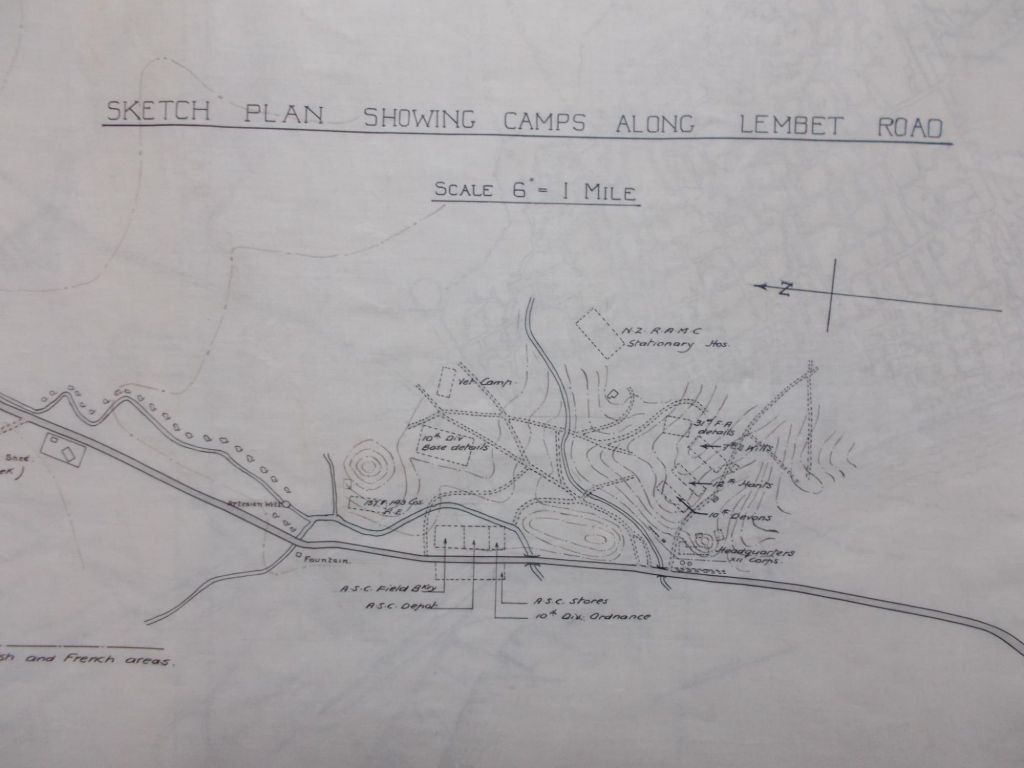
Hats off and three cheers to the valiant SCS members who have just completed their second visit to the National Archives with more maps checked, listed, and photographed. Great work!
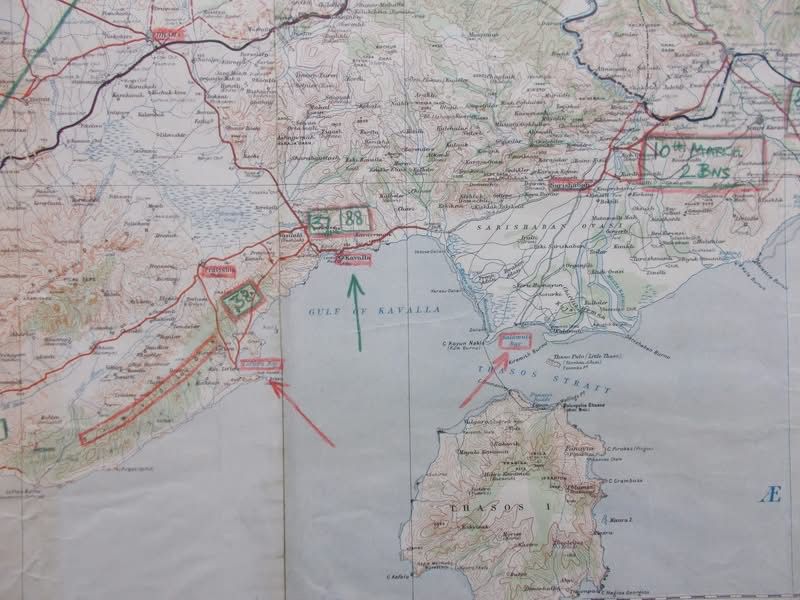
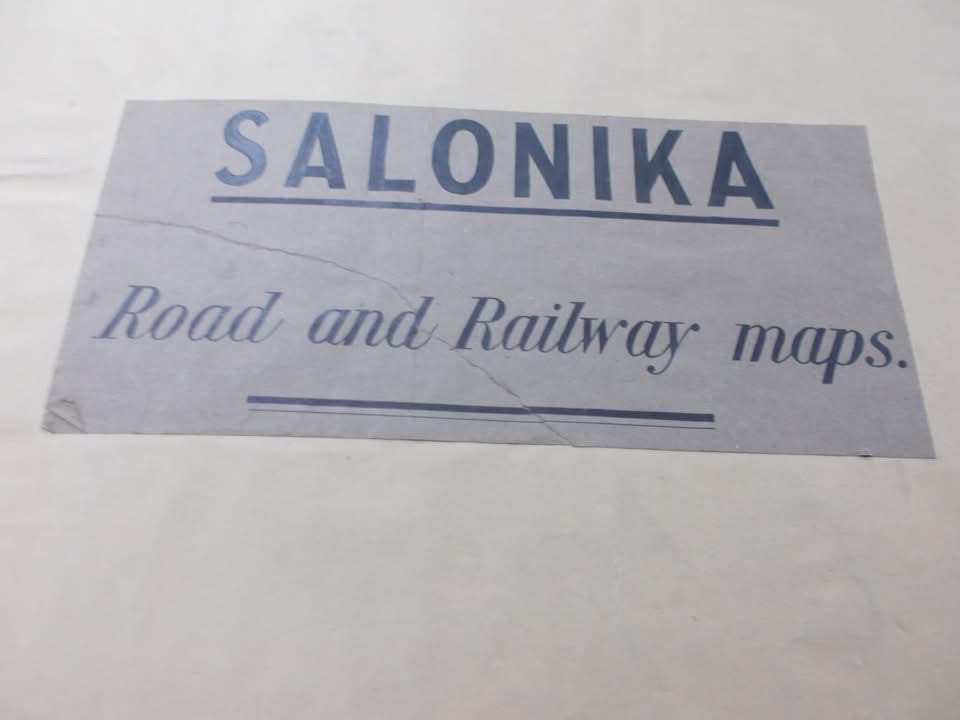
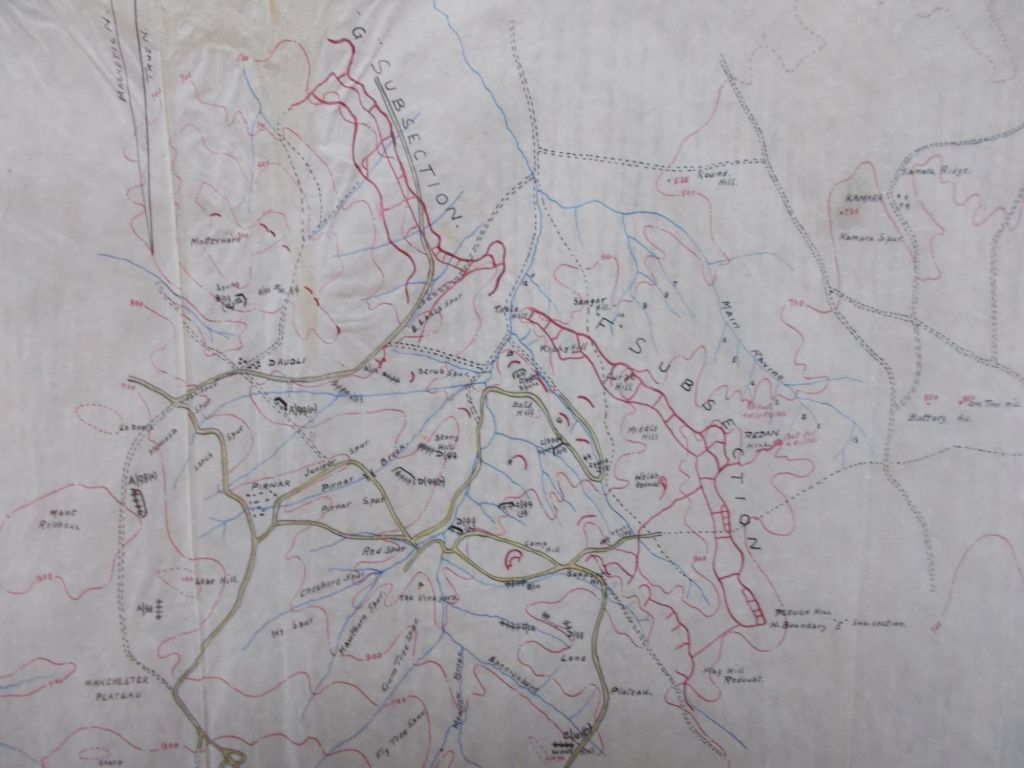
Part of map showing sites of proposed amphibious landings along the Aegean coast and Bulgarian units available to oppose such operations.Typical cover for a folder of Salonika maps under WO 153 series. The maps in this folder were too large to successfully photograph and work on these will have to be done onsite.Part of map showing British artillery battery locations on part of the Birdcage defence line
Readers will be very grateful to SCS member Keith Roberts, and Great War Forum member ‘maureenE’, for pointing out the online availability of two major texts related to the Salonika Campaign.
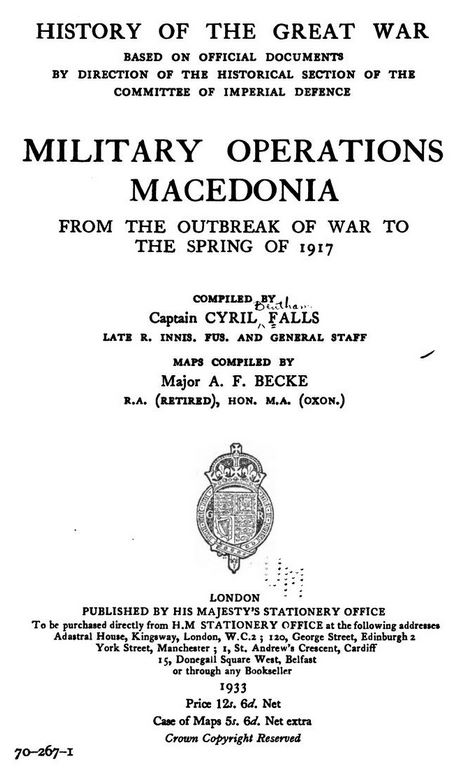
Military Operations MacedoniaVolumes One and Two, by Captain Cyril Falls* were part of the series History of the Great War and based on official documents. Free, immediate, and online access to these texts is a wonderful benefit to anyone interested in the Salonika Campaign.
The digital versions of Volume 1 (1933) From the Outbreak of War to the Spring of 1917, and Volume 2 (1935) From the Spring of 1917 to the End of the War both contain the full text. However, both volumes are missing the maps which were originally in separate cases. Many of these maps are, however, available from the society here, albeit for a relatively small charge.
Both volumes are available on two sites: Internet Archive and Google Books. My preference is to use Google Books, I find the search tool a little easier to use, but that’s a personal choice. Either way, it’s a great that we now have these texts online for all.
*Author Cyril Bentham Falls CBE was a British army officer turned military historian and journalist. After completing his military service, he began writing military histories. From 1923 to the outbreak of war in 1939 he researched and wrote several volumes of the British Government’s ‘Official History of the War’, including the two-volume history of the Macedonian campaign. https://en.wikipedia.org/wiki/Cyril_Falls