
Author: Rob Elliott
In May 1915, teacher Monica Stanley, a 36-year-old spinster from London, left her job for 6 months to help set up a field hospital in Kragujevac under the auspices of the Women’s Imperial Service League founded by Mabel Annie St Clair Stobart. As a domestic science teacher, she was particularly suited to her role as head cook, being responsible also for provisioning. She is mentioned briefly in Mabel Stobart’s book, “The Flaming Sword in Serbia and Elsewhere”, published by Hodder and Stoughton, 1916.
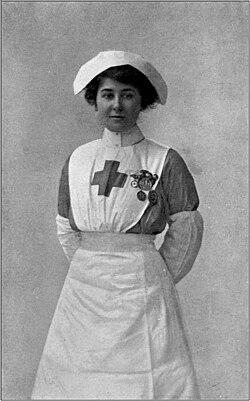
https://www.gutenberg.org/ebooks/33001, Public domain, via Wikimedia Commons
Monica might have been remembered as no more than a footnote in history, but fortunately she kept a diary which was published in 1916 as “My diary in Serbia: April 1 1915-Nov 1, 1915; Attached to the Stobart Field Hospital in Serbia”. Widely available, the diary is included on the SCS DVD. In a plain and unvarnished way, it provides an insight into the setting up of the hospital and several local dispensaries. It also describes her role in purchasing supplies for the kitchen and the availability of foodstuffs from markets and elsewhere. She describes how the hospital staff struggled to cope with typhus, her own difficulties caused by typhus and gastritis, and a period of convalescence at the Berry Unit where she learned about Serbian cookery.
The book also contains many observations on the war and its effects on Kraguyevac and other areas; here is just one example. While at the British Fever Hospital in Belgrade on Saturday July 24th, she writes, “The air raid we had the other day: a French aviator went up and there was a battle in the air; Monsieur Paulhan fired on the Austrian aeroplane and brought it down in Austrian territory…” (My Diary in Serbia, p76)
But who was Monsieur Paulhan? How and why would Monica Stanley know the name of a French pilot?
Isidore Auguste Marie Louis Paulhan (19 July 1883 – 10 February 1963) was already world famous as a pilot and aeronautical engineer before being posted to the Serbian Front with Escadrille MF 99S. He had held many records for speed, altitude and distance, and most notably won a £10,000 prize put up by the Daily Mail for the first person to fly between their offices in London and Manchester within 24 hours. He had taught himself to fly in 1909 and held pilot licence number 10, and is credited with making the first powered flight in the UK at Brooklands. He also toured the United States giving flying demonstrations, and was a capable designer. One of his designs, a two-seater pusher biplane, was bought by the War Office for evaluation in 1911.
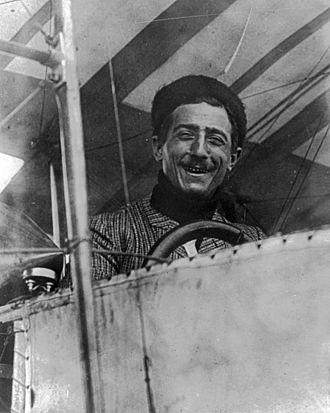
http://hdl.loc.gov/loc.pnp/cph.3a19088, Public domain, via Wikimedia Commons
Escadrille MF 99S (MF designates the aircraft flown – a Maurice Farman 11, S designates Serbia) became operational on 23 April 1915. Monica may have observed Paulhan’s interception of an Austrian aircraft that was bombing Belgrade. The log of the Escadrille records that on July 23, 1915, the aircraft MF 11 No. 193, piloted by Captain Paulhan with Corporal Andre Lestradet as observer, shot down an Austrian aircraft that crashed in the marshes north of Belgrade, on the other side of the Danube. It was destroyed on the ground by a bomb dropped from the Farman. For more information, see: http://albindenis.free.fr/Site_escadrille/escadrille525.htm .
Monica Stanley’s diary concludes with a detailed account of her return journey, with her arriving home on 1 November 1916. Not a great deal seems to be known about Monica in later life – she married in 1927, and died on this day, 25 July, in 1972. With her diary though, she left behind a remarkable account of a volunteer providing help and support to the people of Serbia in their hour of need.

