
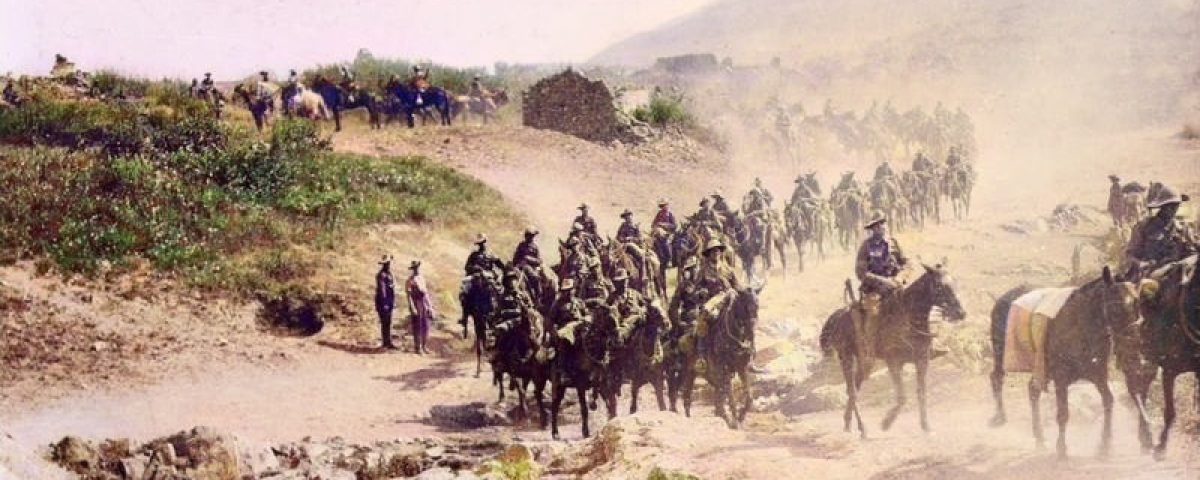
When I wrote What the Soldiers Wore in Salonika (NM47/Apr. 2023) an invaluable, if unexpected, source was a collection of Army Routine Orders from Kew (WO 123/293), for which I have to thank Alan Wakefield. At the time, my only concern was those orders relating to clothing and personal equipment, but they contain much more than that. Launching an expeditionary force and maintaining it in a challenging, foreign environment – even without taking into account the enemy – is quite an undertaking and these orders give an insight into the many and varied issues the Staff had to think about. These are just a few of them from this time 110 years ago.
Salonika Army Routine Orders
13th November,1916
Adjutant-General’s Branch
Censorship was on the mind of the Adjutant-General’s Branch and was keen to remind all ranks – especially officers with ‘Censor Stamps’ – that letters should not disclose:
… the Brigade, Division or other formation to which their own or any other unit belongs, unless it forms a necessary part of that unit’s address.
The concerns of the War Office, that ASC MT drivers were being overpaid (no more than 50% in a unit at the higher rate!), were also communicated, as were details of the new approved uniform for male personnel of the YMCA. This was, essentially, officers’ service dress with a YMCA cap badge, but certainly “at no expense to the Government”.
Quartermaster-General’s Branch
The QMG Branch had a significant announcement on this day:
Approval is given for the issue of Steel Helmets … on the scale of one per all ranks.
There was a caveat for those that were less likely to be found in the frontline, such as Labour Units, Mobile Workshops, Supply Columns etc., who would only get the helmets in forward areas “at discretion of Corps Commanders”. Army HQ and Corps HQs were given a hundred each, for issue “as required.” Sorry mate, you’re 101st in the queue!
16th November,1916
Adjutant-General’s Branch
A list of “Appointments, Commissions, Rewards, etc. approved by the General Officer Commanding Salonika Army, dated 13th November, 1916 is issued herewith.” On a less positive note, the next item lists the documents that were to accompany a soldier sent to base “for transmission to prison”, with different requirements for sentences that had been previously suspended and whether hard labour was involved! Prisoner escorts were reminded that they had to be prepared to remain one night at base, which probably gave little opportunity to see the bright lights of Salonika, such as they were.
Quartermaster-General’s Branch
The QMG Branch had a lot to say about training in the use of live grenades and the care of grenades. Much like the current advice not to return to a dud firework, it felt the need to offer similar advice on dud grenades, which:
… must never be examined with a view to ascertaining the reason for failure to explode ; they are to be destroyed “in situ.”
With another bitter Balkan winter approaching, it must have been a relief for infantry and pioneer battalions, yeomanry regiments and artillery brigades, that they could now indent for one oil stove (“Radius”) for use in the Regimental Aid Post. On a similar wintry note, to prevent the water for cooling Vickers and Maxim machine guns freezing, the quantity was now to be reduced to five pints, with an added pint of Glycerine, obtainable from the Ordnance Officer. This would certainly put a stop to the practice – if it ever really existed – of making tea with this water, once boiling from extended firing!
Next comes a homely notice, giving the last posting days for Christmas letters and parcels to the UK and Canada. Sadly it doesn’t give much notice for parcels to Canada: the very next day, the 17th, was the last day!
Finally there is a notice, rather like the “have you seen this cat” sort, seen on many a lamppost. Anyone having knowledge of the whereabouts of two men and two officers is asked to contact AHQ. The men are both with the Army Service Corps, but the units of the officers are not given:
- TS/4501 Shoeing-Smith B W Whurr
- T4/213985 Driver A Hansley
- Lieutenant F H Clapham
- 2nd-Lieutenant Guy Stirling Bennett
I’m pleased to say that from a quick look in The National Archives Medal Index Cards, Bertram W. Whurr (TS/10521) turned up, made it to sergeant and survived the war, having been in Macedonia since 11 November 1915. Driver Hansley, though, remains elusive!
Lieutenant F H Clapham was also ‘found’. Originally commissioned as a temporary 2nd-Lieutenant in the Royal Irish Rifles, he made it through the war, being mentioned in dispatches in 1917 (London Gazette 21/07/1917 page 7453). This would have been the 1st Battalion RIR, which joined 10th (Irish) Division from 27th Division in November 1916 and went to the Middle East in the autumn of 1917.
Guy Stirling Bennett is an intriguing one. His officer’s service record is held at Kew (WO 339/60707), but this shows him to have been an officer in The Sherwood Foresters (Nottinghamshire and Derbyshire Regiment), which was not with the BSF. An online search reveals a photo of him as a private in the 19th Royal Fusiliers (2nd Public Schools Battalion), in which he enlisted on 12 November 1915. According to this he was then commissioned in The Sherwood Foresters on 4 August 1916. On this evidence, it’s no wonder he couldn’t be found in Salonika!
And finally, the orders are signed-off by Major-General Travers Clarke, Deputy Adjutant and Quartermaster-General, doubtless a busy man!
Discover more from Salonika Campaign Society, 1915-1918
Subscribe to get the latest posts sent to your email.

