
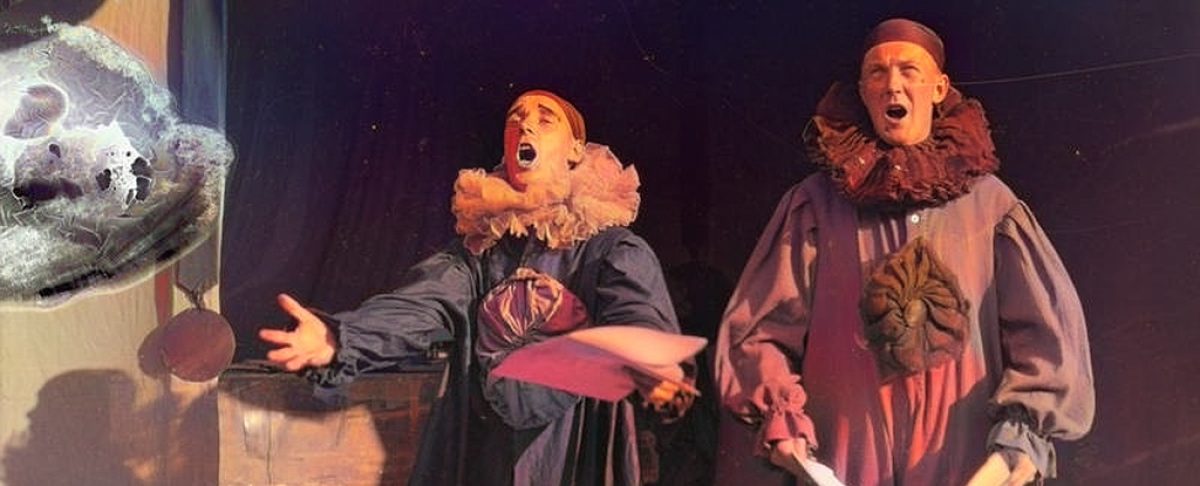
With my particular interest in the Army Cyclist Corps in the Macedonian campaign, I could hardly let ‘World Bicycle Day’ go unnoticed!
At the start of the First World War British infantry divisions were given a squadron of cavalry (or yeomanry) and a company of cyclists for reconnaissance, patrolling and message carrying purposes. The original cyclists came from the infantry battalions of the division and, in November 1914, were ‘rebadged’ as the newly formed Army Cyclist Corps.
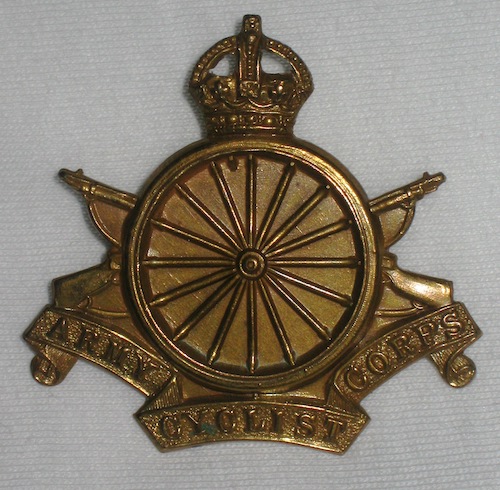
An Army Cyclist Corps cap badge in the author’s collection; this is very much a ‘does exactly what it says on the tin’ sort of cap badge!
Apart from the 60th (2/2nd London) Division – which left its cyclist company in France – all the divisions of the BSF had a cyclist company. During 1916 the decision was made to merge cyclist companies into corps cyclist battalions which, alongside a cavalry regiment, would provide ‘Corps Mounted Troops’. It was not until late in that year that this development came to the BSF which gained two corps cyclist battalions:
- 12th Corps Cyclist Battalion on the Doiran front; formed from 22nd and 26th Divisional Cyclist Companies;
- 16th Corps Cyclist Battalion on the Struma front; formed from 10th, 27th and 28th Divisional Cyclist Companies.
I shall be speaking about cyclists in the Salonika campaign and, in particular, 16th Corps Cyclists in the Struma valley, at the Salonika Study Day at Great War Huts near Bury St Edmunds on Saturday 31st August. So, if you want to know more, ‘get on yer bike‘ and book your ticket now!
Mules, Mountains and Mosquitoes – A First World War Study Day

L/Cpl Fred Braysher of 28th Divisional Cyclist Company in Salonika, early 1916. The clue to the location and date is the slouch hat which was ‘in vogue’ with the BSF in spring and early summer 1916, until sun helmets were issued (Author’s collection).
Discover more from Salonika Campaign Society, 1915-1918
Subscribe to get the latest posts sent to your email.
 Salonika Campaign Society, 1915-1918
Thank you for your posting! I, too, have an interest in the Army Cyclist Corps, as my maternal grandfather was a member of the 16th Corps fighting in the Struma Valley.
I have one of those ACC cap badges. All the more remarkable when you take into account that it has resided in several households in 4 continents between when my Grandfather went home to Wandsworth in 1919, and that I now have it in Victoria!
I have two questions (at this stage!):
So many thanks for your work! Keep it up! it is much appreciated!
Clare Claydon
Down Under
Hi Clare,
Thanks so much for taking the time to comment. I’m always pleased to hear from anyone with an interest in the Army Cyclist Corps and, especially, 16th Corps Cyclists! That’s great that you still have his cap badge – mine came from eBay!
I don’t know if the talks will be filmed/recorded but I’ll certainly be happy to share my slides and a transcript with you (once they’re finished!).
Yes, 16th Cyclist Bn was made up of three companies which came directly from the constituent divisional cyclist companies: A (10th), B (27th) and C (28th) – so my grandfather (ex-28th) would have been in C company and I assume remained with it, but I suppose the needs of keeping the companies manned in the face of malaria hospitalisations may have seen him move around. Sadly no muster rolls survive. So, if you know which divisional company your grandfather came from you can make an assumption as to which company he was in. I’ll email you with some further thoughts.
Best wishes,
Robin
Hi Robin I am researching an Irish relative who emigrated to South Africa circa 1916 next appears on a medal card I found in Kew archives Alphonsus Doyle 16th D A Cyclist C 7832../ 1822 .Royal Irish Regiment , campaign 1914-15 ,” Discharged” back in South Africa circa 1919 where he died 1948.
Any help you can give me in my research would be much Appreciated
regard from the “Wild Atlantic Way”
Tony Murray
Hi Tony – thanks for your message, I’ll see what I can find out and get back to you. Best regards, Robin
Dear Robin,
I am a MA student at Birmingham Uni doing a dissertation on the ACC – to be submitted early Sept.
Would it be possible to make contact please? I am very interested in the ACC in Salonika.
My number is [removed].
Hi Neil – thanks for your message. I’ll be in touch. Best wishes, Robin
My Grandad James Henry Cunningham was in the Army Cyclist Corps and was in the Balkans in 1915. His number was 6025, He was also awarded three medals but unfortunately I have no idea what happened to them. My father who passed told me he was also a boxer and swimmer whilst in the army. I am attempting to write a short history of his career. If anyone can contribute by pointing me in the right direction as to where in the Balkans he served. Thank you
Hello Janice – thank you for your question. James would have served with the British Salonika Force (BSF) in northern Greece. British troops started landing in late 1915. There was some early fighting in Serbia (now Northern Macedonia) against the Bulgarians over the winter, but then the troops settled down to defend the city of Salonika (now Thessaloniki), although no attack ever came. They then moved up to the Greek frontier later in 1916 and created trench lines, along with French, Serbian, Italian, Greek and Russian forces. The main British front was by the lake and town of Doiran (north of Thessaloniki), with another front to the north-east of the city along the valley of the River Struma down to the sea. This was malarial and cyclists were used a lot for patrolling. There were also cyclists on the Doiran front, but the mountainous terrain and the more static trench lines gave them little scope for patrolling on bicycles. The main allied offensives were on the Doiran front and in September 1918 one finally brought about a Bulgarian armistice on 30 September 1918. Your grandfather’s medals would have been: Victory Medal, British War Medal and, probably, the 1914-15 Star, either for landing in Salonika in late 1915, or maybe for prior service on the Western Front (a number of British troops were transferred from France). You’ll find more about the BSF and the campaign on our website and, if you search for ‘cyclists’, you’ll find other articles I have written about cyclists in Salonika. I’ll see what I can find out specifically about James and email you. Best regards, Robin
Hello again Janice – well, I should have looked James up before replying. I had forgotten that, in the context of Medal Index Cards, Gallipoli also counts as the Balkans. His medal index card confirms this (2b is ‘Gallipoli and the Aegean Islands’) and shows that he arrived in theatre on 6 August 1915, so that was the basis for his 1914-15 Star. I have also found out that he was ‘Mentioned in Despatches’, this being published in the London Gazette on 8 July 1919. This shows him to have been attached to the Divisional HQ of 11th Infantry Division – which did serve in Gallipoli and then on the Western Front, but never went to Salonika! I’ll email you the records I found and some links to more information. Best regards, Robin