

In April 2025 I described my exploration of another possible family connection (albeit by marriage) with the Salonika campaign. This concerned Lt George Clark who was the Medical Officer of 7/Royal Munster Fusiliers. His medal index card and the Battalion war diary (WO 95/4296) conclusively place him in Gallipoli but, to see what happened next, required a visit to The National Archives at Kew to look at the next part of the war diary which, of course, has not been digitised. I can now share the next stage of my investigations and, whilst I don’t expect you to be especially interested in my family history, what I found out about 7/RMF may be of wider interest.
Continue reading “More on the Munsters”Category: Salonika Stories
Stories from or about the Macedonian campaign, 1915-1918.
The Sinking of the Rewa
Last year I resolved to share the story of the sinking of the hospital ship, Rewa. I decided to do this on the anniversary of the event in 2026. The trouble was, I failed to check the date and, convinced that it was in February, by the time I looked up the details I realised I had missed it – 4 January! I could have left it until 2027 but, instead, decided to post the story today, Fred Braysher’s birthday, as it was Fred (my grandfather) who told me the story 44 years ago.
Continue reading “The Sinking of the Rewa”More Chocolate Soldiers!
My thanks go to Rob Elliott and Andy Hutt who have both provided further information on 22nd Division’s production of The Chocolate Soldier. Before I share their pearls of wisdom, here is a link to a page with photos (scroll down!), which I found AFTER posting my article. I added it as a comment, but that may have been missed and the photos are certainly worth seeing:
Continue reading “More Chocolate Soldiers!”The Chocolate Soldier
Wilton’s Music Hall is a fascinating theatrical venue in the heart of the East End of London, close to Cable Street where, in 1936, at least one Salonika veteran – PC Fred Braysher – took part in the infamous ‘Battle of Cable Street’.
Continue reading “The Chocolate Soldier”The skirl of the pipes!
Last month I was in London with an evening to spare, so I bought myself a ticket to an event on Horse Guards Parade, something I hadn’t done for many years. The last time I went to one of these, I’m sure it was just billed as ‘Beating Retreat’ by the Household Division, but this was a ‘Military Musical Spectacular’! And the name wasn’t the only change – a large digital screen, electric guitars and fireworks were also innovations, but, at least, the bands of the Brigade of Guards hadn’t changed.
The Salonika campaign was, of course, far too unfashionable for the ‘Gentlemen’s Sons’ of the Guards to take part in – so it was left to ‘The Feet’ (i.e. the line infantry) to do the job – but I did find a Salonika connection during the evening.
Continue reading “The skirl of the pipes!”Remembering Hori Tribe (1877-1917)
I’ve only recently discovered a fascinating and beautifully presented online exhibition commemorating the life of Hori Tribe (1877-1917), an employee of The Royal Parks who served in Salonika before transferring to the Egyptian Expeditionary Force (EEF) in June 1917.
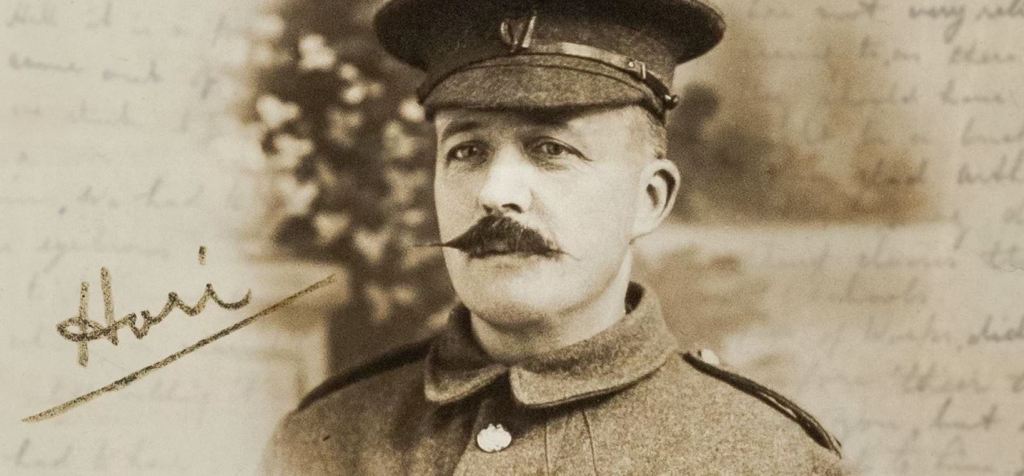
The exhibition, co-curated by the Royal Parks and Hori’s great-granddaughter, Sarah Gooch, has a wonderful and moving collection of photos, drawings and extracts from Hori’s letters.
I certainly won’t attempt to retell Hori’s story here, instead I recommend a visit to the digital exhibition. It is definitely worth a visit and a few moments of your time.
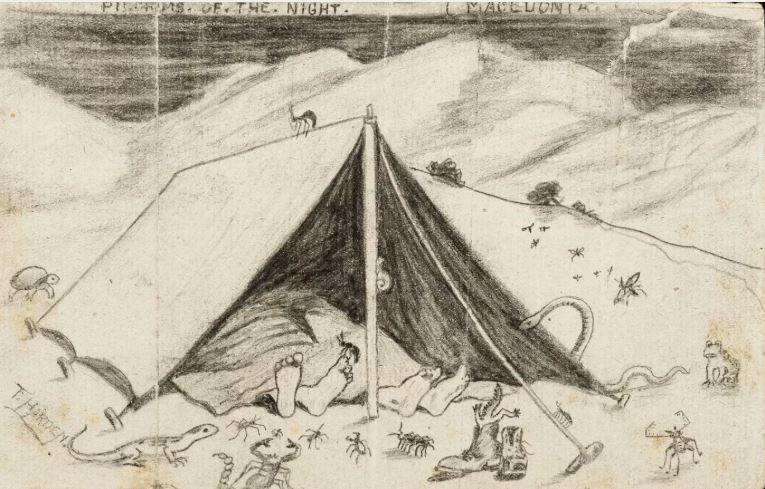
With the EEF since June and now, at the start of December 1917, Hori had two days’ rest at a monastery just outside of Jerusalem. In the final letter he sent home, Hori included some rosemary – associated with remembrance:
‘The pieces of rosemary included I picked from a hedge in the grounds of the monastery.’
Hori spent two days at the monastery just before his last battle.
Hori was killed in action on 8 December 1917. He is laid to rest at the Jerusalem War Cemetery.
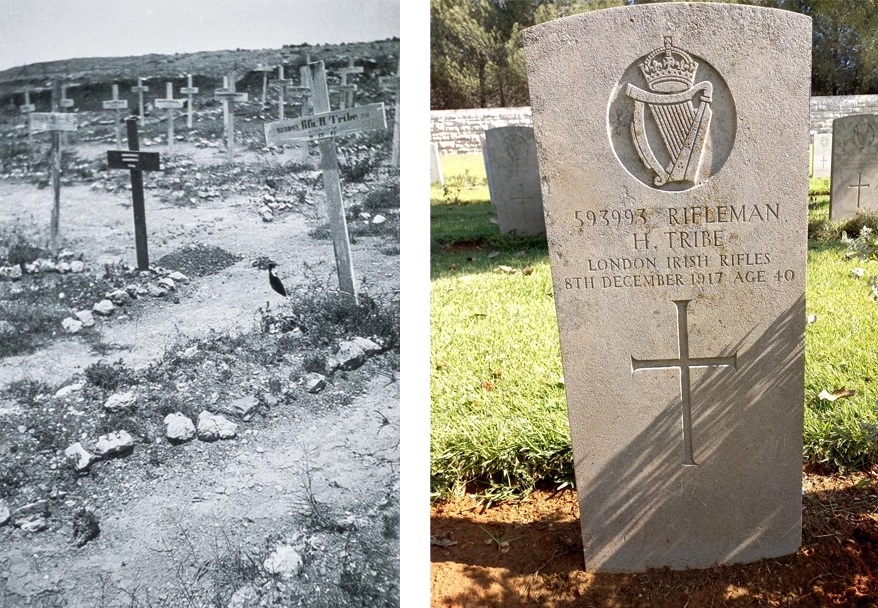
Remembering Hori Tribe – A digital exhibiton celebrating the life of Hori Tribe (1877-1917), an employee of The Royal Parks who was killed in action during the First World War.
Wot … no tanks?
A recent holiday in Dorset gave me the opportunity to visit the Tank Museum at Bovington, something I haven’t done for more than 50 years. It was very exciting, although a little alarming to find myself older than some of the exhibits! Although I did have a quick look at the First World War monstrosities (and took a few photos, below), they were not the reason for my visit. What I wanted to see were tanks from the Second World War: Matildas, Valentines, Churchills, Shermans – especially ‘The Funnies’ – and, my all time favourite, Cromwells … but that’s what happens when your formative years were spent with war comics, classic war movies and Airfix kits … lots of Airfix kits! Anyway, I wasn’t disappointed, but this is not the place to discuss my favourite tanks.
Continue reading “Wot … no tanks?”Pte George Excell of Wotton-under-Edge
One of the things I enjoy most about living in the county of Gloucestershire is its beautiful countryside and many wonderful walks. After a recent hike involving some strenous Cotswold climbs, I stopped for refreshments and recovery in Wotton-under-Edge. Of course, I had to take in the Wotton war memorial where I later discovered a Salonika connection…
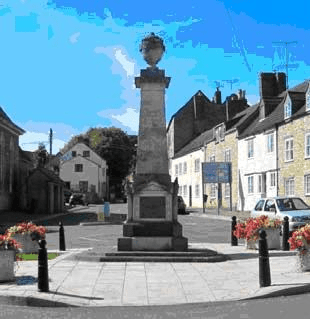
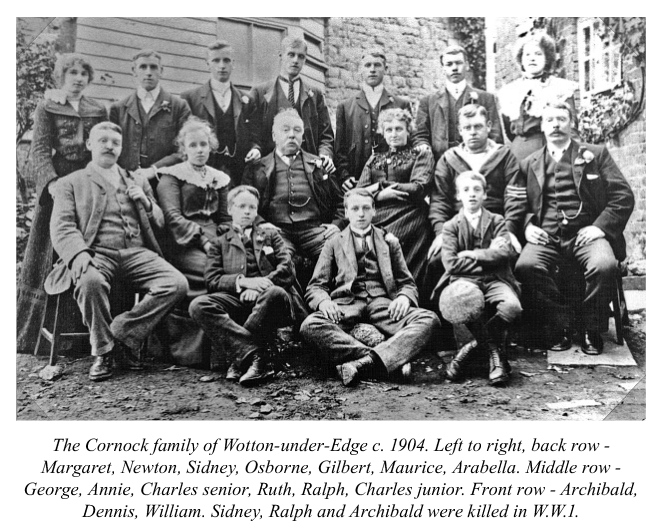
According to the town’s heritage centre, the memorial was erected in 1920 and unveiled by a Mrs Cornock. Apparently, and tragically, eight of her sons served in WWI – three did not return*. Among the names on the memorial is that of George Edward Excell.
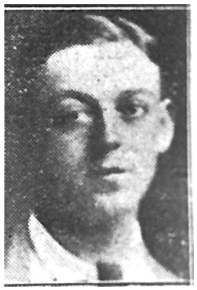
George Edward Excell was born in 1896 in Wotton-under-Edge, one of six children of Edwin and Elizabeth Excell, who lived in the Sinwell area of the town. His father, Edwin, worked as a rural postman, while his mother, Elizabeth served as matron at the Perry & Dawes Almshouses on Church Street, Wotton. Edwin died while George was still young.
After finishing school, George began working for Mr. G. W. Palmer, a boot maker based on Long Street in Wotton. Mr. Palmer later served in the Royal Naval Division as an Able Seaman during the Great War.
At the outbreak of the war, George enlisted in Wotton, joining the 11th Battalion of the Worcestershire Regiment with the service number 18644. The battalion was formed on 14 September 1914 as part of the 78th Brigade in the 26th Division. They trained in Wiltshire, including at Sherrington and on Salisbury Plain, before landing in Boulogne on 21 September 1915. Over the next two years, George saw extensive action on the front lines and was wounded twice.
George Excell recovered from his wounds and resumed service with the Worcestershire Regiment. In September 1918, the 11th Battalion of the Worcesters, including George, was deployed to the Salonika front.
On 16th October 1918, George’s mother, Elizabeth Excell, received a telegram stating that her son was dangerously ill in a hospital in Salonika. Tragically, George had already died of pneumonia four days earlier. It wasn’t until Saturday, 19th October, that she received confirmation of his death. George Excell was 22 years old.
George is buried at Doiran Military Cemetery, in Plot 5, Row H, Grave 28.
Source: ‘First World War Heroes of Wotton-under-Edge’ by Bill Griffiths available online here.
*Bill Griffiths’ book also includes this picture of the Cornock family and the three sons that never returned to Wotton-under-Edge.
‘Topical Budget’ – newsreels
Topical Budget was one of the biggest British newsreels during the silent film era, competing with Gaumont Graphic and Pathé Gazette. It was produced by William Jeapes’ Topical Film Company and first released in 1911. Although several newsreels existed at the time, only Topical, Gaumont, and Pathé remained by the middle of World War I.
Topical had fewer resources than its competitors, and it might not have survived if not for a deal with the War Office, which needed an outlet for its official war films. In 1917, the War Office Official Topical Budget was launched, giving the newsreel exclusive footage from the front lines. Later that year, the War Office Cinematograph Committee (WOCC) bought the Topical Film Company, turning the newsreel into a useful propaganda tool.
After the war, the newsreel once again became the Topical Budget under the ownership of newspaper magnate Edward Hulton. Finally, never having adopted sound, the newsreel ceased production in March 1931.
A significant portion of Topical Budget’s wartime footage is preserved at the Imperial War Museum (IWM), where, after a little searching, you can discover many fascinating films from the Salonika Front.
Object description (IWM)
British troops, mainly 22nd Division, on the Salonika Front, 1917-1918 (?).
Full description (IWM)
(Reel 1) Wounded soldiers with mule transport, snow-covered mountains filmed from an aircraft (Mount Olympus ?). A 13-pounder anti-aircraft gun showing the rangefinder in use. A British Army camp, with a bakery and soldiers washing and eating. Three soldiers in a trench fusing Mills grenades. A Royal Engineers wagon laying a line. A view from the rear gunner’s position of a two-seater aircraft taking off, flying over Salonika harbour, the nearby mountains, and a military camp. (Reel 2) Brigadier-General F S Montague-Bates (66th Brigade, 22nd Division) in a posed position. A return shot of the three soldiers fusing Mills grenades. They change to fitting magazines on Lewis machine guns and using a trench periscope. General Guillaumat inspects a British battalion. General scenes of the British Army camp. A Red Cross wagon on the move. A heavily camouflaged gun (possibly a 60-pounder) and a 6-inch howitzer. More soldiers in trenches. Major-General J Duncan, commanding 22nd Division, and Lieutenant-General H F M Wilson posed together. British soldiers at bayonet practice. (Reel 3) A Highland battalion, probably Black Watch, with its pipe band, and a single piper playing. A French general decorates British troops, who march past.
Video source, all rights acknowledged
World Wetlands Day
Maybe it’s my Fenland heritage, but I have long found wetlands fascinating environments. With the Broads in the east, the Fens in the west and lots of swampy bits in between, Norfolk is an ideal place to live, although on this World Wetlands Day my thoughts go to the Struma Valley. The Struma front, where XVI Corps operated, is the aspect of the Macedonian campaign that interests me most – primarily because it’s where my grandfather, Fred, served – but I don’t often think of it in terms of being a wetland environment.
Continue reading “World Wetlands Day” Salonika Campaign Society, 1915-1918