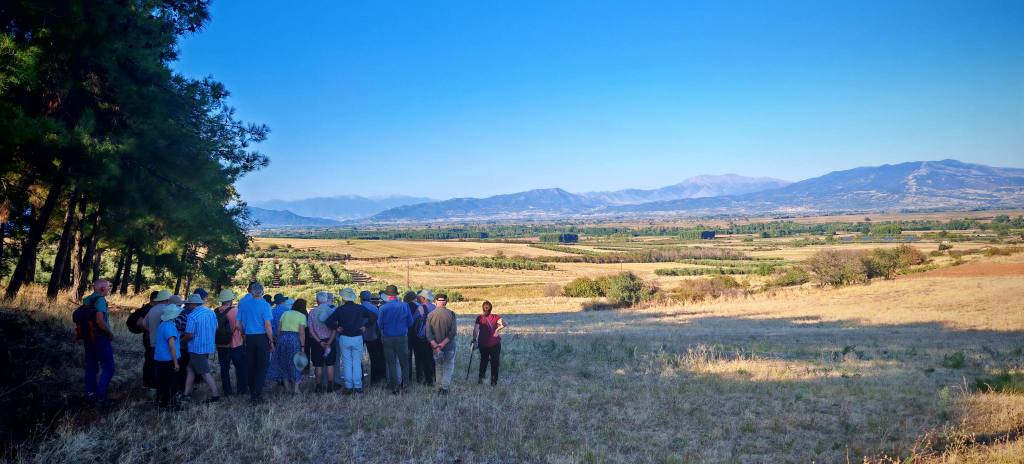
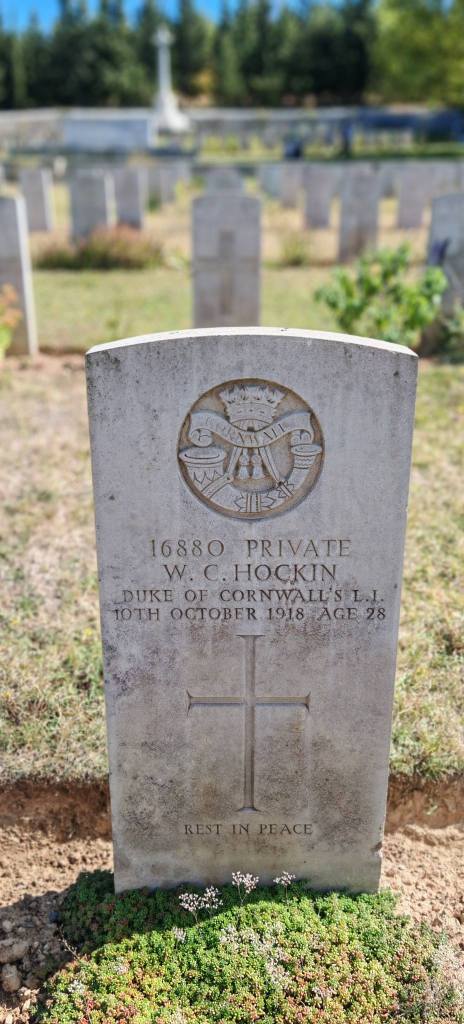
The Society’s 2025 tour (Sunday 21st to Tuesday 30th September) of the British Salonika Force battlefields is now well underway – with battlefield studies, cemetery visits and acts of commemoration. This year the tour has a special focus on artillery and small-scale operations.
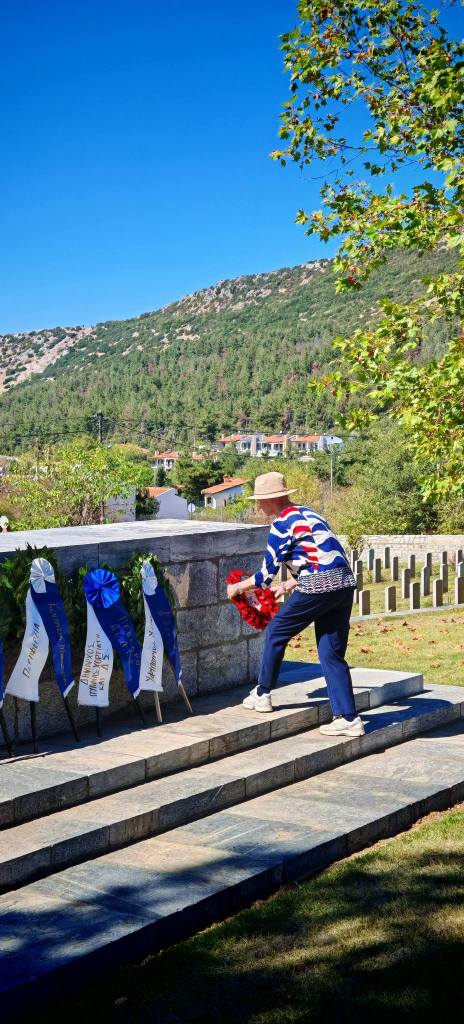
The tour began with a Ceremony of Remembrance at Kirechkoi-Hortkoi cemetery, with a wreath laid by Patron of the Society, the Honourable Ann Straker, before moving on to Triada village for an introduction on the BSF in the Struma Valley and the role of artillery on that part of the front.
You can follow the progress of the tour on Facebook here.
Patron of the Society, the Honourable Ann Straker, lays a wreath at the Ceremony of Remembrance at Kirechkoi-Hortkoi cemetery
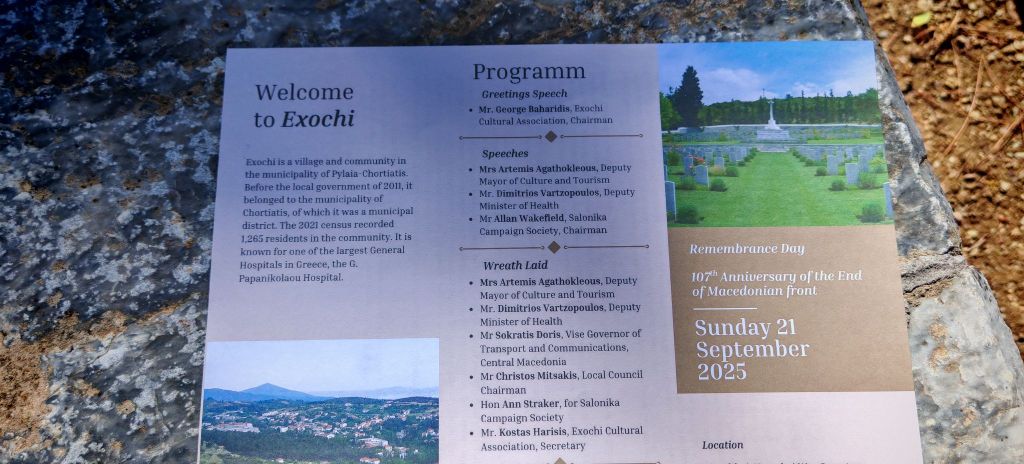
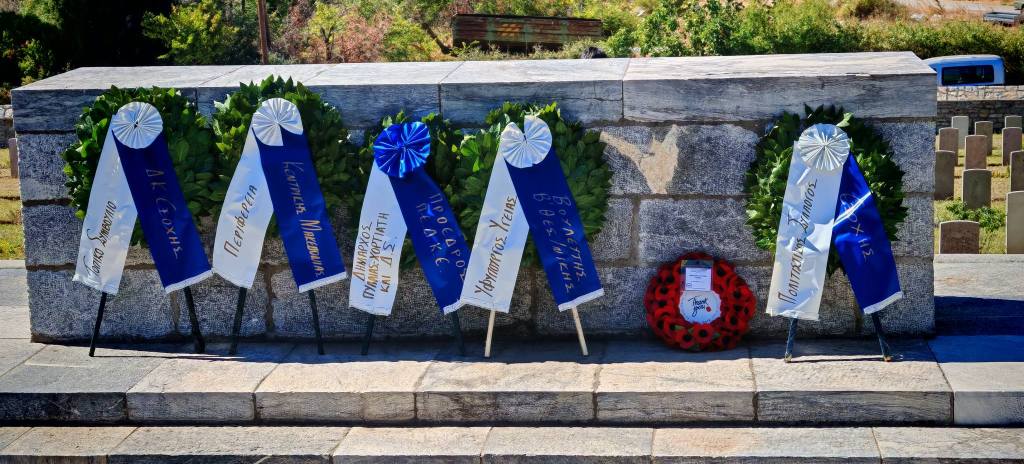
Programme for the Ceremony of Remembrance at Kirechkoi-Hortkoi cemeteryMemorial Wreaths at Kirechkoi-Hortkoi cemeteryTour members begin their site visits
Last month I was in London with an evening to spare, so I bought myself a ticket to an event on Horse Guards Parade, something I hadn’t done for many years. The last time I went to one of these, I’m sure it was just billed as ‘Beating Retreat’ by the Household Division, but this was a ‘Military Musical Spectacular’! And the name wasn’t the only change – a large digital screen, electric guitars and fireworks were also innovations, but, at least, the bands of the Brigade of Guards hadn’t changed.
The Salonika campaign was, of course, far too unfashionable for the ‘Gentlemen’s Sons’ of the Guards to take part in – so it was left to ‘The Feet’ (i.e. the line infantry) to do the job – but I did find a Salonika connection during the evening.
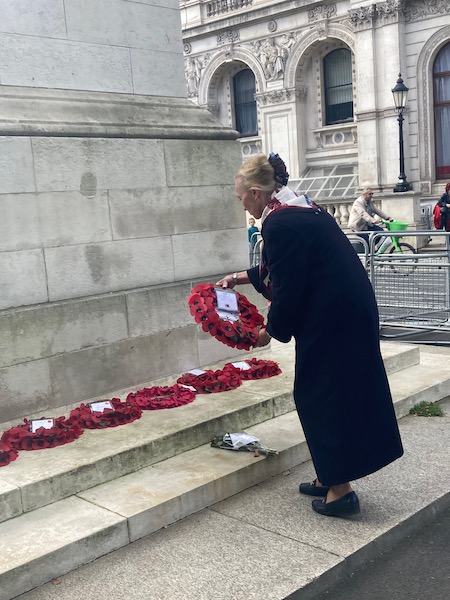
Just a quick reminder that the SCS Annual Meeting takes place at the Civil Service Club, London on Saturday, 11th October 2025. Prior to the meeting, we will be gathering at The Cenotaph, Whitehall at 11:30 for a short commemorative ceremony.
October 2024: Patron of the Society, the Hon. Ann Straker, lays the poppy wreath at the Cenotaph (photo by Vernon Creek).
There then follows the opportunity for lunch at the club before the meeting starts at 12:30 with a series of talks:
Dr. Jake Gasson, Salonika: The Battle Against Boredom.
Chris Loader, 10th Battalion The Hampshire Regiment: The OG Salonika Battalion.
Alan Wakefield, Balkan Gunners: Some Aspects of the Artillery War in the Salonika Campaign.
The cost of the annual meeting is £10.00 per person, excluding lunch. Please note, advance booking is required (by September 20th 2025) as availability of seats is strictly limited.
Full details of the meeting and how you can reserve your place can be found here.
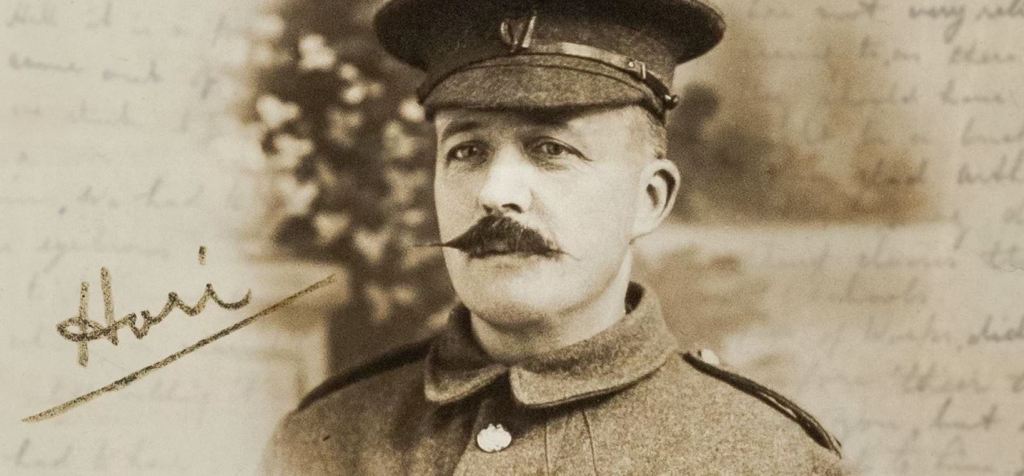
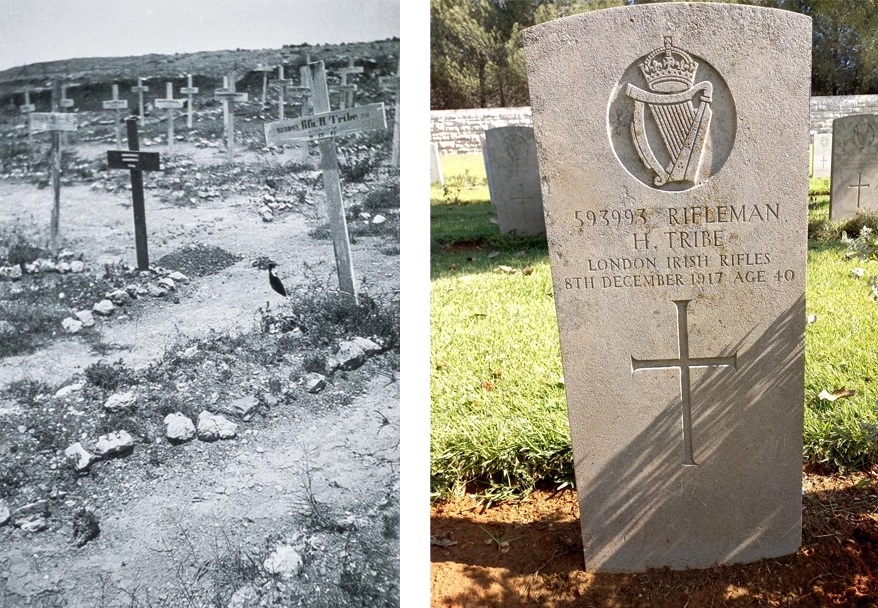
I’ve only recently discovered a fascinating and beautifully presented online exhibition commemorating the life of Hori Tribe (1877-1917), an employee of The Royal Parks who served in Salonika before transferring to the Egyptian Expeditionary Force (EEF) in June 1917.
The exhibition, co-curated by the Royal Parks and Hori’s great-granddaughter, Sarah Gooch, has a wonderful and moving collection of photos, drawings and extracts from Hori’s letters.
I certainly won’t attempt to retell Hori’s story here, instead I recommend a visit to the digital exhibition. It is definitely worth a visit and a few moments of your time.
With the EEF since June and now, at the start of December 1917, Hori had two days’ rest at a monastery just outside of Jerusalem. In the final letter he sent home, Hori included some rosemary – associated with remembrance:
‘The pieces of rosemary included I picked from a hedge in the grounds of the monastery.’
Hori spent two days at the monastery just before his last battle.
Hori was killed in action on 8 December 1917. He is laid to rest at the Jerusalem War Cemetery.
Remembering Hori Tribe – A digital exhibiton celebrating the life of Hori Tribe (1877-1917), an employee of The Royal Parks who was killed in action during the First World War.
SCS Secretary Chris Loader recently recorded (on July 28th) a new podcast as part of the History Rage series in which he shares his personal connection to the Salonika Campaign, through his family history, and discusses the background and complexities of the war in Greece.
You can listen to the podcast here (or via the image below):
The podcast is also available via these other podcast channels:
The Society’s occasional email-newsletter, The New Balkan News* has recently been sent out to subscribers. The July issue contains news about the SCS Annual Meeting in October and also includes a number of interesting articles:
Archaeology in the Struma Valley
Botany & Salonika
Request for Information
Help needed in identifying a Salonika combatant
Mule Musings.
One article (Archaeology in the Struma Valley) reports on archaelogical research on the site of the ancient city of Amphipolis, at the mouth of the River Strimon/Struma.
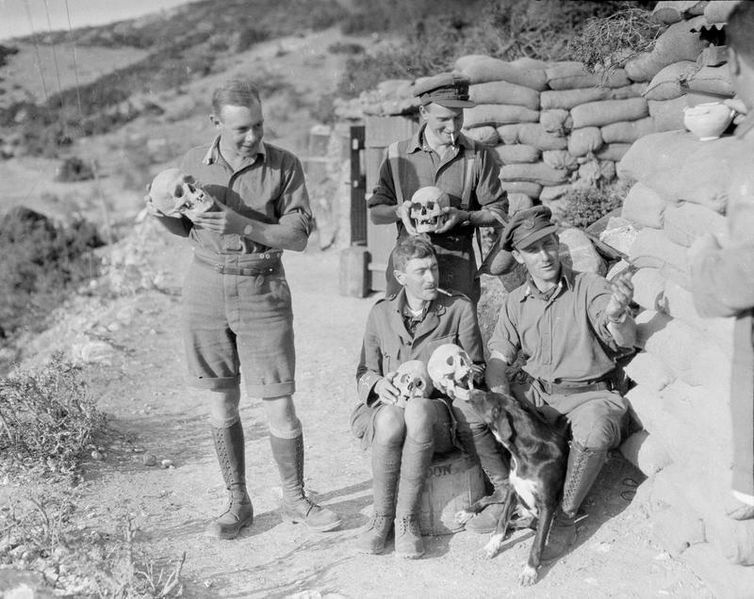
Officers of the 2nd King’s Shropshire Light Infantry with skulls excavated during the construction of trenches and dugouts at the ancient Greek site of Amphipolis, 1916. Image Source: Imperial War Museum Q 32521
It was here at Amphipolis in 1916 that British troops discovered human remains and artefacts while digging trenches. To read the article, and the rest of the email newsletter, please click here.
And, if you haven’t, please consider subscribing to the NBN here.
*The New Balkan News is available to Society members and non-members alike. The name was inspired by the newspaper of the British Salonika Force – The Balkan News, published 1915-1919 – and was the idea of founding editor, Martin Wills, when it was launched in 2013. All previous newsletters are freely available here.
A recent holiday in Dorset gave me the opportunity to visit the Tank Museum at Bovington, something I haven’t done for more than 50 years. It was very exciting, although a little alarming to find myself older than some of the exhibits! Although I did have a quick look at the First World War monstrosities (and took a few photos, below), they were not the reason for my visit. What I wanted to see were tanks from the Second World War: Matildas, Valentines, Churchills, Shermans – especially ‘The Funnies’ – and, my all time favourite, Cromwells … but that’s what happens when your formative years were spent with war comics, classic war movies and Airfix kits … lots of Airfix kits! Anyway, I wasn’t disappointed, but this is not the place to discuss my favourite tanks.
Have you been to Zeitenlik? Even if the name doesn’t ring any bells, if you’ve been to the CWGC Lembet Road Cemetery – and the neighbouring allied cemeteries – then you have been to Zeitenlik. Don’t laugh, but I’ve often wondered why this part of Salonika has such a Germanic-sounding name – even allowing for the cultural and ethnic mix of the Balkans. It hasn’t kept me awake at night, nor have I been so bothered that I’ve asked Google, but it has crossed my mind more than once. I suppose this shows that a smidgin of half-remembered O’ Level German is – if not actually dangerous – at least unhelpful!
On a recent trip to London I took a stroll through Hyde Park and, for the first time ever, came across the dramatic Cavalry Memorial, unveiled in May 1924. A little under a year later, the first wreath laying ceremony was held at the memorial and, in 1927, the Combined Cavalry Old Comrades Association was formed. The Association has organised an annual parade and memorial service on the second Sunday in May, ever since.
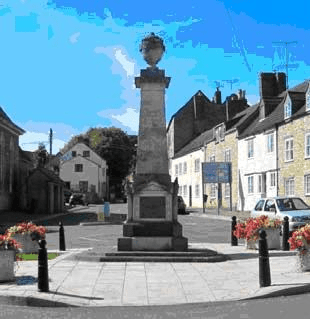
One of the things I enjoy most about living in the county of Gloucestershire is its beautiful countryside and many wonderful walks. After a recent hike involving some strenous Cotswold climbs, I stopped for refreshments and recovery in Wotton-under-Edge. Of course, I had to take in the Wotton war memorial where I later discovered a Salonika connection…
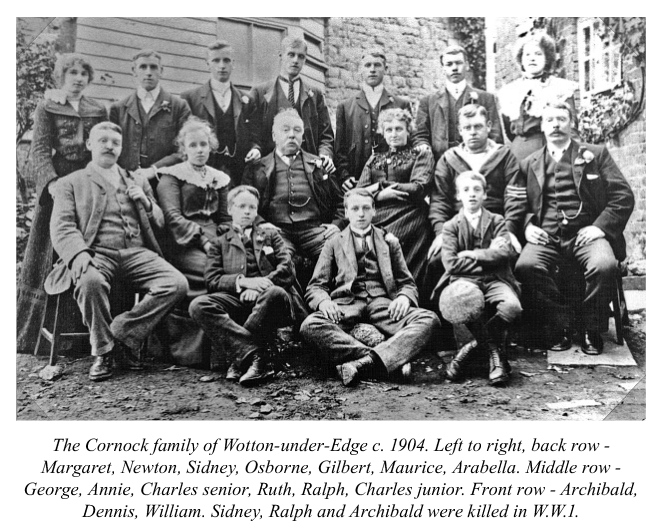
According to the town’s heritage centre, the memorial was erected in 1920 and unveiled by a Mrs Cornock. Apparently, and tragically, eight of her sons served in WWI – three did not return*. Among the names on the memorial is that of George Edward Excell.
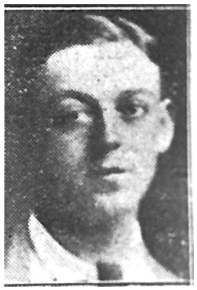
A photograph of George was published in the Gazette on 2nd November 1918.
George Edward Excell was born in 1896 in Wotton-under-Edge, one of six children of Edwin and Elizabeth Excell, who lived in the Sinwell area of the town. His father, Edwin, worked as a rural postman, while his mother, Elizabeth served as matron at the Perry & Dawes Almshouses on Church Street, Wotton. Edwin died while George was still young.
After finishing school, George began working for Mr. G. W. Palmer, a boot maker based on Long Street in Wotton. Mr. Palmer later served in the Royal Naval Division as an Able Seaman during the Great War.
At the outbreak of the war, George enlisted in Wotton, joining the 11th Battalion of the Worcestershire Regiment with the service number 18644. The battalion was formed on 14 September 1914 as part of the 78th Brigade in the 26th Division. They trained in Wiltshire, including at Sherrington and on Salisbury Plain, before landing in Boulogne on 21 September 1915. Over the next two years, George saw extensive action on the front lines and was wounded twice.
George Excell recovered from his wounds and resumed service with the Worcestershire Regiment. In September 1918, the 11th Battalion of the Worcesters, including George, was deployed to the Salonika front.
On 16th October 1918, George’s mother, Elizabeth Excell, received a telegram stating that her son was dangerously ill in a hospital in Salonika. Tragically, George had already died of pneumonia four days earlier. It wasn’t until Saturday, 19th October, that she received confirmation of his death. George Excell was 22 years old.
Source: ‘First World War Heroes of Wotton-under-Edge’ by Bill Griffiths available online here. *Bill Griffiths’ book also includes this picture of the Cornock family and the three sons that never returned to Wotton-under-Edge.