

I have always loved illustrated books, so couldn’t let National Illustration Day go unnoticed. Obviously, as children, we start off looking at picture books but my love of illustrated books has continued, although I do read the words too – honest!
Continue reading “Happy National Illustration Day!”Tag: Resources
Useful resources for the Salonika campaign enthusiast.
‘Topical Budget’ – newsreels
Topical Budget was one of the biggest British newsreels during the silent film era, competing with Gaumont Graphic and Pathé Gazette. It was produced by William Jeapes’ Topical Film Company and first released in 1911. Although several newsreels existed at the time, only Topical, Gaumont, and Pathé remained by the middle of World War I.
Topical had fewer resources than its competitors, and it might not have survived if not for a deal with the War Office, which needed an outlet for its official war films. In 1917, the War Office Official Topical Budget was launched, giving the newsreel exclusive footage from the front lines. Later that year, the War Office Cinematograph Committee (WOCC) bought the Topical Film Company, turning the newsreel into a useful propaganda tool.
After the war, the newsreel once again became the Topical Budget under the ownership of newspaper magnate Edward Hulton. Finally, never having adopted sound, the newsreel ceased production in March 1931.
A significant portion of Topical Budget’s wartime footage is preserved at the Imperial War Museum (IWM), where, after a little searching, you can discover many fascinating films from the Salonika Front.
Object description (IWM)
British troops, mainly 22nd Division, on the Salonika Front, 1917-1918 (?).
Full description (IWM)
(Reel 1) Wounded soldiers with mule transport, snow-covered mountains filmed from an aircraft (Mount Olympus ?). A 13-pounder anti-aircraft gun showing the rangefinder in use. A British Army camp, with a bakery and soldiers washing and eating. Three soldiers in a trench fusing Mills grenades. A Royal Engineers wagon laying a line. A view from the rear gunner’s position of a two-seater aircraft taking off, flying over Salonika harbour, the nearby mountains, and a military camp. (Reel 2) Brigadier-General F S Montague-Bates (66th Brigade, 22nd Division) in a posed position. A return shot of the three soldiers fusing Mills grenades. They change to fitting magazines on Lewis machine guns and using a trench periscope. General Guillaumat inspects a British battalion. General scenes of the British Army camp. A Red Cross wagon on the move. A heavily camouflaged gun (possibly a 60-pounder) and a 6-inch howitzer. More soldiers in trenches. Major-General J Duncan, commanding 22nd Division, and Lieutenant-General H F M Wilson posed together. British soldiers at bayonet practice. (Reel 3) A Highland battalion, probably Black Watch, with its pipe band, and a single piper playing. A French general decorates British troops, who march past.
Video source, all rights acknowledged
Map cataloguing work continues…
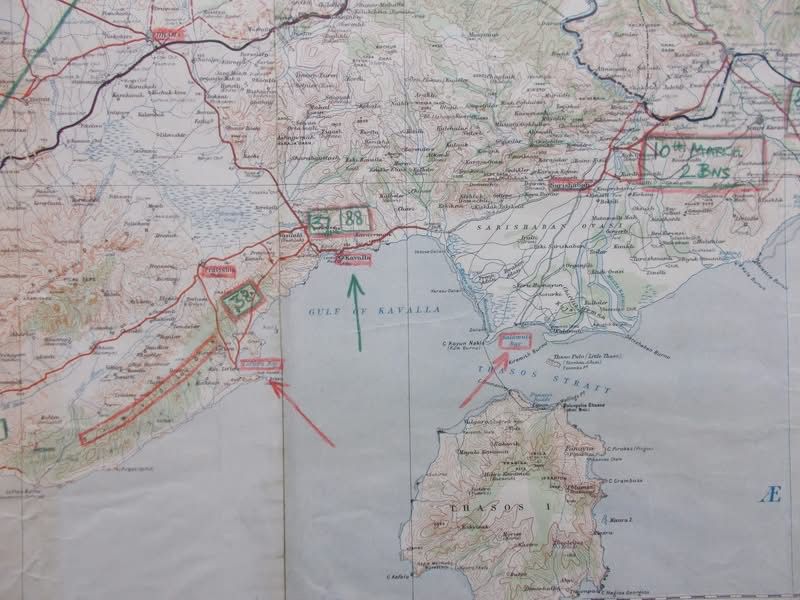
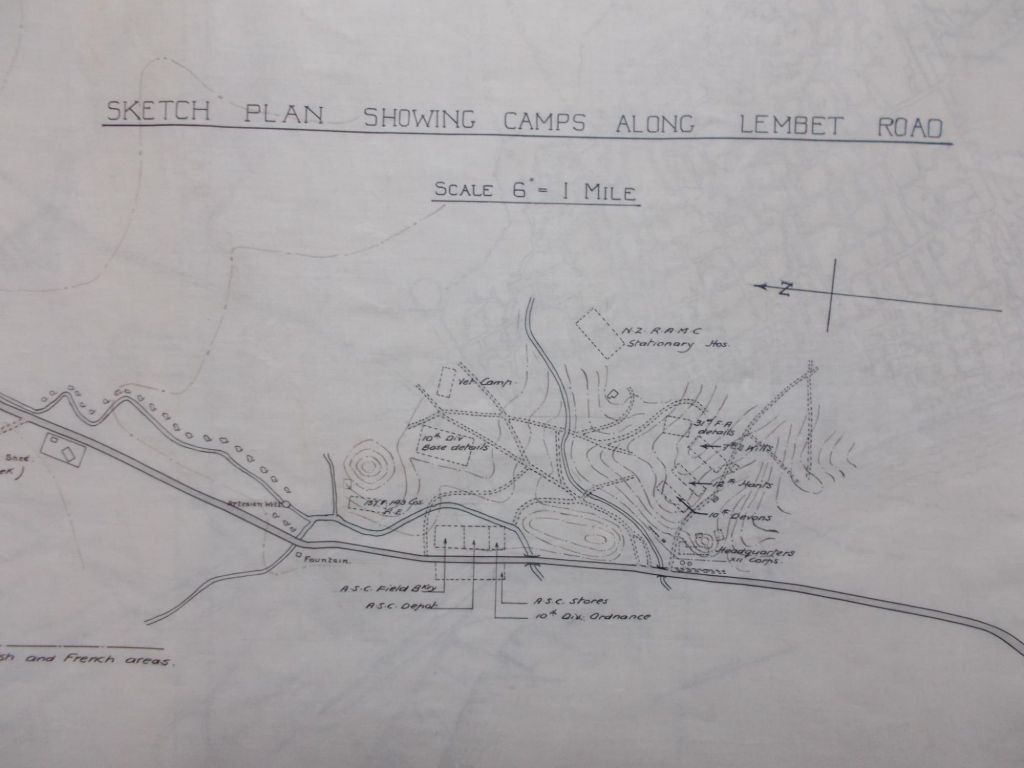
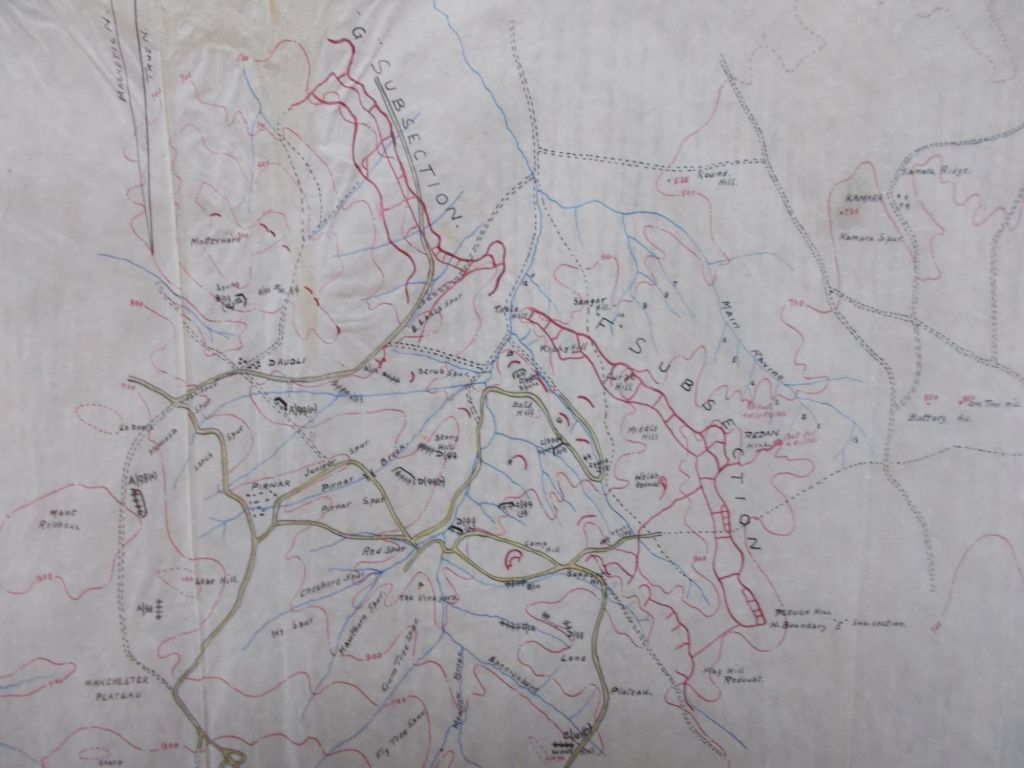
Hats off and three cheers to the valiant SCS members who have just completed their second visit to the National Archives with more maps checked, listed, and photographed. Great work!
Secrets of Salonika – online presentation
As part of the to the Great War Group‘s series on online talks, SCS Secretary, Chris Loader recently presented Secrets of Salonika – Insights from the battlefields of Greece & North Macedonia. That talk is now freely available at YouTube.
Chris also presents a podcast series, Salonika Secrets.
SCS volunteers catalogue campaign maps
Last week a team of volunteers from the Salonika Campaign Society began a project at The National Archives to catalogue sets of Salonika Campaign maps to allow individual sheets to be identified by researchers using TNA’s online database. More detailed information on the maps will be released on the SCS website as the project progresses.
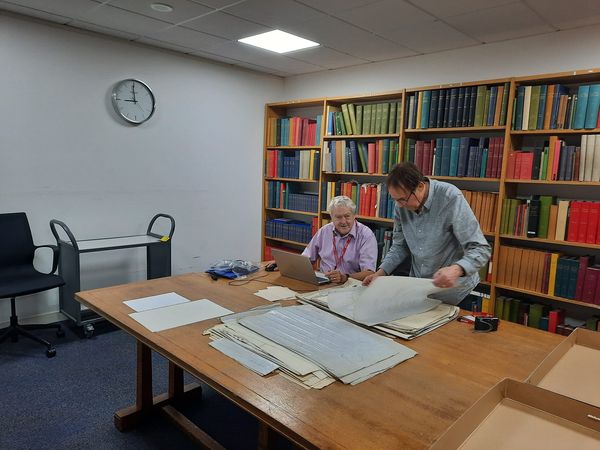
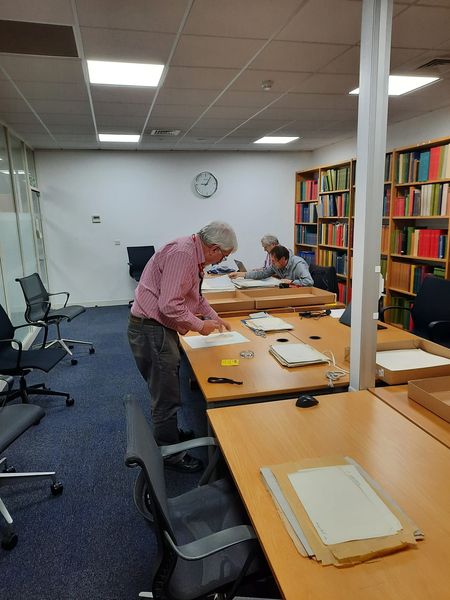
During the first session some fascinating material came to light including hand sketched panoramas of sectors of the Birdcage Line, artillery barrage maps and water supply maps for the Struma Valley.
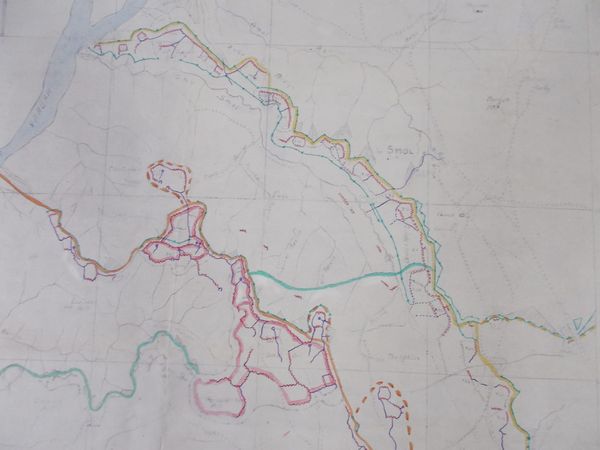
Many thanks to Dr Will Butler, Head of Military Records at TNA, for organising a work space and access to the maps for this first scoping session.
The Salonika campaign’s so boring!
No, this isn’t a sudden cri de couer after twenty years of reading about and studying the Salonika campaign, but rather an acknowledgment of the tedium experienced by many of those who served in Macedonia between 1915 and 1919. This was the subject of a fascinating podcast I recently came across.
Continue reading “The Salonika campaign’s so boring!”Innovative mapping tool now available!
The Trench Maps Place Names Index
As a result of a remarkable piece of work researched and initiated by SCS Membership Secretary, Keith Edmonds, we are pleased to provide a new file to aid research and understanding of the Salonika Campaign.
The Trench Maps Index is a .pdf file which lists approximately 8,500 place names from the Salonika theatre, in alphabetic sequence, together with their corresponding coordinates. The names, and their respective Easting/Northing, have been determined from the collection of maps available from the Society and show:
- Place Name
- The map from where the location reference (Easting/Northing) was taken
- The map scale
- The Easting and Northing and
- The calculated, corresponding Latitude and Longitude.
Where a location reference has been provided on the respective map, the place’s location is shown in italicised blue text in the index, as in the following example.

But here’s the thing… clicking on any name shown in blue text will load Google Maps at that location as indicated by a red ‘pin’!
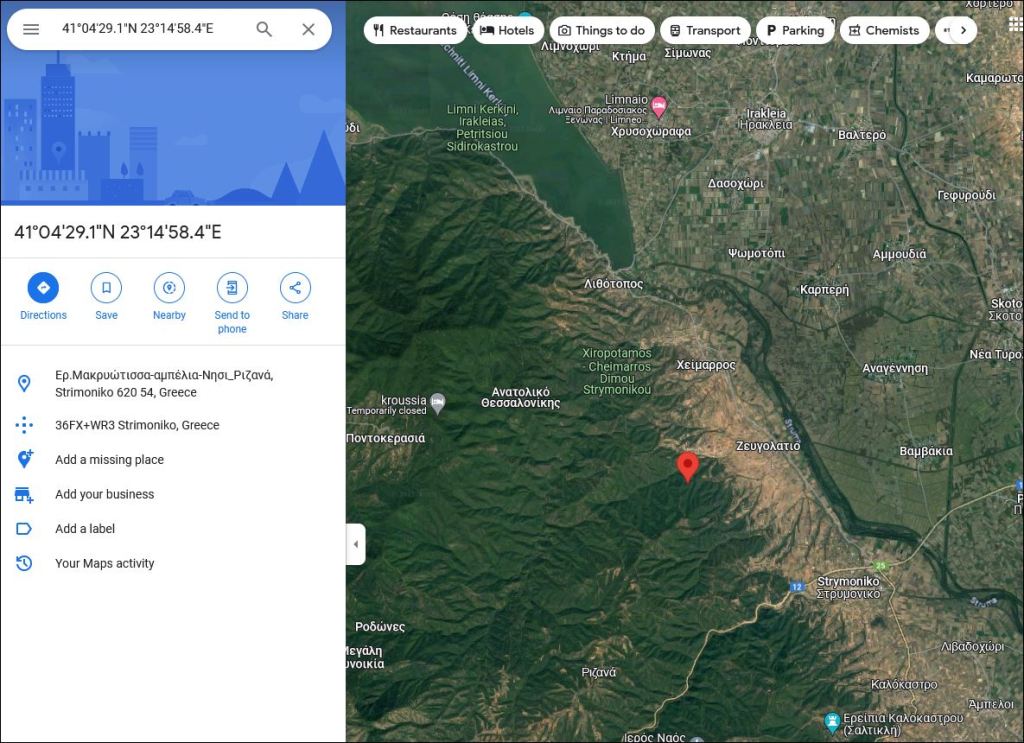
This ability to locate campaign locations in Google Maps is a remarkable innovation made possible by the research begun by Keith leading to collaboration with Professors Clifford J Mugnier and Gábor Timár.
As a result, Professor Timár presented a paper on the subject, Georeference of the Allied Trench Maps of the WW1 Salonika Front at the 16th ICA Conference, Digital Approaches to Cartographic Heritage at the Faculty of Geography, Babeş–Bolyai University, Cluj-Napoca, Romania on 22nd-24th September 2022. The co-authors of the paper are listed as Gábor Timár, Keith Edmonds, Clifford J. Mugnier.
This new file is available to all members at the SCS Members’ Area and on all future purchases of the SCS Digital Collection DVDs.
A Tale of Two Hard-to-Find Salonika Titles
Many thanks to Society member Keith Roberts for the following reviews:
As a result of working on the SCS bibliography I have arguably parted with too much money purchasing books about the campaign for myself. Some, in fact most, of the books published in the aftermath of the Great War are now both rare and expensive. Only a limited number have been reprinted but quite a few are available to download free of charge from the ‘Internet Archive‘, and a few at modest cost, as Kindle ebooks, but I’m still happier with a real book in my hands. Not long ago I came upon a couple of closely related privately-published items…
1914-1919 Memoirs of the 32nd Field Ambulance, 10th Irish Division
The first item was 1914-1919 Memoirs of the 32nd Field Ambulance, 10th Irish Division by C, (Charles), Midwinter who was a sergeant in that unit. The booklet was published in 1933 and described his time in the unit from the outbreak of war to November 1918 by which time the unit was in Palestine. The only copies that I have been able to trace are in the libraries of The Imperial War Museum, and Leeds University.
The content is a well-written narrative describing the unit’s experiences, from formation, via Gallipoli and Macedonia to Palestine. After the introductory pages and the unit’s experience of the Gallipoli campaign, the author describes their part in the Salonika Campaign in pages 40-56.The text names some members of the unit, and draws frequently upon the recollections of Sgt Midwinter. 32 FA, a Territorial unit, landed in Salonika on 10 October 1915 and, after a short interval, deployed behind the positions held by part of the 10th Irish Division at Kosturino. Subsequently they occupied a number of locations during the remainder of their time in Salonika, before moving to Egypt and Palestine in late 1917. Written by a soldier rather than a medically qualified individual the narrative has little to say about the medical part of the unit’s work, describing rather their movements, and locations.
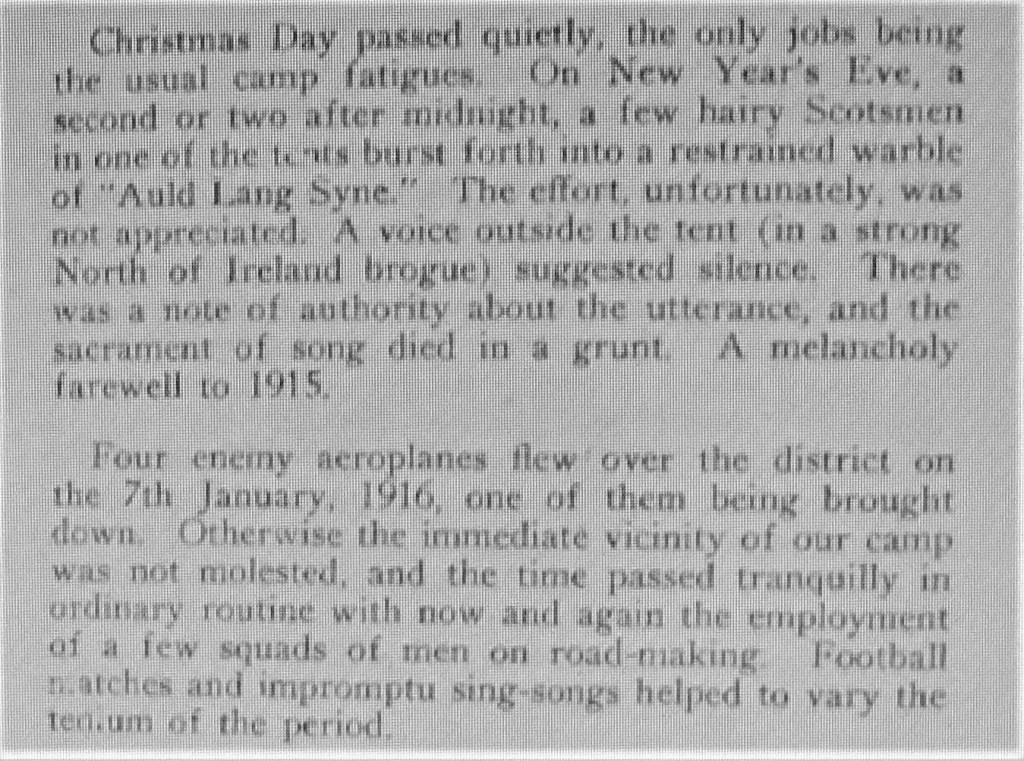
December 1915/January 1916
The Badge of Honour
The second booklet, which I stumbled upon more recently, is The Badge of Honour edited by Godfrey A Gill, who published three other booklets on Cornish subjects. This is another privately published work, printed in 2015. It is well presented with a small number of photographs. This book is very different, and is built entirely around a transcription of the diary kept by a Plymouth man, Private Tom Wherly describing his personal experience of service in 32nd. Field Ambulance.
The style is quite different, being a record of his diary entries (with some gaps), from his enlistment until 11 September 1918. It records some of his experience at various locations, the weather, his ailments and his food, the things that he thought his family might like to know about as it is made clear that he wrote these comments for the benefit of his family. They were identified in this new century by a family member and after some time this volume emerged in 2015. There are few comments about military events as a result of which the editor inserted several appendices in which he addressed the background and current events of the time. The editor is not a military historian, but his comments are generally well founded, apart from referring to the ‘Field Ambulance Corps’ rather than to the Royal Army Medical Corps.
The descriptions of Tom Wherly’s life, especially while serving in the Salonika theatre of war give an interesting perspective of the thoughts and experience of a man serving in a non-combat role in a very human way, describing the aspects of his military life that he thought would give the best description of his experience. As such it is a very human document, and enables the reader to get a sense of the daily life of one of the many members of the BSF whose service was essential, but entirely behind the front lines.
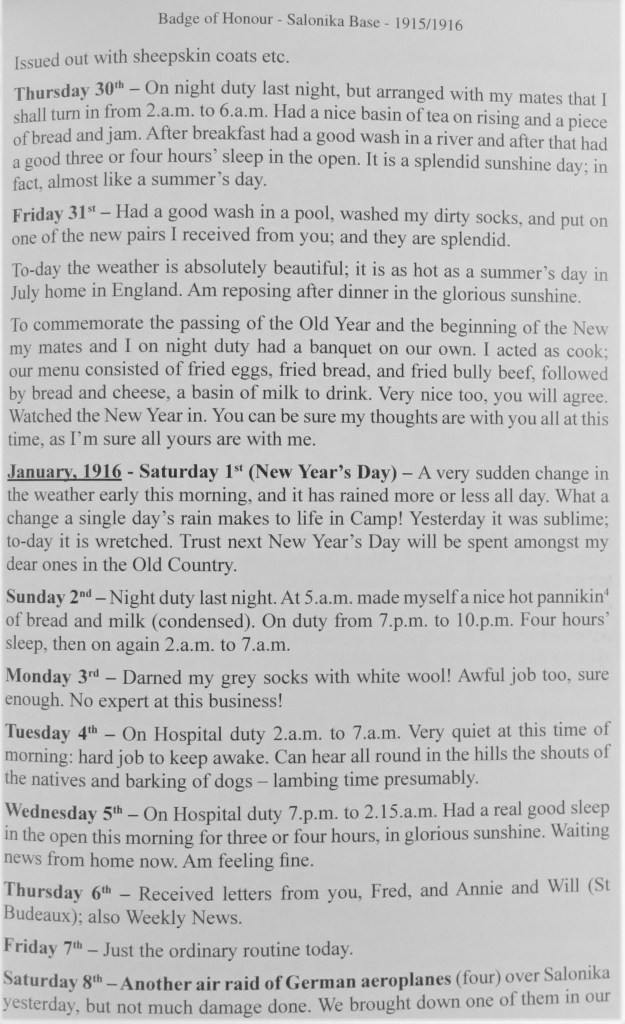
also December 1915-January 1916
The Badge of Honour is nicely printed with stiff card boards and glossy paper and a small number of photographs. There are 106 pages but the editor is responsible for a number with his explanatory appendices and notes. I have discovered that just 18 original copies of The Badge of Honour are still available at the original price of £7.95 plus postage. I plan to purchase a small number for friends I will be meeting either during our next tour in September, or at the AGM October 2023. The remainder can be purchased from The Mayflower Studio, Fore Street, East Looe PL13 1AE, email at mayflower.looe@btconnect.com
Two tales of two men
Both men received the 1915 Star, in addition to the Victory and the British War Medal. Beyond his medal record almost all we know about Charles Midwinter is that he started the war as a private, and ended a sergeant.
We know quite a lot more about Samuel Thomas Pawley Wherly, because this diary was in the hands of his descendants, and some of his army records survived the 1940 bombing of Arnside Street. Like Charles Midwinter, he joined up at the beginning of the war, and his service was continuous from 28 October 1914 until 13 May 1919 when he was discharged as no longer fit for war service. His attestation form states that he has four years previous experience as a volunteer with the Devon Royal Garrison Artillery. Like many others he was issued with the (Silver) War Badge and the few surviving pages of his service record show that he served for four years and 198 days before his discharge in 1919, and that he was discharged with a 50% degree of disability on the grounds of Melancholia with a pension of 13s 9d weekly to be reviewed after 52 weeks. His role in the RAMC is described as “Nursing Duty Orderly”.
Keith Roberts
A little bit of Salonika in … Brussels
Taking advantage of a Eurostar ticket sale, Mrs B and I recently enjoyed a jaunt to Belgium, with a few days in Brussels and a few in Ieper (Ypres). Our last night found us in a hotel close to Bruxelles-Midi (Zuid) station, where we would be taking the Eurostar home the next day, and where we had ended our train journey from Ieper (train from Poperinge, changing at Gent-Sint-Pieters for Brussels).
Continue reading “A little bit of Salonika in … Brussels”New Book Out Today!
You may recall that back in September I alerted you to the promised publication of a new book about the Macedonian campaign, written by Jon Lewis and published by Helion & Company. I am pleased to say that, since then, I have been in touch with Jon who is a member of the Society. Jon tells me that the book is being released today. We congratulate him on the culmination of many years of research and hard work and wish him well with the book.
Continue reading “New Book Out Today!” Salonika Campaign Society, 1915-1918