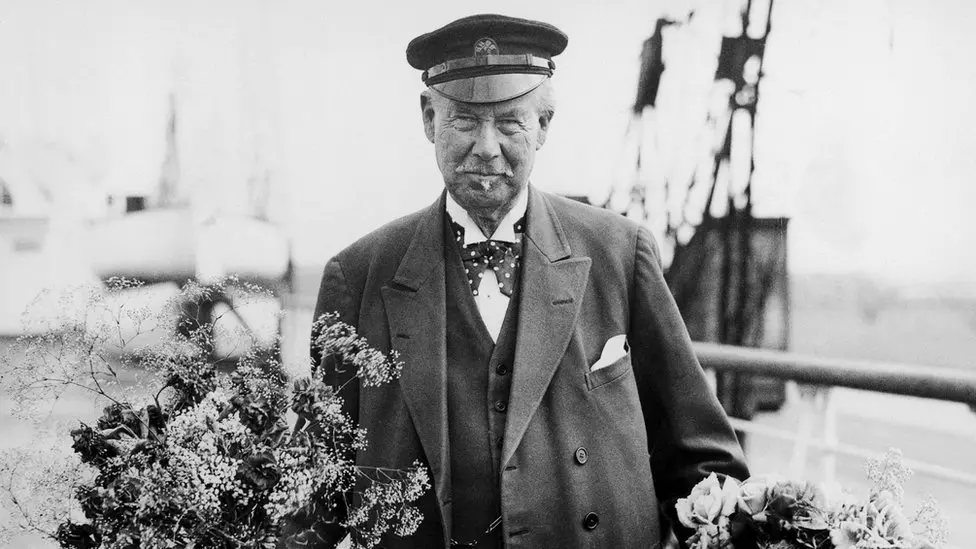
Sir Thomas Lipton (1848–1931) was a Scottish businessman and philanthropist best known for founding the Lipton tea company, which became one of the largest tea brands in the world. He was also a noted sportsman, famously competing in the America’s Cup yacht races several times, and made significant contributions to charity and education throughout his life.
During World War I, Lipton visited Serbia to offer humanitarian aid, moved by the suffering caused by the conflict. Recognizing the dire need for medical support, he donated substantial funds and medical supplies to assist Serbian soldiers and civilians, especially during the devastating 1915 retreat. His efforts helped establish field hospitals and provided relief to those affected by both the war and the widespread disease in the region.
This remarkable, and to me at least, largely forgotten story will be told with much more skill and knowledge by Colonel (Retd) Nick Ilic in a free online talk this week. As Nick explains, “It is a fascinating story and I’ve assembled a large number of photographs to try and bring it to life.”
The talk is on 11 February at 7pm and should last about an hour. You can join via this link:
As is customary on the first Saturday after the anniversary of the Bulgarian armistice (30 September 1918), SCS members and friends gathered at the Cenotaph in Whitehall on Saturday 5 October to lay a wreath and remember the dead of the British Salonika Force.
My thanks go to David Jenkins who – rather longer ago than I am prepared to admit – shared the story of his grandfather, along with some fascinating photos.
Samuel Jenkins enlisted in the 6th (Service Battalion), Royal Inniskilling Fusiliers on 1 September 1914, the Battalion having been raised in Omagh during the previous month. Samuel’s service with The Skins is a little hazy, but we know he sailed from Liverpool in early July with the rest of 10th (Irish) Division, with his overseas service commencing with his disembarkation on 11 July 1915, probably on Lemnos. One (!) of his National Archive medal index cards give this date with the note ‘(2B) Balkans’, meaning ‘Balkan Theatre – Gallipoli and Aegean Islands’. This made him eligible for the 1914/15 Star. Four weeks later, the Division landed at Suvla Bay, Gallipoli.
Although women who had served in Salonika – in whatever capacity – were eligible to join the SRA from the very start, they didn’t gain their own specific section in The Mosquito until September 1931 (issue 15), with Eileen Moore’s ‘Woman’s Page’. Later, this was expanded to ‘Women’s Pages’ and continued for the rest of The Mosquito’s long existence. So it was only right and proper that the final issue in May 1969 – a longer, glossier souvenir album, entitled Salonika Memories 1915-1919 – included it’s own ‘Women’s Pages’. By now this was edited by Miss N. M. Simcox. In her final editorial, she had this to say:
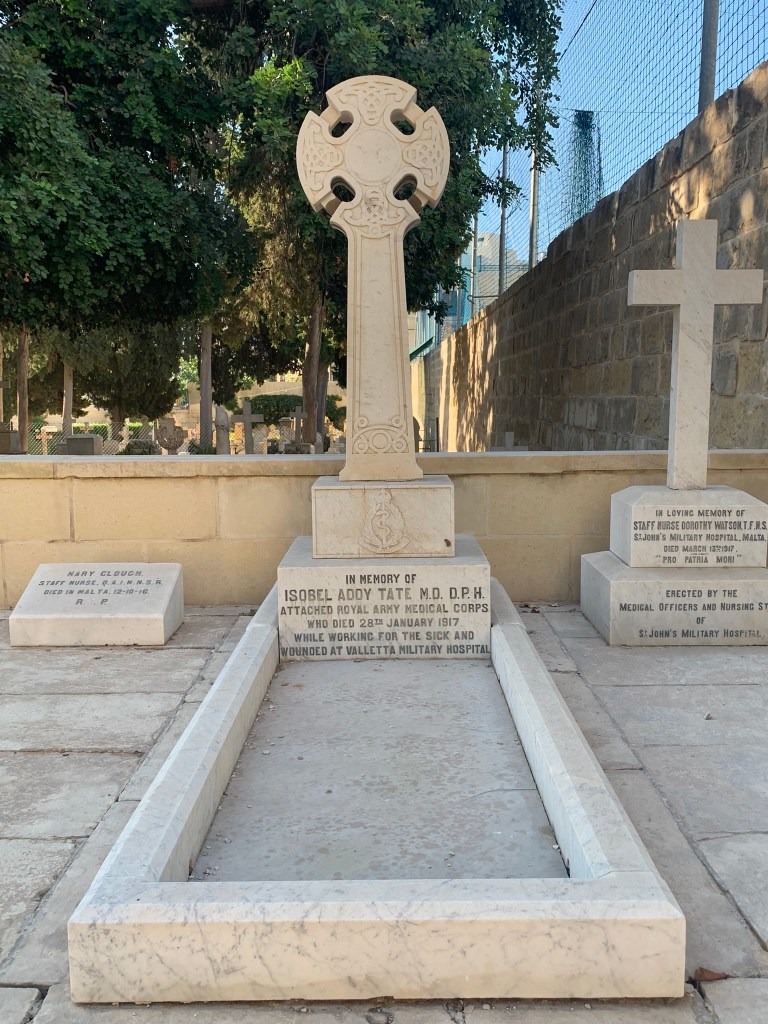
‘X’ (formerly Twitter) is not a favourite medium of mine but it can, in some circumstances, be an informative and interesting forum. In the past year the Society has set up an account and we have managed to both share and learn from this online community. For example, in a series of posts, @DanielJPhelan (Speaker, tour guide, & EOHO volunteer for @CWGC) shared a thread about a discovery while on holiday in Malta. During his stay, Dan visited Pieta Military Cemetery and it was there that he found the grave of Dr Isobel Tate.
On his return home, Dan researched and shared his findings in a series of posts and images on X (Twitter). Thanks Dan for sharing your research!
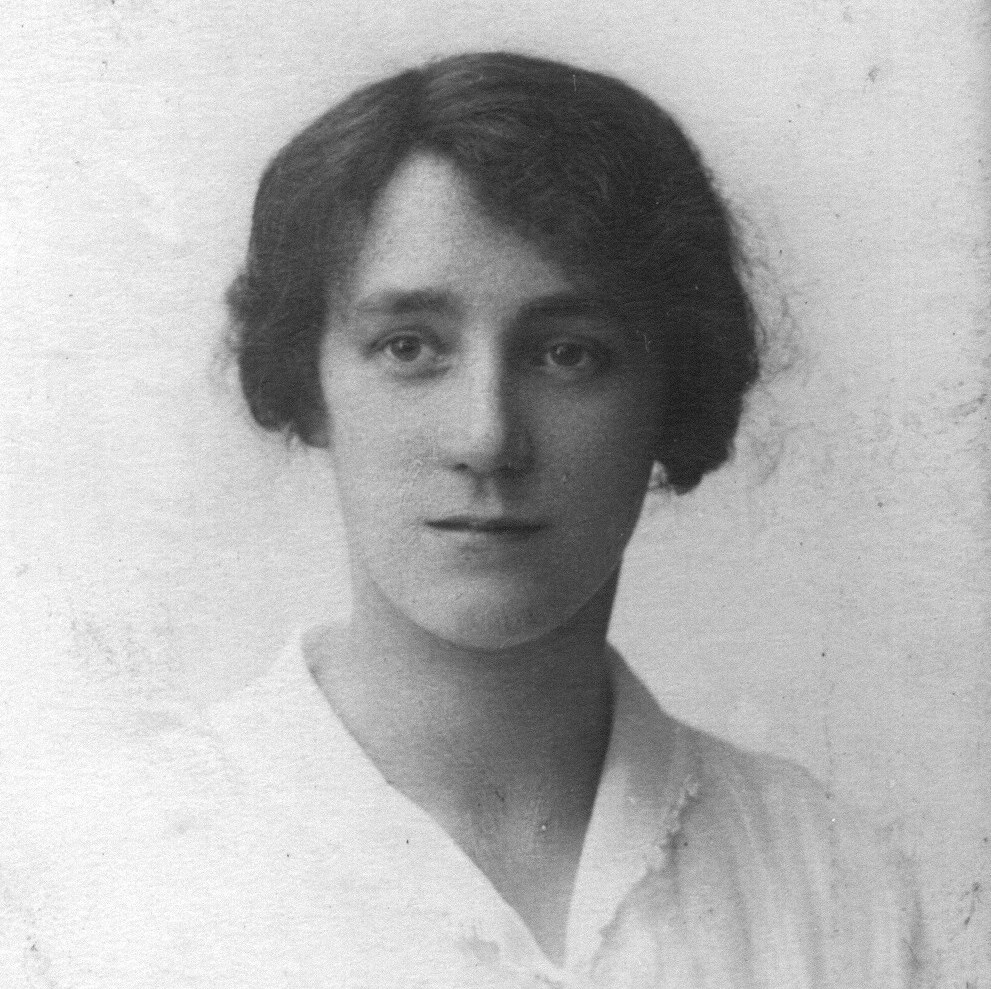
“Isobel Addey Tate was born, around 1874, in Country Armagh, Northern Ireland. At a time when female doctors were rare, she studied medicine at Queens University, Belfast graduating in 1899. Continuing her studies, she qualified as a Doctor of Medicine in 1902.
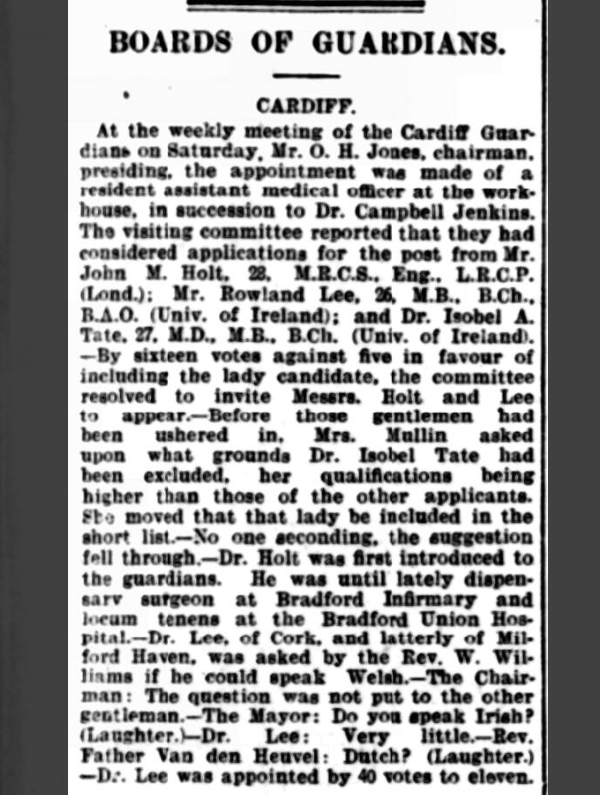
After qualifying, a huge achievement, she moved to England and held a number of positions in hospitals and medical institutions. However, it seems pursuing her career in medicine was not easy…
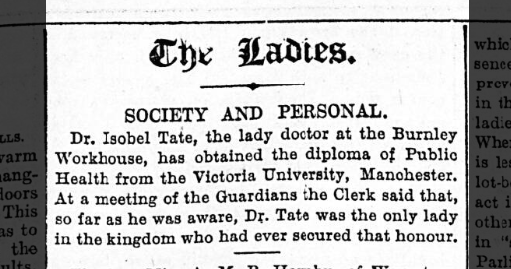
In 1904, while working at the Burnley Workhouse, Dr Tate obtained a Diploma in Public Health from Victoria University, Manchester. It was thought at the time that Dr Tate was the only lady in the kingdom who had ever secured that honour.
In 1915, with the Great War being fought, Dr Tate volunteered to serve with the Serbian Relief Fund. The relief fund was set up and commanded by Mrs Mabel St Clair Stobart. It had seven women surgeons and doctors, which included Dr Tate.
While serving with the Serbian Relief Fund, Dr Tate contracted typhoid and returned home to convalesce. Once well again she became a radiographer at Graylingwell War Hospital, near Chichester. Feeling she ‘was not doing enough’ Dr Tate offered to go abroad again.
Isobel Tate volunteered for service with RAMC and embarked for Malta in August 1916. In Malta she treated sick and wounded servicemen, including casualties from Gallipoli and Salonika. While working at Valletta Military Hospital she became ill. Sadly, on 28th January 1917, Dr Isobel Tate succumb to her illness and died of typhoid fever.
The funeral of Dr Isobel Tate took place on Tuesday 30th January 1917. Her flag-draped coffin was carried by medical officers, flanked by two lines of wreath carrying NCOs from the RAMC. The firing party contained 40 men of the Royal Garrison Artillery. A lengthy train of medical officers, officers from other units, and local members of the medical profession followed her coffin. At the graveside assembled ‘lady doctors’, principal matron, matrons, sisters, and nurses, from all hospitals and camps on the island.
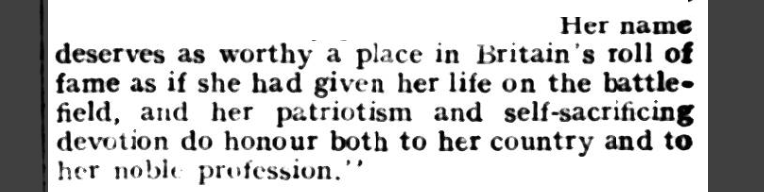
It’s incredible to think that Isobel Addey Tate lived, served, and achieved so much, in an era before women even had the vote. I think this quote from a newspaper at the time is very fitting.”
You can read the complete thread from Dan on Twitter @DanielJPhelan:
While on holiday in Malta I came across an interesting war grave at the @CWGC's Pieta Military Cemetery. The grave belongs to a trailblazing #WW1 female doctor. Below is a short thread on the remarkable and life service of Dr Isobel Tate… 1/🧵 pic.twitter.com/P8MjB4OEI7
The nature of ‘social media’ does not really allow for detail and detailed discussion, so Dan’s account of Isobel Tate’s life is necessarily short. If you would like to read more about her life, and the challenges she and other women faced, there is a more in-depth examination here.
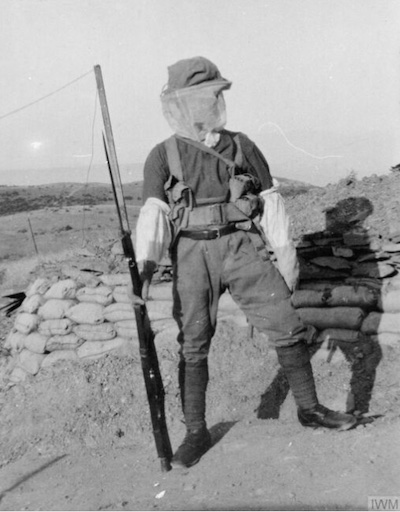
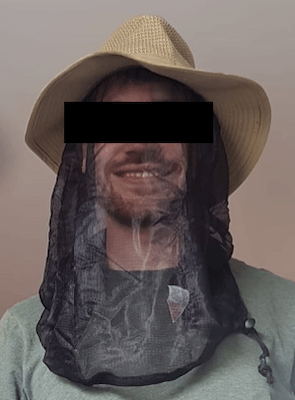
With family members heading off to tropical climes, I was quick to share my ‘specialist knowledge’ of anti-mosquito precautions – based entirely on reading about the BSF – and shared this splendid photo with the travellers:
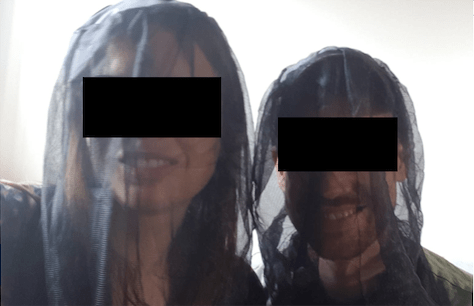
I’m not sure how impressed they were, but I thought it gave an excellent impression of the precautions to take. So I was especially pleased to see anti-mosquito face veils at a reasonable price in a well-known hiking and outdoors shop and promptly bought one for each member of the party. I have seen them in use, although this was in the UK and – I suspect – more to humour me than a serious indication of an intention to wear them in foreign parts.
Just think how chuffed members of the BSF would have been to have these – they even look great with a slouch hat …
(of course, in proper use the veil should be tucked in at the neck!)
Well, they are on their travels and I don’t like to ask if they’ve used them yet, but I will be looking out for traces of mosquito bites on their faces when they return!
If you are travelling this summer, I hope you manage to avoid mosquitoes and midges. If not, maybe you should invest in one of these veils as a practical tribute to the BSF!
The ‘Ninth Annual Memorial Service for Women in Foreign Medical Missions in the Great War’ takes place on Saturday 18th February 2023.
The event takes from 11:00 -14:30 at the Serbian Orthodox Church of St Sava 89 Lancaster Rd, London W11 1QQ with speakers Colonel Nick Ilic, the former British Defence Attaché in the Embassy in Belgrade, and Zvezdana Popovic.
11.00 – Memorial Service in The Serbian Orthodox Church of St Sava
13.00 -14.30 – Refreshments and Talk in the Bishop Nikolaj Community Centre
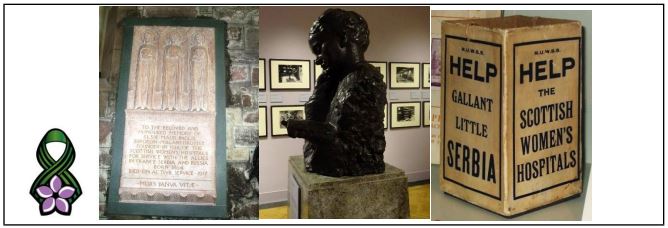
The occasion will also feature a talk about the legacy of Dr Elsie Inglis, Scottish Women’s Hospitals and women in other foreign medical missions in Serbia, Corfu, Vido and the Salonika Front after the death of Dr Inglis.
If you would like to attend, RSVP via: info@serbiancouncil.org.uk
According to one contemporary writer, Malta “…assumed the role of nurse, and her breakwaters seem like arms stretched out to receive her burden of suffering. Once the hospital ship has passed within their shelter the rolling ceases, and the wounded feel that they have reached a haven of rest.” So wrote the Rev. Albert MacKinnon in 1916 in “Malta: The Nurse of the Mediterranean” – an early reference to the soubriquet by which the island came to be known during the First World War.
As the war in France began to grind into stalemate, other fronts opened in the Dardenelles and Gallipoli, with disastrous consequences for the allied forces. The scale of casualties was unprecedented and required an urgent response,
“That Malta should become the home of one of the British Empire’s largest systems of war hospitals was not anticipated in the early months of the war. It was not until May 1915 that the first badly wounded casualties from the Gallipoli campaign started to pour into Malta. The first convoy of 600 patients arrived on May 4, followed by a further 400 a day later, and on May 6 another 600 cases were brought ashore. Before the end of May, upward of 4,000 casualties from the Gallipoli campaign had reached Malta…The end of May saw the number of hospital beds catering for the sick and injured rise to over 6,000 in 14 hospitals spread all over the island.” Source: Times of Malta
In Salonika, a hostile climate and serious illness – mainly malaria – were the principle cause of casualties. Malta again provided an immediate solution,
“After January 1916, the number of sick and wounded fell very considerably with the scaling down of the Gallipoli campaign, only to rise again with a vengeance in the summer of 1916, as the Salonika campaign proceeded. However, the number of hospital beds remained in the region of 25,000, and reached a maximum of 25,522 housed in 27 hospitals by April 1917. The number of sick patients, suffering mainly from “dysentery and enteric group of diseases”, always exceeded the number admitted with war wounds. With the end of the Gallipoli campaign and the start of the Salonika campaign in October 1915, this trend in admissions became even more marked as a result of a rush of malaria cases from Salonika. Up until April 30, 1917, Cottonera, a mixed hospital catering for both the sick and injured, received 2,867 sick but only 308 wounded.” Source: Times of Malta
Malta’s strategic location in the Mediterranean – and its history as a British Protectorate – made it an important naval base for the British and, together with its climate, also an important place of rest and healing. But it was also hundreds of miles from Salonika and by April 1917, increasing submarine attacks on hospital ships made it unsafe to continue evacuating casualties to Malta from Salonica. Five General Hospitals, Nos 61, 62, 63, 64 and 65 were therefore mobilized at Malta for duty in Salonica, arriving on 11 July 1917. Malta’s role as the ‘nurse of the Mediterranean’ had, effectively, ended. Source: MaltaRAMC
We all know that malaria was a terrible scourge of the BSF during the Macedonian campaign. It says something for the tricksy nature of the disease that it has taken over one hundred years for a reliable vaccine to be developed – and it still needs to be approved and manufactured:


 Salonika Campaign Society, 1915-1918