Tales from the Battlefields

Tales from the Battlefields is a free podcast from battlefield guide and researcher Terry Whenham. It focuses on “the unheard stories of men who served on the Western Front during World War 1.”

However, in Episode 68 of the podcast, Terry interviews Chris Loader who travelled with the Society on the SCS Battlefield Tour in September this year. Chris describes the background to the campaign and his visit to the location where his two-times grandfather on his father’s side, Private Henry Loader of the 10th Hampshire’s, was mortally wounded in September 1918. I listened with a lot of interest to the story of Henry – and Chris’s research and visit – and I’m sure you will find it a worthwhile use of your time too. In my humble opinion of course!

You can listen to the podcast for free on Apple, Amazon Music, Spotify and directly from this page.

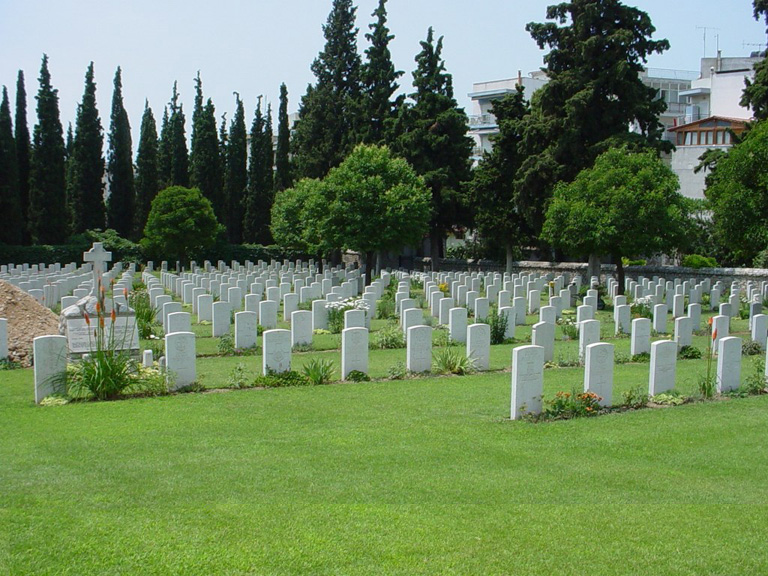
Lembet Road Cemetery – final resting place of Henry Loader. Image from CWGC

Happy Saint Andrew’s Day!

Having marked the national days of England, Wales and Ireland over the past year, I could hardly ignore Scotland. Having done one of those family history DNA tests, I was very disappointed to find no trace of Scottish ancestry – 16% Welsh was something of a surprise – so my only claim to Scottish heritage is my great-grandfather from East London who served for 12 years with the Cameronians (Scottish Rifles) in India and South Africa at the end of the 19th century. Was it the allure of the tartan trews? Anyway, I wish all our Scottish members, friends and visitors a very happy Saint Andrews day.

Continue reading “Happy Saint Andrew’s Day!”

General Milne’s first few months…

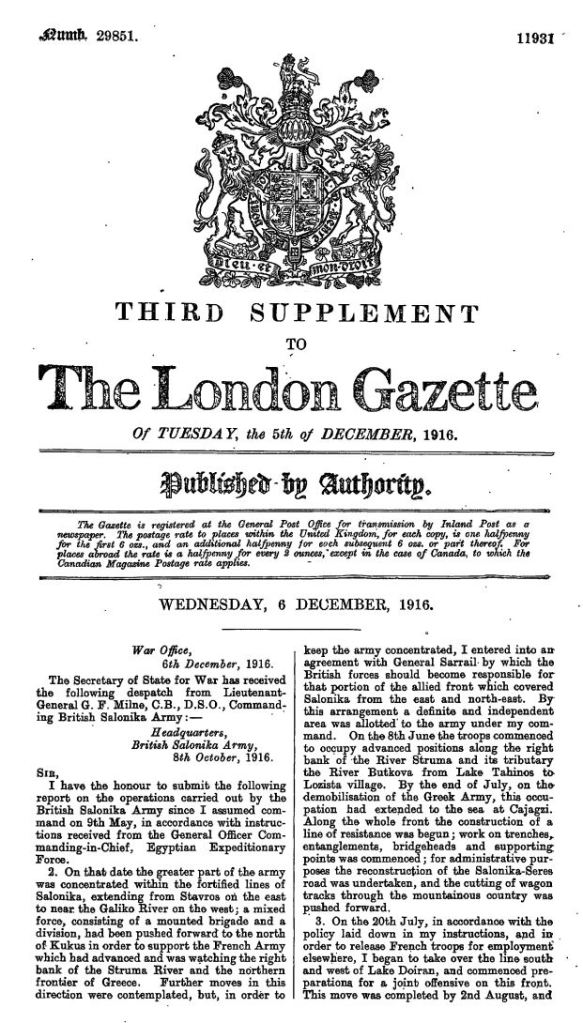
On this day, May 9th 1916, Lieutenant General George Francis Milne succeeded Lieut-General Bryan Mahon to become overall Commander-in-Chief of British Troops in Macedonia. Five months later, in October 1916, Milne submitted a report (published in The London Gazette of December 6th) summarising “the operations carried out by the British Salonika Army since I assumed command.”

To begin with, Milne states, “…in order to keep the army concentrated, I entered into an agreement with General Sarrail [French general and overall commander of the Allied forces in Salonika] by which the British forces should become responsible for that portion of the allied front which covered Salonika from the east and north-east. By this arrangement a definite and independent area was allotted to the army under my command.”

It’s interesting to read primary sources such as this against a wider background of historical perspective and analysis. In, ‘Under the Devil’s Eye’ Alan Wakefield and Simon Moody provide the context for Milne’s comments, “The new British commander was soon tested by the Frenchman’s brinkmanship when Sarrail stated that he had orders from Paris to launch an offensive and was prepared to do so with or without British assistance. Milne realised that, with his forward troops in close contact with the French, the BSF would either be dragged into an attack, which was beyond his operational remit, or, by holding back, risk accusations of failing to support an ally. He skilfully sidestepped the issue by asking for a separate British zone of operation… Sarrail agreed to the proposal and at a stroke Milne had disengaged his troops from the French.”

That analysis gives another layer of understanding to Milne’s report of how, “…in accordance with the policy laid down in my instructions, and in order to release French troops for employment elsewhere, I began to take over the line south and west of Lake Doiran…” and explains how actions in the area made it possible, “to shorten considerably the allied line between Doiran Lake and the River Vardar and on 29th August, in agreement with General Sarrail, I extended my front as far as the left bank of the river so as to set free more troops for his offensive operations.”

Politics aside, the rest of Milne’s report is a readable account of the first few months of his command in which he gives credit to the sections of his command and the men – and women – involved in the British side of the campaign.

You can download and read Milne’s entire report here. ‘Under the Devil’s Eye’ is available here.


Featured image, General Sarrail, commander of Allied forces in Macedonia (16 January 1916 – 22 December 1917), with General Sir George Milne, commander of the British Salonika Force from 9 May 1916. Source, IWM


It’s St George’s Day!

Having celebrated the Welsh battalions of the BSF on St David’s Day and the Irish ones on St Patrick’s Day, how should I mark St George’s Day? I feel writers’ cramp coming on just thinking about typing out the names of the 52 or so English battalions of the BSF (see NM 11, April 2005) so, instead, will go for an easier option. The Royal Regiment of Fusiliers was formed on 23 April 1968, celebrates St George’s Day and, indeed, has an image of St George slaying the dragon on its cap badge. It was created by amalgamating four English fusilier regiments: Royal Northumberland Fusiliers, Royal Warwickshire Fusiliers, Royal Fusiliers (City of London Regiment) and Lancashire Fusiliers. Three of these regiments provided battalions for the BSF.

Continue reading “It’s St George’s Day!”

Rough Riders Remembered

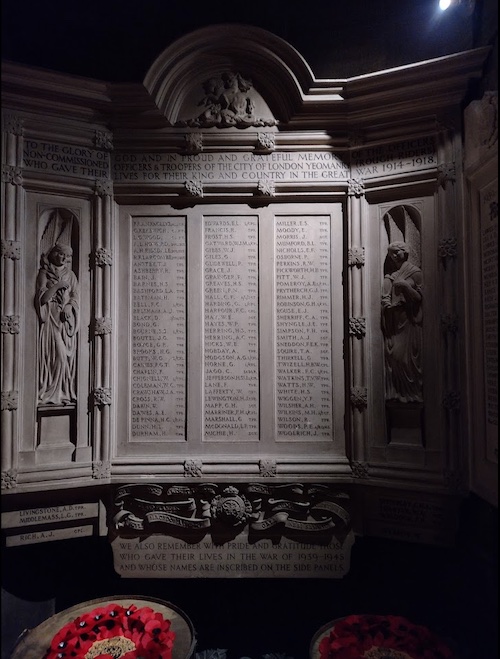
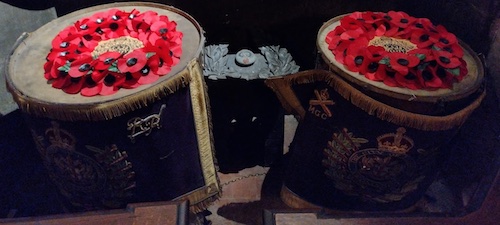
Whilst in London recently we were passing through Smithfield on our way to St Paul’s, when I came across a hidden church: St Bartholomew the Great. It was open so we couldn’t resist going in for a nosey around and I’m very glad we did. It was especially atmospheric as it had some lighting on (it was going dark outside), a choir was practising for a concert and I’m sure there was a lingering smell of incense. With a long history – founded in 1123 – there is much of interest inside, but the item that especially caught my eye was comparatively recent: a memorial to the fallen of the City of London Yeomanry (Rough Riders) in the world wars.

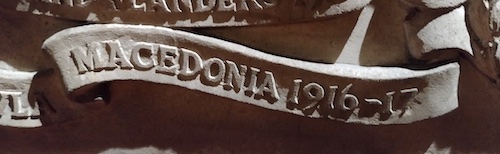
One of the Regiment’s battle honours is ‘Macedonia 1916-17’.

1/1st City of London Yeomanry (Rough Riders) arrived in Salonika from Egypt – having earlier been in Gallipoli – in November 1916 as part of 8th Mounted Brigade. Its sojourn in Macedonia was relatively brief and the Brigade returned to Egypt in June 1917, where it became part of the Yeomanry Mounted Division which took part in the campaign in Palestine. In mid-1918 the Regiment moved to France as part of the Machine Gun Corps.

These are most of the dead from the First World War – several more are on a side panels:

According to the CWGC website, just five are buried in Greece. All are described as ‘died’, which suggests to me that the cause was disease or accident, but I know that’s not conclusive. From the dates of death, just one of the casualties is from the time the Regiment spent in Macedonia:

Two are casualties from the Gallipoli campaign, buried on the island of Lemnos

Just one is from the regiment’s time in Macedonia:

The other two died after the regiment left for Egypt, so stayed on in Macedonia for some reason:

Water for man and beast: a typical scene in Salonika. An illustration dated 1917 from one of the many part works of the period, showing British Yeomanry watering their horses at a fountain in the city.
‘Water for man and beast: a typical scene in Salonika’. An illustration dated 1917 showing Yeomanry in Salonika from one of the many part works of the period.

To find out more, please visit:

Directory of WW1 Websites


Canada’s contribution to the First World War cannot be underestimated. More than 650,000 Canadians and Newfoundlanders served in the war with 66,000 killed and over 172,000 wounded. Such was the contribution, Canada had its own signature on the Treaty of Versailles. In Salonika, Canadian medical services provided care at Nos. 4 and 5 General Hospitals, and Nos. 1 and 3 Stationary Hospitals (see this earlier post).  It’s of no surprise therefore that Canadians continue to research this significant period of their history.

One such research group is the CEF Study Group – an Internet discussion forum for the study, sharing of information and discussion related to the Canadian Expeditionary Force (CEF) in the Great War.

The CEF Study Group has just published its 2022 ‘List of Recommended Great War Websites’. Our own site is included among a directory of 2000+ websites, grouped into 31 logical sections. We are described thus: “This very detailed and multi-layered Blog site has numerous theme ‘buttons’ which take the reader deeper into the topic. Site is mature and very well organized.” (A recognition of former editor Robin Braysher’s work, I should add).

Readers may well find this a useful resource for research. The directory can be downloaded here.