
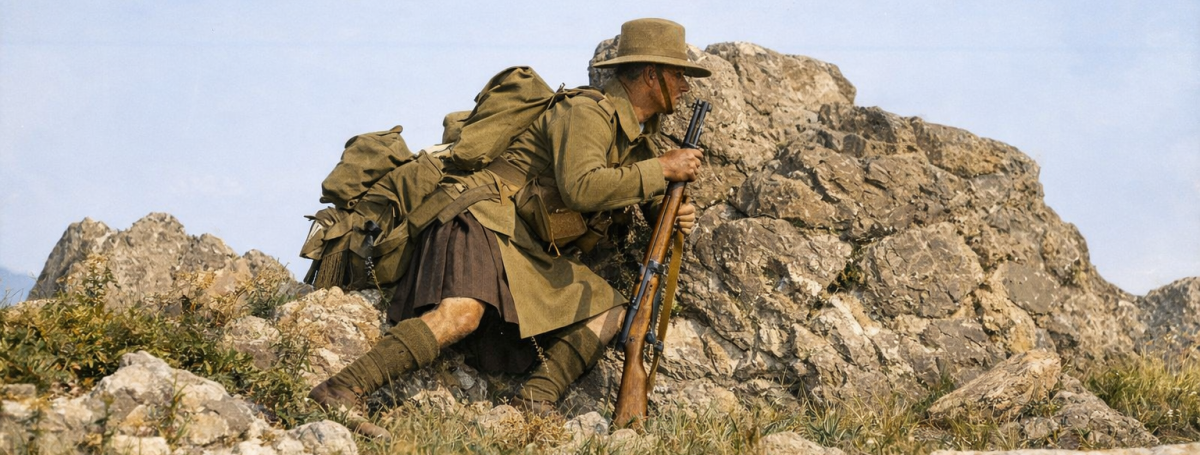
Searching for information recently about nursing in Salonika, I stumbled across Mettle and Steel: the AANS in Salonika. It’s an account of the punishing nature of Australian military nursing in Salonika. From 1917, Australian nurses were sent into this difficult and unfamiliar theatre of war to relieve the British, French and Canadian nurses and to provide nursing care to British soldiers and prisoners of war. As nursing ‘our boys’ was a major motivation for overseas service, it was something of a disappointment for many that they could not nurse Australian soldiers.
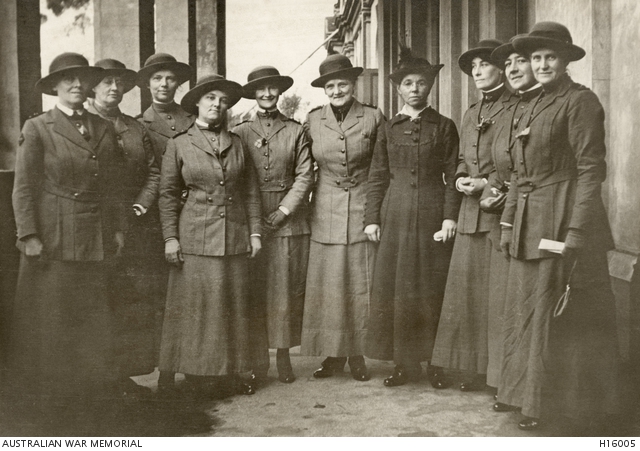
A group of Australian Army nurses about to depart from Adelaide for Salonica, 14 June 1917. From the left: Miss Molly Wilson, Mrs J. Tyers, Miss Edith Horton, Miss Marion Geddes, Miss Laura Begley, Mrs Jessie McHardie White (Principal Matron), Mrs Forsyth (wife of General Forsyth), Miss Violet Mills (Matron of No 5 Australian General Hospital who was on a visit to Adelaide), Miss Alice Prichard and Miss Florence G. Gregson.
I hadn’t quite appreciated the scale and complexity of the Australian nursing presence: four contingents were dispatched via Egypt, under constant U-boat threat, and then distributed across a shifting network of British hospitals in Greece and the surrounding hills. Each unit was allocated one Matron, ten AANS Sisters and eighty Staff Nurses. The nurses were led by senior matrons such as Jessie McHardie White, who oversaw not only clinical standards but the welfare and morale of hundreds of nurses. Staff Nurse Lucy May’s personal account helps convey the experience of Salonika in winter:
[12 October 1917] Water racing thru wards & reached halfway up bedsteads, haversacks, boots, socks, pants floating down road…
[21 October] Lanterns blowing out & leaving you in dark…
[23 October] Still don weather attire, only wearing men’s pyjama pants, putties, gum boots, man’s shirt also. Had dress tucked around waist all night…
[2 November] Imagine me [on night duty] over my ankles in mud, dragging one foot out then other foot & standing on one leg in grim peril or sitting down hastily…feeling the rain oozing through my mack. This is the life?”
As winter ended, the nurses then faced oppressive summers dominated by malaria. The AANS uniform was adapted in an attempt to counter the mosquito risk. A ‘mosquito proof’ nurse would be clad in her working dress, huge gloves, rubber boots and thick veil which, according to Lucy Tydvil Armstrong:
“made it quite impossible to carry out our duties, when men were rigoring and vomiting all night long, we just had to do away with the precautions, & run the risk of being bitten with mosquitos.”

A group of Australian Army Nursing Service nurses at the 52nd British General Hospital at Kalamaria, Greece ready for night duty wearing headdress provided for protection against mosquitoes. C 1918.
Despite the precautions, Matron McHardie White later reported that, ‘most of the nurses were affected by it [malaria] one time or another…’ By August 1918 45 nurses had been sent back to Australia from Salonika and another 14 were waiting to go, mostly on grounds of ill health. The death of Sister Gertrude Evelyn Munro in 1918 underlines the very real cost of the AANS service.
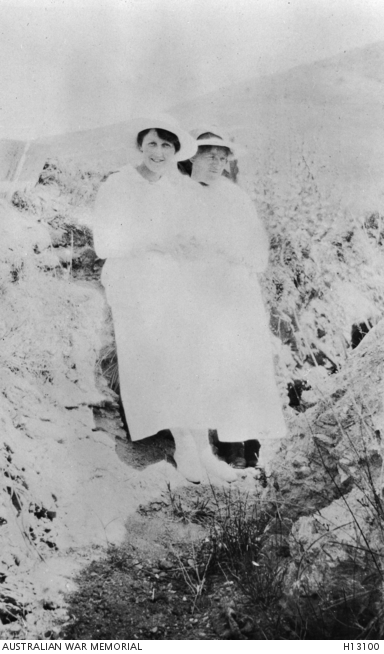
Sisters Gertrude Evelyn Munro and Amy Christie of the AANS. The photograph was probably taken at the 60th British General Hospital, Salonica.
Despite deteriorating health and official doubts about the value of their continued presence, the nurses remained in Salonika until after the war ended, not returning home until early in 1919. Their courage and professionalism were acknowledged through praise and decorations from British, Serbian and Greek authorities. Matron McHardie White, as just one example, was awarded the Serbian decoration of the Order of St Sava and was made a Member of the British Empire.
Nurses’ Narratives
It’s always interesting to read first-hand accounts of experience and so it was good to see that some diary and retrospective narratives written by the AANS nurses have been, and are being, transcribed. Staff Nurse Vivian A Lee Shea, for example, recalled,
We arrived in the midst of summer & the height of the Malaria & Dysentry season, & work commenced right away. We had much to learn. We were all new to each others ways & the medical Staff & personnel had only just landed as we ourselves had.
The Hospital was rather well situated at an elevation of about 2000 ft above sea level & this gave us a cooler summer, but made it impossible to live there in the winter months. During the winter months we occupied the Prisoners of War Hospital in the Base area. Here we nursed British Troops, as well as prisoners of War, the latter were representatives from practically every one of the Baltic States. Germans Bulgars, Turks, Romanians, Greeks Albanians & Serbs, in fact any one found in enemy lines.
Annie E Major-West remembered,
We remained in Salonika till February 1919, during the whole time the work was very heavy at times the hours on duty were particularly long. these conditions were occasioned by the prevalence of Sickness amongst the Sisters and Medical Officers.
Frequently the Bulgars & Germans were over in Planes endeavouring to bomb
the Town but the Vicinity of the Hospital was never damaged, during the Month
of August 1917 the town was partially destroyed by fire, Supposed to have
been the work of Spies.
- Read the full article Mettle and Steel: the AANS in Salonika.
- Search for first hand accounts here: https://transcribe.awm.gov.au/transcription
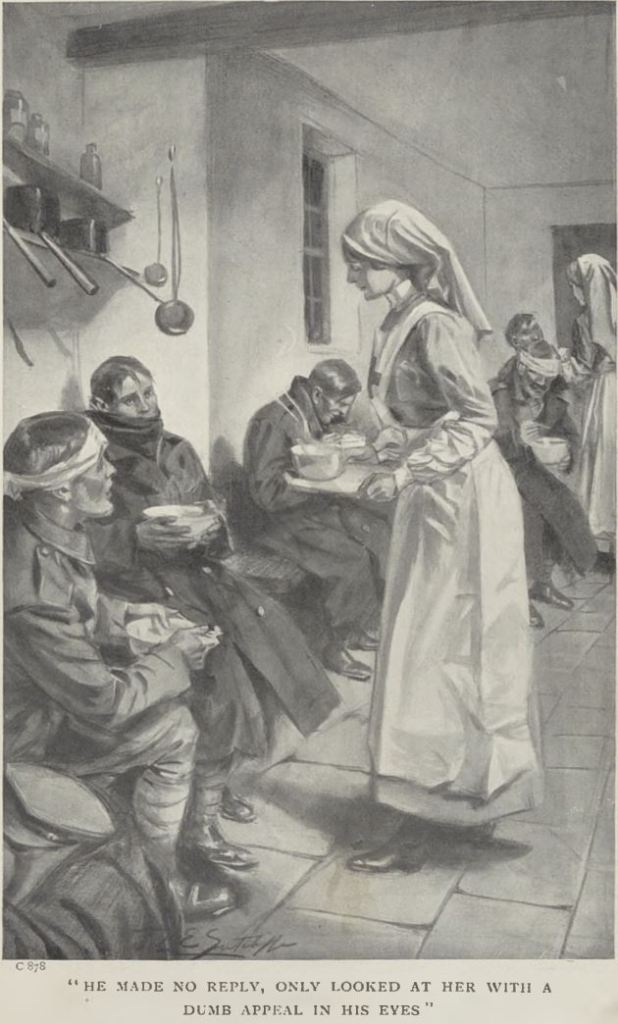
 Salonika Campaign Society, 1915-1918