And earlier in the year, Jake also explained the background to the Salonika Campaign for Redcoat History.
*Dr Jake Gasson is a National Army Museum Fellow based at King’s College London, where he is a postdoctoral researcher. He obtained a DPhil from Pembroke College, Oxford, specialising in the Macedonian front of the First World War.
The ‘Artillery & Small Operations’ Tour – Sunday 21 to Tuesday 30 September 2025
Explore the key locations of the British Salonika Force during the 2025 battlefield tour, with a special focus on artillery and the small-scale but intense operations that defined the campaign—raids, ambushes, and offensive patrols.
At Doiran, we’ll examine the crucial role of both British and Bulgarian artillery during the First and Second Battles of Doiran. On the Kosturino battlefield, we’ll revisit the desperate December 1915 fighting of the 10th (Irish) Division. In the Struma Valley, we’ll explore the sites of XVI Corps’ limited offensives between 1916 and 1918, as well as the defensive positions held by British forces.
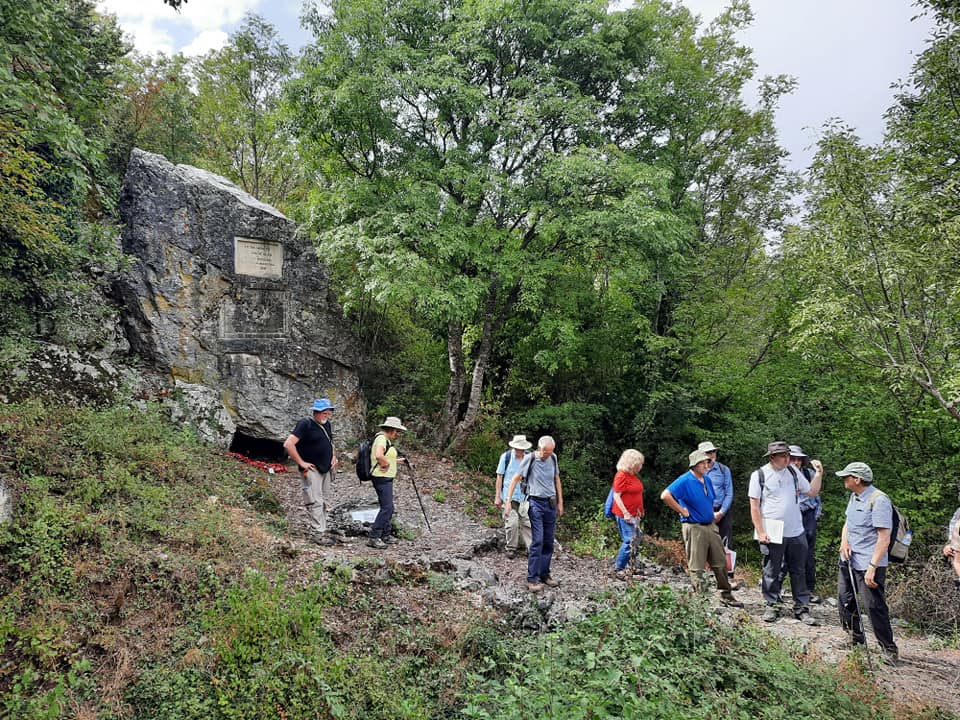
Exploring sites during the 2024 tour
Our journey continues to Bowls Barrow and Smol (now Micro Dassos) in the Vardar sector, where we’ll see firsthand how operations were often designed to divert Bulgarian attention from Doiran. We’ll also visit sections of the Birdcage Line defences and the village of Mavroplagia (formerly Karamudli) in the Krusha Balkan Hills.
The tour will include visits to several Commonwealth War Graves Commission cemeteries, including Doiran (with the Memorial to the Missing), Karasouli, Kirechkoi-Hortakoi, Lembet Road, and Struma.
Running from Sunday 21 to Tuesday 30 September 2025, the tour is timed to coincide with the official commemorations marking the end of the Salonika Campaign, held over the last full weekend of September.
Led by SCS Chair, Alan Wakefield, this is a great opportunity to walk in the footsteps of BSF history.
To register your interest and receive further details, contact Alan Wakefield via email.
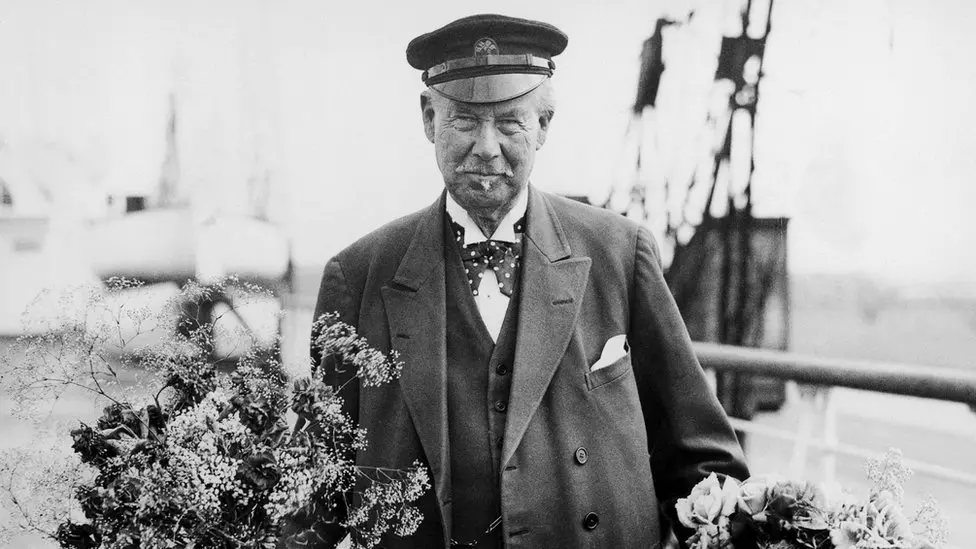
Sir Thomas Lipton (1848–1931) was a Scottish businessman and philanthropist best known for founding the Lipton tea company, which became one of the largest tea brands in the world. He was also a noted sportsman, famously competing in the America’s Cup yacht races several times, and made significant contributions to charity and education throughout his life.
During World War I, Lipton visited Serbia to offer humanitarian aid, moved by the suffering caused by the conflict. Recognizing the dire need for medical support, he donated substantial funds and medical supplies to assist Serbian soldiers and civilians, especially during the devastating 1915 retreat. His efforts helped establish field hospitals and provided relief to those affected by both the war and the widespread disease in the region.
This remarkable, and to me at least, largely forgotten story will be told with much more skill and knowledge by Colonel (Retd) Nick Ilic in a free online talk this week. As Nick explains, “It is a fascinating story and I’ve assembled a large number of photographs to try and bring it to life.”
The talk is on 11 February at 7pm and should last about an hour. You can join via this link:
Maybe it’s my Fenland heritage, but I have long found wetlands fascinating environments. With the Broads in the east, the Fens in the west and lots of swampy bits in between, Norfolk is an ideal place to live, although on this World Wetlands Day my thoughts go to the Struma Valley. The Struma front, where XVI Corps operated, is the aspect of the Macedonian campaign that interests me most – primarily because it’s where my grandfather, Fred, served – but I don’t often think of it in terms of being a wetland environment.
As today sees the start of the Lunar New Year, I take this opportunity to wish all our readers a happy Year of the Snake. A brief online search suggests that snakes symbolise good luck and rebirth, the pursuit of love and happiness, and wealth and wisdom; so reasons for optimism in 2025! If you were born in a Year of the Snake, heading east is said to be auspicious, so perhaps you should sign-up for a Salonika battlefield tour with the SCS. It’s almost certainly a good idea, even if you were born under another animal!
Amongst the souvenirs of the campaign collected by Private Herbert Price of the ASC Supply Department is a rather fragile flyer for Salonika’s Palace Cinema for the week beginning Monday 30 October 1916. Two films were on offer, the first a French silent film from the previous year, Strass & Compagnie, described as ‘a grand patriotic and poignant drama … in four long parts’, which doesn’t seem a great choice for men seeking escapism from war. In which case, maybe Herbert’s preference was for the 1912 American short, A Millionaire for A Day. Described by one US paper as ‘a screaming comedy’, this 1912 American silent short – based on a true story – is about a mechanic who goes to New York City and squanders his inheritance in a single day, returning home broke but wiser (Wikipedia). On the coming Friday, the film Pont du Diable (Devil’s Bridge) was promised, although this sounds uncomfortably like a location in the Struma valley!
SCS Secretary, Chris Loader, has just released a new episode of his podcast Salonika Secrets (mentioned here in April, 2024).
In Episode 4 of the podcast, Chris begins a new series dedicated to sharing the stories of the fallen officers of the 10th Hampshire Regiment during the Salonika Campaign.
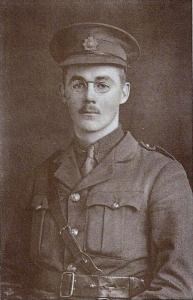
The series begins with the story of Lieutenant John Howard Tanner, who was killed on September 15, 1916, and is buried in the Struma Military Cemetery in Greece.
With so much talk in the media about the possible impact of Artificial Intelligence (AI), I thought I’d see what AI could produce on the Salonika Campaign. So, I visited ChatGPT and gave it the following prompt:
“Write a short introduction to the Salonika Campaign of 1915-1918 where British forces were involved. Explain the political background, the reasons for British involvement, the initial and ongoing difficulties, successes, and failures of the campaign.”
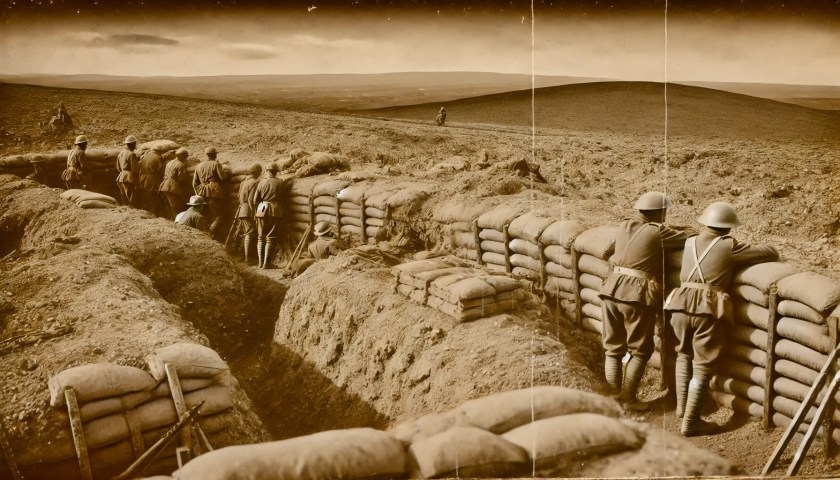
And, within seconds, the AI had produced the text (in blue) below and, after a little more prompting, the accompanying image. What do you think? How would you mark this AI homework?
The Salonika Campaign (1915–1918)
The Salonika Campaign (1915–1918), part of the broader Balkan theater [sic] of World War I, was a politically contentious and strategically complex operation involving British and Allied forces. It originated against the backdrop of the collapse of Serbia, a key Allied power in the Balkans, and the desire to contain Central Powers’ influence in the region.
ChatGPT describes the image it has created thus, “Here is a refined sepia-tinted image of the Salonika Campaign during World War I. The focus is on a single trench with fewer soldiers, enhancing the sense of isolation and authenticity as if it were a genuine photograph from the time.”
Political Background and British Involvement
The campaign was driven by a mix of strategic necessity and political considerations. Following Bulgaria’s entry into the war on the side of the Central Powers in 1915, Serbia was invaded and overrun by a combined Austro-Hungarian, German, and Bulgarian force. This development alarmed the Allies, who sought to stabilize the region and prevent further Central Powers’ advances into Greece and the eastern Mediterranean.
British involvement was spurred by a combination of commitments to its Entente allies—particularly France—and the need to secure the strategic link between the Mediterranean and the Near East, including the Suez Canal. However, British Prime Minister Herbert Asquith’s cabinet was divided on the campaign, with many seeing it as a diversion of resources from the more critical Western Front.
Initial and Ongoing Difficulties
From the outset, the Salonika Campaign faced severe challenges. The Allied forces, including British troops, landed in Salonika (modern Thessaloniki) in October 1915 to provide relief to Serbia, but the rapid fall of Serbia and the harsh Balkan winter forced a retreat into Greece. The ensuing stalemate in the region mirrored the trench warfare of the Western Front but was compounded by mountainous terrain, inadequate infrastructure, and endemic diseases such as malaria, which significantly weakened troop effectiveness.
The political situation in Greece further complicated matters. Greek neutrality was contested, with pro-Allied and pro-Central Powers factions vying for control. A coup in 1917 finally brought Greece into the war on the Allied side, but this delay hindered effective coordination and progress.
Successes and Failures
Despite its challenges, the Salonika Campaign achieved some notable successes. Allied forces eventually went on the offensive in 1918, spearheading operations that led to the decisive Vardar Offensive. This contributed to the capitulation of Bulgaria in September 1918, the first of the Central Powers to surrender, and helped to secure an Allied victory in the Balkans.
However, the campaign is often criticized for its high costs relative to its limited strategic impact. It tied down large numbers of troops and resources that some argued could have been better used on the Western Front. The campaign’s slow pace and significant casualties, largely due to disease, also fueled skepticism about its value.
In hindsight, the Salonika Campaign highlights the interplay of military strategy, political maneuvering, and the complexities of coalition warfare in a volatile region. While its immediate successes were limited, its role in destabilizing the Central Powers’ position in the Balkans and hastening the end of the war was significant.
As you eat your Christmas meal – whether it’s traditional, exotic, vegetarian or vegan – spare a thought for the Mongey Wallahs, the cooks who had to feed large numbers of men everyday of the year during the Macedonian campaign: with no gas or electric hobs and ovens, often unreliable provisions and extremes of temperature to work in, not to mention the activities of the enemy. These unsung heroes of the BSF get little attention so, at this time of year when food plays such an important in the festivities, it’s good to remember them and their vital role.
Looking back, I see that my last update on ‘our’ mule, Noah, was exactly a year ago. This is very remiss of me, although if you are a member you will have been able to read more about him in the latest issue of The New Mosquito. Suffice it to say, he is in fine fettle and enjoying life in the winter paddock with his donkey and mule chums at the Redwings Horse Sanctuary near Great Yarmouth. At the Society’s annual meeting in October it was agreed that he should follow Muffin in becoming an Honorary Member of the Society, to recognise the vital part played by mules and other animals in the Macedonian campaign. A splendid certificate has been produced and will be presented in the coming year. As you can see from the photo which follows, Noah is a handsome chap who, like Muffin, is on the small size but with a big personality!

 Salonika Campaign Society, 1915-1918