
In April 2025 I described my exploration of another possible family connection (albeit by marriage) with the Salonika campaign. This concerned Lt George Clark who was the Medical Officer of 7/Royal Munster Fusiliers. His medal index card and the Battalion war diary (WO 95/4296) conclusively place him in Gallipoli but, to see what happened next, required a visit to The National Archives at Kew to look at the next part of the war diary which, of course, has not been digitised. I can now share the next stage of my investigations and, whilst I don’t expect you to be especially interested in my family history, what I found out about 7/RMF may be of wider interest.
The next war diary for 7/RMF, covering the period October 1915 to October 1916, is found in WO 95/4837, the diaries of 30th Infantry Brigade. On 1 October the Battalion was at Lala Baba, near Suvla Bay, and at 1930 moved to the South Pier for embarkation on HMT Osmanieh. This first page got me off to a cracking start as it listed the Battalion strength on leaving the Peninsula – 315 other ranks – and named all the officers, including ‘Lieut. GW Clarke [sic] (RAMC)’. Just to keep me on my toes, George was not the only ‘Clark’, there were also Second Lieutenants WFH Clark and NP Clarke!
Landing next day at Mudros, the Battalion moved into camp, remaining on the island until 14 October when it embarked on HMT McGillivray for Salonika. During its time on Mudros there were the inevitable inspection parades, training and fatigues, especially as they had to clear up after 29th Brigade and the rest of 30th Brigade who sailed before them. A number of officers and men rejoined the Battalion from hospital, along with some new arrivals, and they also gained – on the ration strength – 500 men for 29th Brigade (Royal Dublin Fusiliers and Connaughts).
At 0800 on 15 October they arrived at Salonika, but delays in disembarking and waiting for transport meant they didn’t arrive at Lembet Camp until about 2120. It was raining hard and the camp is described as ‘a mass of mud no tents.’ At the same time a draft of 592 ORs and 10 subalterns from the Dorset Regiment reported. Dorset is a long way from Munster!
There is an interesting assessment of the Battalion’s health at the end of the month in Ghevgjeli, especially given what they were about to face in the winter advance into Serbia:
Health of Battn. fair. Men were not entirely recovered from hardships of Peninsula. DORSET draft were affected by local conditions and the Battn. marching powers were very poor. In addition march discipline had to be taught the new men.
This suggests that the Medical Officer would have been busy, but was it George Clark? After his encouraging mention on 1 October, his name vanishes from the war diary. He does not show as one of the officer admitted to hospital or otherwise departed, but nor is the arrival of a new MO noted.
During the advance into Serbia, the Battle of Kosturino and subsequent retreat there is only one mention of specific medical activities within the Battalion. By late November conditions were very severe. The temperature was said to be -15°F / -26°C with many cases of frostbite and exhaustion. A temporary Battalion hospital was established at Kajali – a village about 3km from Kosturino and just below the ridge of Crête Rivet – where men could be warmed.
And then, finally, the identity of the Medical Officer during this period is revealed in an entry from 16 February 1916, when the Battalion was engaged in road making on the Kapadjilar-Hortiach road:
Lieut. A Bremner RAMC M.O. in charge of Battalion was transferred to 31st Field Ambulance.
On 31 July 1916 the war diary records that:
CAPT. A. BREMNER, RAMC attached 7 R Muns Fus [was] awarded the Military Cross for gallantry in Serbia (Date of Gazette unknown).
So what happened to George Clark from his embarkation from Gallipoli on 1 October 1915 until his marriage in Bradford on 4 July 1916, when he described himself as ‘Physician and Surgeon’? Did he remain on Mudros and then return home from there? Did he sail to Salonika and remain on the troopship? If he did disembark at Salonika, he presumably didn’t remain very long. It’s frustrating that the CO of 7/RMF didn’t record the change of MO, especially as he was otherwise very punctilious in recording officers’ arrivals and departures and appointments within the Battalion. Was George sick or did he leave under a cloud? Whatever the case, this marked the end of his military career until 1 October 1918 when he became a Medical Officer in the Royal Air Force, with the rank of captain.
It’s been an interesting search even if an element of mystery remain. I knew George Clark’s son, knew that George had served in Gallipoli and admired his sword hanging above the fireplace. My grandfather, who had served in Salonika, also knew all this, indeed, his niece was George’s daughter-in-law so I think that if there had been a Salonika connection it would have been remarked upon – but you never can tell with families!
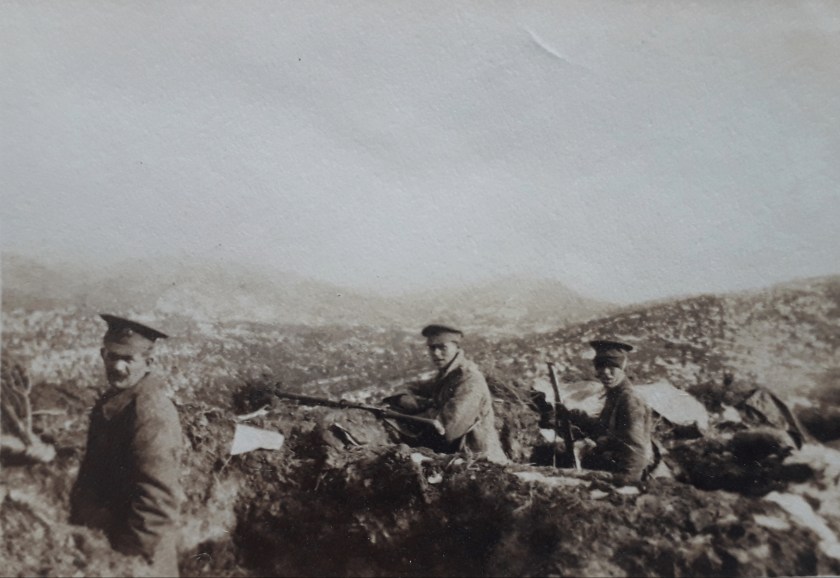
Irish fusiliers – possibly Munsters – in a shallow trench or sangar during the winter fighting in 1915 around Kosturino. The photograph is believed to have been taken by 2nd Lt David Cowan of 5/Connaught Rangers. With thanks to Graeme Sheppard and David Cowan’s grandson for sharing this photo with the Society.
Discover more from Salonika Campaign Society, 1915-1918
Subscribe to get the latest posts sent to your email.
 Salonika Campaign Society, 1915-1918