
It was five o’clock in the morning on the edge of hell. Captain Jimmy Eynon looked up through the goggles of his gas mask at Grande Couronne, cursed savagely, and kicked a rugby ball high into the air. Before it fell, a Welshman had been shot to pieces … and another … and another.
from ‘Now the Agony!’ by Gareth Bowen in ‘The South Wales Echo‘, 1964
So begins a graphic account (part 8 of a series in The South Wales Echo) of the part played by the ‘Cardiff Pals’ – 11th (Service) Battalion, Welsh Regiment – in the Second Battle of Doiran on 18 September 1918. It continues:
Now came the final dividend for the Cardiff Pals Battalion, thrown into an attack doomed to failure from the moment it had been conceived. “ELEVENTH WELCH WILL TAKE THE TASSEL AND THE KNOT-AND THEN JOIN THE ASSAULT ON GRANDE COURONNE FROM THE SOUTH-EAST.”
I am grateful to Jon Bowen for sharing with us this newspaper article and details of one of the soldiers mentioned in it, his great uncle David Briley. David enlisted at the start of the war as 15071 Private Briley in 11/Welsh, which was formed in Cardiff. It moved to the south of England where it joined 67th Infantry Brigade as part of 22nd Division. The Battalion landed in France on 6 September 1915, but was off to Salonika at the end of October. Before leaving the UK, David had his photo taken with his mother, Mary.
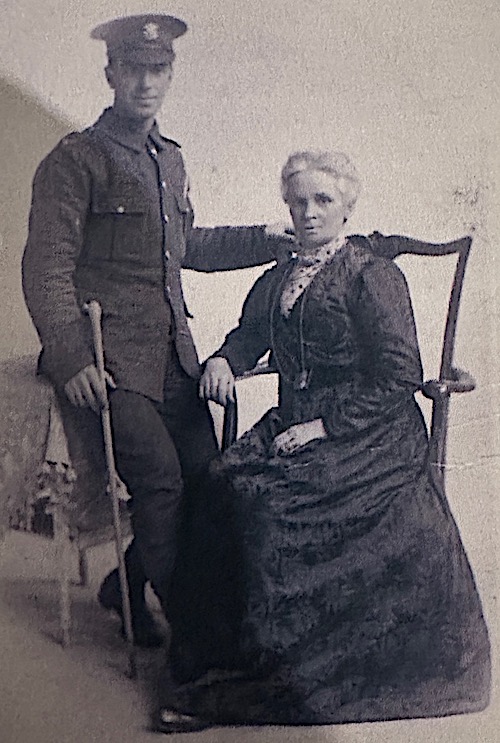
David and Mary Briley.
Whilst in Salonika, David had two spells in No. 21 Stationary Hospital: in July 1917 with a slight shrapnel wound in his left arm and a few months later with ‘pyrexia’ (an unexplained fever). Photos from Salonika show that he was promoted to corporal and then gained an extra stripe – as lance sergeant – in time for the attack of September 1918.

Corporal Briley (right) and friend in summer kit and a more formal portrait of Lance Sergeant Briley in service dress.
This sketch map of the Doiran battlefield in 1918 (from ‘Salonika Memories 1915-1919’ published by the SRA in May 1969) gives the quaint names of many of the features of this bloody battlefield. 11/Welsh’s objectives – ‘Tassel’ and ‘Knot’ – are not shown but were around the central feature known as ‘Hilt’, with Grand Couronné looming above.
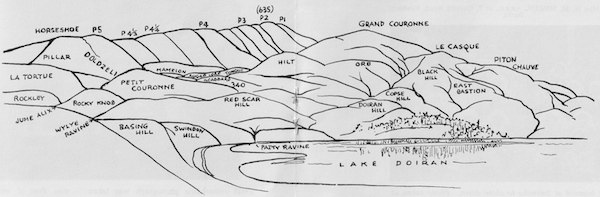
The Official History (Vol. II, pp169-170) describes how the 67th Brigade’s attack started promisingly behind its rather thin barrage. 11/Welsh – the centre battalion – took the first line of Bulgarian trenches on ‘Sugar Loaf’ and reached its final objectives – ‘Knot’ and ‘Tassel’ – but, with only a handful of survivors, were soon driven out. Gareth Bowen takes up the story in ‘The South Wales Echo’:
Lieutenant Guthrie Morgan was injured for the third time in the war, a machine gun bullet shattering his thigh. Stokey Lewis VC, his orderly, lay down by his side.
“Quick, Stokey, take my maps and papers – and get out of here,” groaned Morgan.
“I’m getting you back, Sir,” said Stokey, carrying him as far as he could … and then dragging him until stretcher bearers took over.
Down dropped the Pals, never to rise … Bish, Bottomley, Bowen, Brett, Briley, Broyden, Bunford, Crashaw, CSM Cummings, Davies A., Sergeant F. Davies, Dinham, Eaton, Evans B., Fitton, Gibson, Gillard, Goodman, Hall, Hogg, Harding, Harris, Harrison, Harvey, Hellawell, Hollinshead, Houghton, James, Jefree, G. Jones, L. Jones, R.W. Jones, W. Jones, W.T. Jones … to name but a few.
By eight a.m. the 11th Welch “had ceased to exist,” as dead, dying and wounded lay on the slopes of The Tassel and The Knot. Every battalion that swarmed up the Couronne slopes that morning was butchered.

Photograph reproduced in ‘The South Wales Echo’, 1964.
David Briley was 27 years old. His body was never found so – like many of his comrades – he is remembered on the Doiran Memorial, which stands peacefully on Colonial Hill, overlooking the lake, town and battlefield of Doiran. The men of the 22nd Division are also remembered on their own memorial – an inscribed slab, inset in a huge rock in the hills above New Doiran town. A photograph of this was reproduced in the final issue of The Mosquito – ‘Salonika Memories, 1915-1919’ in May 1969.

Found in poor condition, the memorial was replaced with a smaller copy and rededicated in November 2008. You can read about the project in The New Mosquito, number 19 (April 2009).
My thanks go to Jon Bowen for sharing with us the story of his great uncle David and for the newspaper article and photographs.
If, like me, you are wondering – Jon is not related to Gareth Bowen, the journalist who wrote the article for The South Wales Echo (although Jon’s father did work for that paper); nor, as far as he knows, is he related to Gwilym Bowen who died with David Briley that day on the hills above Doiran.
Discover more from Salonika Campaign Society, 1915-1918
Subscribe to get the latest posts sent to your email.
 Salonika Campaign Society, 1915-1918
Hi My name is Jeffrey Cuffe and I am a family historian. My Grandfather on my mothers side was in the 11th Service Battalion and in Salonika. I am currently writing up his life story in a book form to ensure he and his compatriots are not forgotten.
I would be grateful of any further information from anyone in the group who has connections with the Cardiff Pals and willing to let me include into my book.
My email is jeff.cuff28[at]gmail.com I live in Cardiff.