
No, I’m not straying off topic with a post about drug smuggling, this is genuinely about four-legged equines. Mules are a rare sight in the UK so I guess, for most of us, they are something from the past – maybe an animal that frustrated or amused our grandfathers (or great-grandfathers etc.) over one hundred years ago in Macedonia. However, because of their versatility they are still very much in use around the world, particularly in hilly or mountainous country.
I am pleased to share these photos of working mules in northern Colombia, which shows the variety of colours these animals come in.

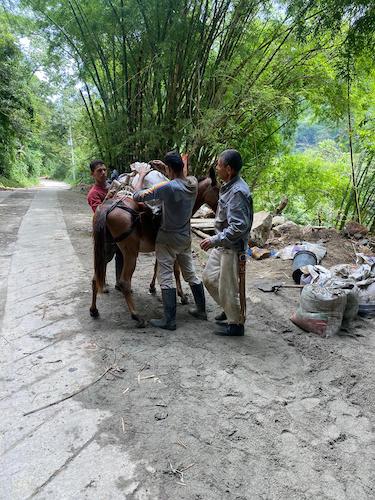

At first glance you may think – horses – but it’s the ears that give them away. Definitely mules! (Photos by Sam Braysher)
During the First World War the British Army sourced some of its mules from South America – Argentina, rather than Colombia – which provided particularly big and sturdy mules for draught use, so rather bigger than those shown above, although it looks like they can still carry a reasonable load. The two fine looking draught mules in the photograph below, may well be from Argentina, although that’s no gaucho, but an ASC driver!

The pair of mules that won second prize at a Divisional Horse Show, Salonika, May 1916. © IWM Q 31938
Discover more from Salonika Campaign Society, 1915-1918
Subscribe to get the latest posts sent to your email.
 Salonika Campaign Society, 1915-1918
Robin missed the opportunity to explain the breeding of mules, many of you who are not countrymen will be oblivious of the genetics involved. Also, you might like to learn the difference between a Mule and a Moke.
Hi Terry,
Thank you for responding so swiftly – it’s always good to know there are people out there reading these posts! Some details of mule biology may have been mentioned over the years, but I’m sure it would do us good to have a refresher!
The basics for mules are: dad’s a donkey (for long ears and intelligence – not stubbornness) and mum’s a horse (for long legs and stamina). The reverse hybrid is a ‘hinny’, which don’t seem to be much used – not sure why. Mules and hinnies tend to be sterile.
As for mokes, you’ve got me there, I can only think of the ‘Mini Moke’ – the 1960s vehicle which featured in ‘The Prisoner’ (“I am not a number …”) – but that is definitely off topic!
Robin
Thanks Robin,
Yes, you are already au fait with the male /female relationships. Your Hinny is unfamiliar to me but seems the accepted term nowadays for my Moke. Eighty-odd years ago country boys in my Herefordshire would know the difference but to tell the truth Mules or Mokes were rare beasts. About the age of ten, in out-of-school time I used to pump the bellows for the village Blacksmith but he never had either to shoe.
I’m new to this site, I recently discovered my wife’s grandfather, Albert Williams was in Salonika with a Royal Engineers Rail Operating Company.
Kind regards,
Terry Gurney.
Thanks Terry, that’s interesting. We don’t seem to have much of a mule tradition in this country, maybe it’s because we’ve preferred horses and ponies, but the lack of suitable donkeys probably hasn’t helped. The French and the Spanish on the other hand have big donkeys ideal for producing big sturdy mules – Poitu and Andalucian donkeys, respectively – which influenced the Americas, of course. There’s lots of fascinating material and pictures online, if you don’t mind disappearing down a mule shaped rabbit hole and, closer to home, you can see Alice, a mule belonging to the US Marine Corps on our web site – just search ‘Alice the mule’ – she’s a big girl!
I’m glad you’ve found our web site and hope you find it useful and of interest. If you go to the tabs at the top of this page and follow ‘The BSF / Army Headquarters / Royal Engineers’ you will find information about the BSF’s RE units and associated war diaries at The National Archives, Kew. Sadly those for Macedonia have not been digitised, so they either have to be seen in person or you can pay to obtain a copy. The Imperial War Museum has a fine collection of digitised photos from the campaign (https://www.iwm.org.uk/collections) and a search on ‘Salonika railways’ will bring up many interesting photos. Joining the Society is, of course, also a good way to find out more about this rather neglected campaign.
Thanks again for getting in touch.
Best wishes,
Robin
Do you have any information about the Mule Trains in the 10th Division during 1915- 1918. Relative was a driver.
Hello John,
Thank you for your question. I am assuming your relative was a horse transport driver with the Army Service Corps. You will find an order of battle for the 10th (Irish) Division on this excellent web site (10th Divisional Column, ASC is right down the bottom): http://www.longlongtrail.co.uk/army/order-of-battle-of-divisions/10th-irish-division/
You can then follow-up the various ASC Horse Transport Companies on this web page – and find a lot more information about the ASC: http://www.longlongtrail.co.uk/army/regiments-and-corps/the-army-service-corps-in-the-first-world-war/
10th (Irish) Division started to arrive in Salonika from Gallipoli in October 1915. The Official History (Vol. 1 pages 50-51) has this to say about the Division which had been hastily shipped to Mudros: “Its first-line transport, left in the United Kingdom, was made from that of the 13th Division in animals and vehicles, and the personnel was to rejoin at Salonika.” The infantry landed at Salonika on 5th October and, without transport, had trouble getting their tents etc. up to the camp. The next day 500 transport animals landed from Mudros with few nosebags and no picketing pegs or ropes, “… This gave the Army mule one of those opportunities to display his variability of temperament of which he never failed to take advantage.”! At this stage, the British Salonika Force (BSF) was still using horse/mule-drawn wheeled transport and it was the difficulties of operating on poor Balkan roads (or no roads at all) in hilly terrain which prompted a proposal to switch to pack transport for front-line units.
This change was approved in July 1916 and, with many more mules sent from Egypt and America, was completed in the autumn of 1916. Divisional Trains of the sort in which your relative may have served had a mixed establishment of pack mules and wheeled transport. Many ASC drivers were replaced by Cypriots, Macedonians and Cretans for wheeled transport, with the ASC men becoming the ‘drivers’ (i.e. leaders) of pack mules. Under the new pack establishment a Divisional Train typically had 691 drivers, 1030 pack mules and 70 vehicles (drawn by 252 draught mules) in the ‘Pack Echelon’ and 667 drivers, 285 vehicles (drawn by 1248 draught mules) and 10 pack mules in the ‘Wheeled Echelon’. The Official History (Vol. 1 page 282) describes the “Salonika 4” pack transport establishment as “… the most perfect that has ever been devised for warfare in mountainous country from every point of view except that of cost and extravagance in forage.” Hardly was it up and running when – for various reasons – many of Salonika’s mules, horses and pack transport drivers were needed in Egypt for the forthcoming Palestine campaign. With numerous adjustments, the BSF was able to meet the War Office’s requests but at a considerable loss in its mobility, although pack transport was retained for the fighting troops. Your relative may well have gone to Egypt as part of this transfer of ASC drivers or he may have gone when 10th (Irish) Division moved to Egypt in September 1917.
You will find other relevant material by going to ‘Themes’ (bottom right-hand side of the web page) and clicking on the ’10th Division’ and ‘Transport’ buttons. You will also find more about the ASC in the Salonika campaign here: https://salonikacampaignsociety.org.uk/bsf/army-headquarters/army-service-corps/
I hope you have found this useful.
Best wishes,
Robin
My grandfather Alfred Brown was a driver with the artillery at Salonica. When I was a little girl he told me many stories about his mules. He claimed to have taught one to kick officers. Said that mules were superior to motor transport in treacherous conditions.
Thanks for taking time to comment and for sharing the story. Mules feature in lots of reminiscences from the Salonika campaign and played a vital role.