Remembrance in Wartime

The following account of the 1944 Annual Muster of the Salonika Reunion Association is taken from The Mosquito, issue 68, December 1944.

Lord Milne talking to his ‘old comrades’ on the occasion of the 20th Annual Muster in London, on Sunday, October 1st, told them this story: One of your members went to the wrong place this morning and asked a sentry where the Salonika Reunion Association was meeting. The sentry replied “I don’t know; I don’t think there is any meeting. There are none left alive.” This caused a lot of laughter.

“Well we are very much alive!” commented “Uncle George,” ” and this is the best parade we have had since the commencement of the war.” He said he thought it a wonderful turn-out after five years of war, and it was typical of the high state of morale of the nation. It was a great pleasure for him to see them again, and if they did not think him rude, he congratulated them on their personal appearance.

… Stating that he hoped this would be our last meeting in war-time, at least during the European war, he looked forward to a real Victory Reunion next year. “Au revoir! Good luck to you! …”

… With the S.R.A. standard and escort in the lead, we marched – a long line of threes, twisting amongst the held-up traffic – until we arrived at the Cenotaph in Whitehall. When we had halted and turned towards the national war memorial we were standing six deep. In the centre, facing the south side of the Cenotaph, stood Lord Milne with our head officials, and they were flanked on their right by a single line of women – our nursing sisters, V.A.D.s, etc..

Then, receiving from our hon. secretary and hon. treasurer, the large wreath of gilded laurels, inscribed “To the Honoured Memory of Our Fallen Comrades. From the Members of the Salonika Reunion Association,” Lord Milne, bareheaded, advanced with Colonel W.R.D. Robertson (president of the S.R.A.) and placed our tribute on the base of the Cenotaph. Colonel Robertson, who was in army uniform, saluted, they turned and resumed their positions. The parade, closely scrutinised by onlookers on the pavement, then did a smart left-turn and marched away. We had paid tribute to those whom we left on the rugged hillsides and the open plains of Macedonia, in city cemetery or in lonely unidentified graves – heroes all! For twenty years we have kept faith with them in this simple ceremony at the Cenotaph. “they shall grow not old . . . . we will remember them” – always!
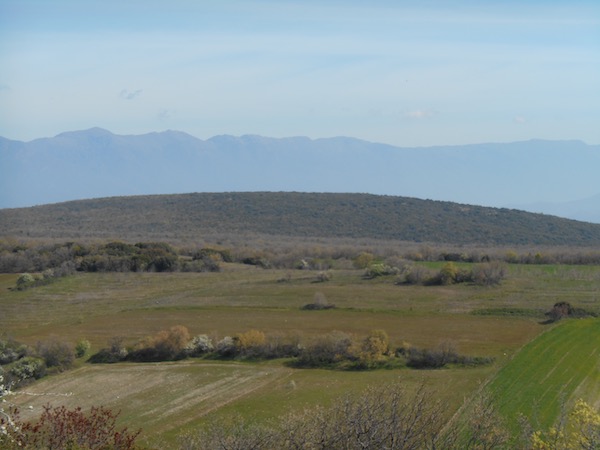
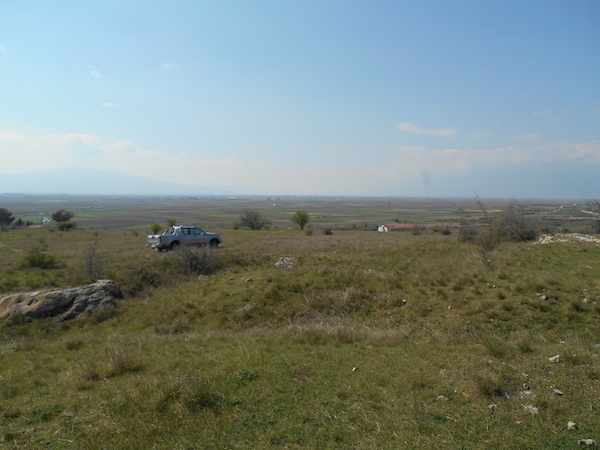
A photograph from the Doiran battlefield, showing the view from Castle Hill across to La Tortue. Taken in March 1916 by Robin Braysher.

“… the rugged hillsides …

A photograph looking across the Struma valley from the Bulgarian lines. Taken in March 1916 by Robin Braysher.

… and the open plains of Macedonia.”

Photographs taken by the author in March 2016: a view from Castle Hill to La Tortue on the Doiran front (top) and across the Struma valley from the Bulgarian lines (bottom).

William Richmond and 10/Black Watch (4)

William Richmond was demobbed in 1919; his medal index card in The National Archives shows that he entered the ‘Class Z Reserve’ on Valentine’s Day. This allowed him to return to civilian life, but there was an obligation to ‘return to the colours’ if necessary, an obligation which was not abolished until 31 March 1920. The card also shows that he was eligible for the famous trio of Great War campaign medals known as Pip, Squeak and Wilfred, named after cartoon characters: the 1914/15 Star (for his service overseas before 31 December 1915), the British War Medal and Victory Medal.

Continue reading “William Richmond and 10/Black Watch (4)”

Air Raid!

All was peaceful on Tuesday, February 27th, 1917, until shortly after 4 o’clock in the afternoon, there suddenly appeared what looked like a flock of geese coming from the north. Within seconds, it was realised that they were enemy planes – 15 of them flying in echelon formation. They made straight for Summer Hill camp and the town, dropping one or two bombs on the way on remount depôts.

Continue reading “Air Raid!”

Message from the Chair

Dear Members and Friends,

As I sit writing this over Easter, the world is in the grip of the coronavirus COVID-19 pandemic. I hope you and your families are keeping well and that you are getting used to the social and commercial lock-down that is currently in place. Like many of you, I’ve been working from home since mid-March and coming to terms with only seeing work colleagues, friends and family online. Thankfully we live in an age of remarkable communications technology enabling us to maintain instant contact across the globe from our living rooms. One can only imagine what the men and women of the BSF would have given for anything approaching this level of modern comms.

Continue reading “Message from the Chair”

Missing SRA plaque

We have been contacted by Phil, a volunteer on the Imperial War Museum’s War Memorials Register Project.  They have a record of a memorial plaque that was placed in St John’s Church, Hanley, Staffordshire by the Salonika Reunion Association in memory of those who served and died in Salonika.

The church is now an antiques centre and Phil has spoken to the owner who has confirmed that the plaque is no longer there.  He said that a number of plaques were removed during the period when the church was closed.

A quick search of The Mosquitothe publication of the SRA  – has not revealed any mention of the church, the plaque or any dedication ceremony, so it remains a mystery. Does anyone out there know anything about the plaque? Please contact us if you do and we will pass the information onto Phil.

The Doiran Memorial.
The Doiran Memorial serves the dual purpose of a Battle Memorial of the British Salonika Force (for which a large sum of money was subscribed by the officers and men of that force), and a place of commemoration for more than 2,000 Commonwealth servicemen who died in Macedonia and whose graves are not known. The memorial was designed by Sir Robert Lorimer with sculpture by Walter Gilbert. It was unveiled by Sir George Macdonogh on 25 September 1926. It stands on Colonial Hill in northern Greece, overlooking the lake and town of Dojran in Northern Macedonia. Photo by the editor, March 2016.