
I doubt that members of the Salonika Campaign Society really need International Women’s Day to remember the service and sacrifice of the women of the Scottish Women’s Hospital who served in the Balkans. The Society has remembered them in books, in talks and presentations, at events and in articles, both printed and online. Even so, it may be helpful to have a reminder of these redoubtable women and their noble enterprise, through the graves of just four of their number. I photographed these on a visit to Thessaloniki ten years ago, at the CWGC Lembet Road Military Cemetery. They are: Sister Mary de Burgh Burt, Sister Florence Missouri Caton, Masseuse Olive Smith and Alice Annie Grey.
Continue reading “Remembering …”Tag: Roll of honour
Individuals named on this website who served in the Salonika campaign, 1915-1918.
More Chocolate Soldiers!
My thanks go to Rob Elliott and Andy Hutt who have both provided further information on 22nd Division’s production of The Chocolate Soldier. Before I share their pearls of wisdom, here is a link to a page with photos (scroll down!), which I found AFTER posting my article. I added it as a comment, but that may have been missed and the photos are certainly worth seeing:
Continue reading “More Chocolate Soldiers!”The Chocolate Soldier
Wilton’s Music Hall is a fascinating theatrical venue in the heart of the East End of London, close to Cable Street where, in 1936, at least one Salonika veteran – PC Fred Braysher – took part in the infamous ‘Battle of Cable Street’.
Continue reading “The Chocolate Soldier”Remembering Hori Tribe (1877-1917)
I’ve only recently discovered a fascinating and beautifully presented online exhibition commemorating the life of Hori Tribe (1877-1917), an employee of The Royal Parks who served in Salonika before transferring to the Egyptian Expeditionary Force (EEF) in June 1917.
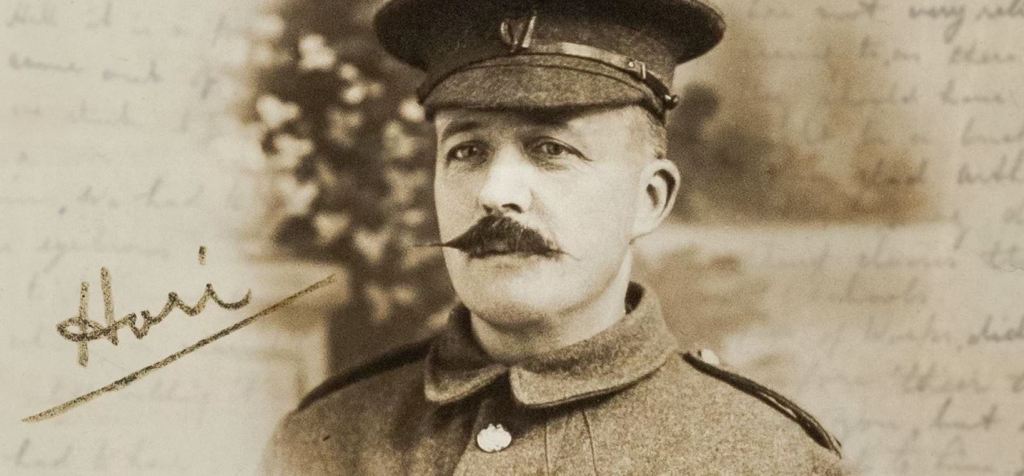
The exhibition, co-curated by the Royal Parks and Hori’s great-granddaughter, Sarah Gooch, has a wonderful and moving collection of photos, drawings and extracts from Hori’s letters.
I certainly won’t attempt to retell Hori’s story here, instead I recommend a visit to the digital exhibition. It is definitely worth a visit and a few moments of your time.
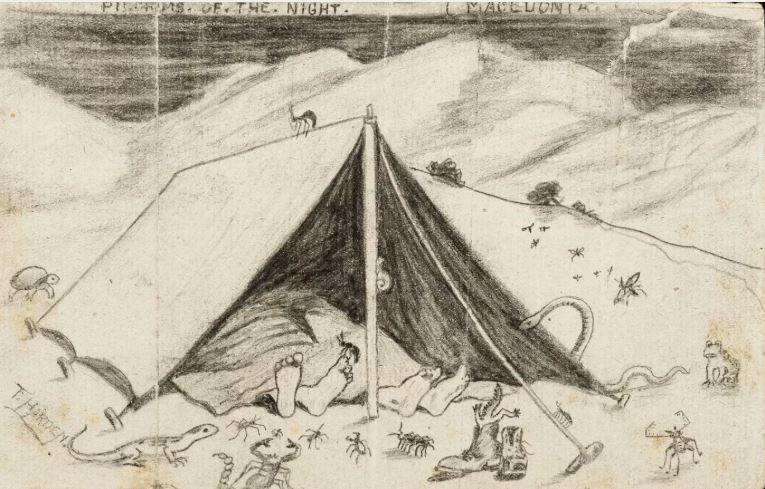
With the EEF since June and now, at the start of December 1917, Hori had two days’ rest at a monastery just outside of Jerusalem. In the final letter he sent home, Hori included some rosemary – associated with remembrance:
‘The pieces of rosemary included I picked from a hedge in the grounds of the monastery.’
Hori spent two days at the monastery just before his last battle.
Hori was killed in action on 8 December 1917. He is laid to rest at the Jerusalem War Cemetery.
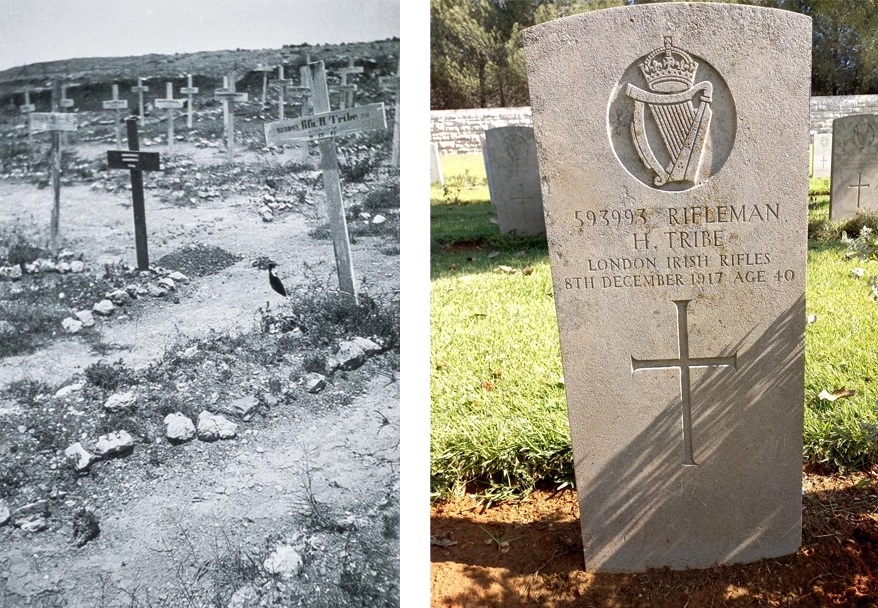
Remembering Hori Tribe – A digital exhibiton celebrating the life of Hori Tribe (1877-1917), an employee of The Royal Parks who was killed in action during the First World War.
Pte George Excell of Wotton-under-Edge
One of the things I enjoy most about living in the county of Gloucestershire is its beautiful countryside and many wonderful walks. After a recent hike involving some strenous Cotswold climbs, I stopped for refreshments and recovery in Wotton-under-Edge. Of course, I had to take in the Wotton war memorial where I later discovered a Salonika connection…
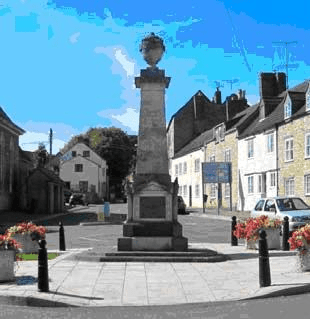
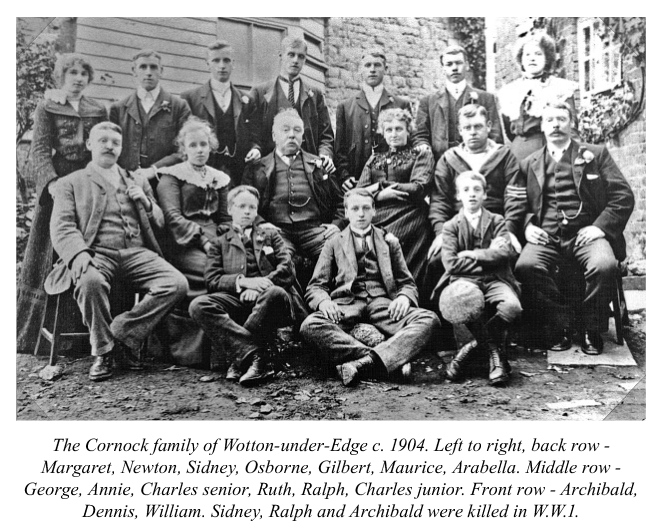
According to the town’s heritage centre, the memorial was erected in 1920 and unveiled by a Mrs Cornock. Apparently, and tragically, eight of her sons served in WWI – three did not return*. Among the names on the memorial is that of George Edward Excell.
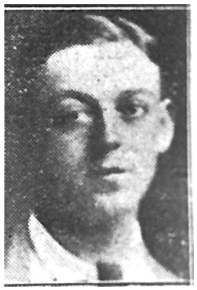
George Edward Excell was born in 1896 in Wotton-under-Edge, one of six children of Edwin and Elizabeth Excell, who lived in the Sinwell area of the town. His father, Edwin, worked as a rural postman, while his mother, Elizabeth served as matron at the Perry & Dawes Almshouses on Church Street, Wotton. Edwin died while George was still young.
After finishing school, George began working for Mr. G. W. Palmer, a boot maker based on Long Street in Wotton. Mr. Palmer later served in the Royal Naval Division as an Able Seaman during the Great War.
At the outbreak of the war, George enlisted in Wotton, joining the 11th Battalion of the Worcestershire Regiment with the service number 18644. The battalion was formed on 14 September 1914 as part of the 78th Brigade in the 26th Division. They trained in Wiltshire, including at Sherrington and on Salisbury Plain, before landing in Boulogne on 21 September 1915. Over the next two years, George saw extensive action on the front lines and was wounded twice.
George Excell recovered from his wounds and resumed service with the Worcestershire Regiment. In September 1918, the 11th Battalion of the Worcesters, including George, was deployed to the Salonika front.
On 16th October 1918, George’s mother, Elizabeth Excell, received a telegram stating that her son was dangerously ill in a hospital in Salonika. Tragically, George had already died of pneumonia four days earlier. It wasn’t until Saturday, 19th October, that she received confirmation of his death. George Excell was 22 years old.
George is buried at Doiran Military Cemetery, in Plot 5, Row H, Grave 28.
Source: ‘First World War Heroes of Wotton-under-Edge’ by Bill Griffiths available online here.
*Bill Griffiths’ book also includes this picture of the Cornock family and the three sons that never returned to Wotton-under-Edge.
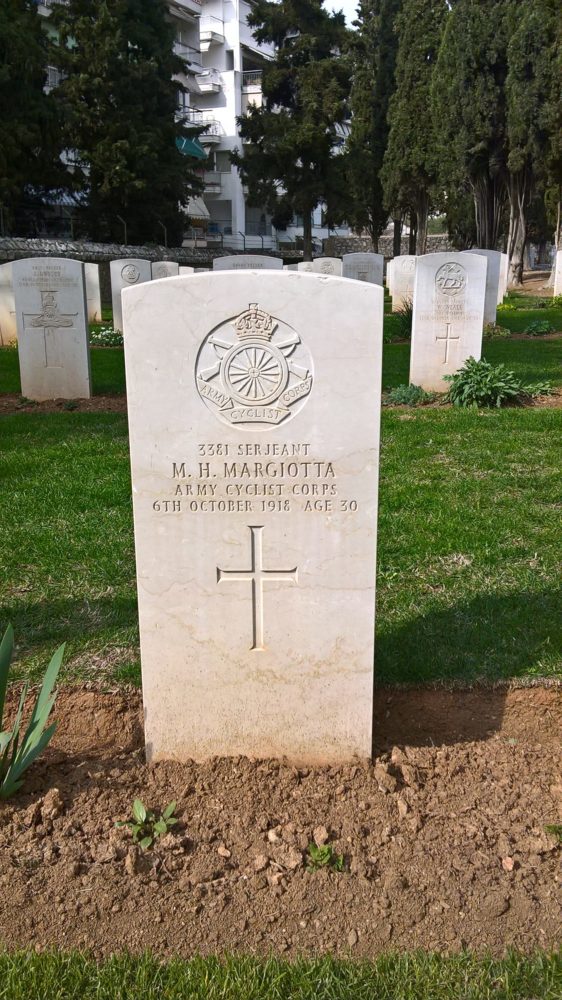
A Gold Medal Cyclist: the story of Sergeant Michael Henry Margiotta
Regular contributor to these pages, Robin Braysher, first wrote about Michael Margiotta on 6th October 2018 – the 100th anniversary of Michael’s death in Salonika. You can now read a much fuller account by Robin of Michael’s life and service and how he was honoured by the King of Serbia to become “A Gold Medal Cyclist” at the excellent site: Away from the Western Front.
Remembering Samuel Jenkins and 6/Royal Inniskilling Fusiliers
My thanks go to David Jenkins who – rather longer ago than I am prepared to admit – shared the story of his grandfather, along with some fascinating photos.
Samuel Jenkins enlisted in the 6th (Service Battalion), Royal Inniskilling Fusiliers on 1 September 1914, the Battalion having been raised in Omagh during the previous month. Samuel’s service with The Skins is a little hazy, but we know he sailed from Liverpool in early July with the rest of 10th (Irish) Division, with his overseas service commencing with his disembarkation on 11 July 1915, probably on Lemnos. One (!) of his National Archive medal index cards give this date with the note ‘(2B) Balkans’, meaning ‘Balkan Theatre – Gallipoli and Aegean Islands’. This made him eligible for the 1914/15 Star. Four weeks later, the Division landed at Suvla Bay, Gallipoli.
Continue reading “Remembering Samuel Jenkins and 6/Royal Inniskilling Fusiliers”Soles of boots were tied on with rags
Although women who had served in Salonika – in whatever capacity – were eligible to join the SRA from the very start, they didn’t gain their own specific section in The Mosquito until September 1931 (issue 15), with Eileen Moore’s ‘Woman’s Page’. Later, this was expanded to ‘Women’s Pages’ and continued for the rest of The Mosquito’s long existence. So it was only right and proper that the final issue in May 1969 – a longer, glossier souvenir album, entitled Salonika Memories 1915-1919 – included it’s own ‘Women’s Pages’. By now this was edited by Miss N. M. Simcox. In her final editorial, she had this to say:
Continue reading “Soles of boots were tied on with rags”William Richmond and 10/Black Watch (4)
William Richmond was demobbed in 1919; his medal index card in The National Archives shows that he entered the ‘Class Z Reserve’ on Valentine’s Day. This allowed him to return to civilian life, but there was an obligation to ‘return to the colours’ if necessary, an obligation which was not abolished until 31 March 1920. The card also shows that he was eligible for the famous trio of Great War campaign medals known as Pip, Squeak and Wilfred, named after cartoon characters: the 1914/15 Star (for his service overseas before 31 December 1915), the British War Medal and Victory Medal.
Continue reading “William Richmond and 10/Black Watch (4)”‘Awards and Honours of the Macedonian Campaign’ research project – an update.
We are very grateful to SCS Member, Rob Elliott for leading this project that attempts to compile a single record of the awards and honours given to those serving in the Macedonian Campaign. Full details of the aims of the project can be found here.
Rob, with some help from Society Chairman Alan Wakefield, and Members Harry Fecitt and Andy Siddall, has made remarkable progress in compiling this database of honours. A first release was made on 12th January, containing 1067 entries with 276 citations, and Rob has just published the second update , comprising 1960 names of which 283 have full citations. The database is available on the SCS Members’ Area here.
For a full explanation of the work and progress made so far, please read Rob’s report here.
If you are able to spare some time in helping Rob, please send him a message via the form below.


 Salonika Campaign Society, 1915-1918