
Modern Thessaloniki seems a quintessentially Greek city but, during the First World War, it was a multi-ethnic and multi-cultural city which, just a few years before, had been part of the Ottoman empire. It was especially a Jewish city.
Continue reading “The Jews of Salonika”Tag: Remembrance
The aim of the Society is to perpetuate the memory of those of all nations who served, whether they were members of the armed forces, medical services or civilian staff. The Society does not seek to glorify war and is neither politically nor commercially motivated.
Rough Riders Remembered
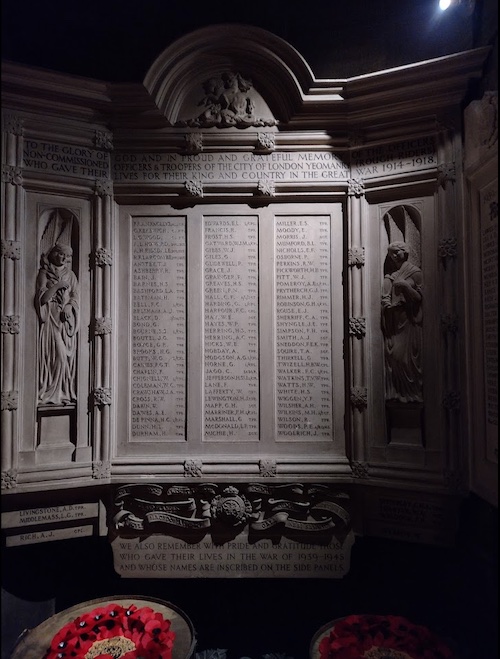
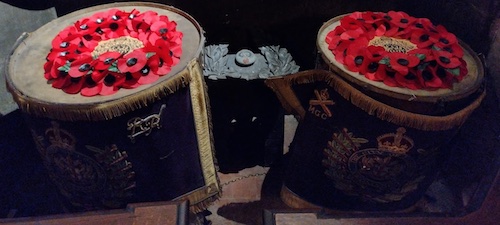
Whilst in London recently we were passing through Smithfield on our way to St Paul’s, when I came across a hidden church: St Bartholomew the Great. It was open so we couldn’t resist going in for a nosey around and I’m very glad we did. It was especially atmospheric as it had some lighting on (it was going dark outside), a choir was practising for a concert and I’m sure there was a lingering smell of incense. With a long history – founded in 1123 – there is much of interest inside, but the item that especially caught my eye was comparatively recent: a memorial to the fallen of the City of London Yeomanry (Rough Riders) in the world wars.
One of the Regiment’s battle honours is ‘Macedonia 1916-17’.
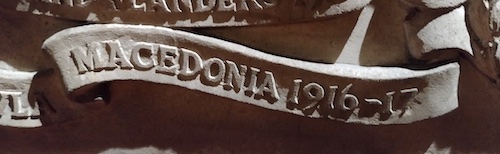
1/1st City of London Yeomanry (Rough Riders) arrived in Salonika from Egypt – having earlier been in Gallipoli – in November 1916 as part of 8th Mounted Brigade. Its sojourn in Macedonia was relatively brief and the Brigade returned to Egypt in June 1917, where it became part of the Yeomanry Mounted Division which took part in the campaign in Palestine. In mid-1918 the Regiment moved to France as part of the Machine Gun Corps.
These are most of the dead from the First World War – several more are on a side panels:

According to the CWGC website, just five are buried in Greece. All are described as ‘died’, which suggests to me that the cause was disease or accident, but I know that’s not conclusive. From the dates of death, just one of the casualties is from the time the Regiment spent in Macedonia:
Two are casualties from the Gallipoli campaign, buried on the island of Lemnos
- 24 October 1915 – 2240 Private Horatio Cortissos De Pinna, aged 27; buried at East Mudros Military Cemetery (III.C.67);
- 1 December 1915 – 2824 Private Y F Wiggen; buried at Portianos Military Cemetery (V.A.83).
Just one is from the regiment’s time in Macedonia:
- 4 March 1917 – 3178 Private Thomas Victor Wilmott Watkins, aged 29; buried at Salonika (Lembet Road) Cemetery (937).
The other two died after the regiment left for Egypt, so stayed on in Macedonia for some reason:
- 13 October 1917 – 41436 Private W R S Wybrow, aged 45 (possibly a victim of influenza); buried at Kirechkoi-Hortakoi Military Cemetery (21);
- 15 March 1918 – 7436 Private W Laffeaty, aged 36; buried at Mikra British Cemetery, Kalamaria (232).

To find out more, please visit:
- The Yeomanry pages on The Long, Long Trail website
- The Inns of Court and City Yeomanry website (which includes the museum)
…if needs be to stop there for good.
My thanks go to Lucy London (of the excellent Forgotten Poets of the First World War site) for sending on this poem, and details of its author, written in 1915.
A Candid Opinion
Do we want to back to the trenches?
To get biscuits and bully to eat
To get caught by a sniper’s chance bullet
Or crippled with frost bitten feet.
There are some say they’re anxious to get back
There are others who say they are not.
It is not that they care for the danger
Or are frightened that they will get shot.
It’s the awful conditions you live in,
Midst the rain and the mud and the dirt.
Where you’d give a month’s pay for a square meal,
And twice that amount for a shirt.
No, I’m not at all anxious to go back,
But I’ll have to go that’s understood
So I’m willing and ready to go there
And if needs be to stop there for good.
The poem’s author was William Fox Ritchie, born on 15th June 1887 in Bellshill, Lanarkshire, Scotland. William joined Princess Louise’s Argyll and Sutherland Highlanders in April 1909 and served in Malta and India. With the outbreak of war he served in Flanders where he suffered from frostbite and, in 1915, was invalided home.
Perhaps as his poem suggests, William felt compelled to return to active service. In 1917 he volunteered and joined 12th Battalion of the Argyll and Sutherland Highlanders in Salonika. Serjeant William F. Ritchie was killed in action at the Grand Couronne, Salonika on 12th September 1918. He is buried at Doiran Military Cemetery where his inscription reads, Until the day break and the shadows flee away.

Source: https://livesofthefirstworldwar.iwm.org.uk/lifestory/3753074
Remembered
At the Cenotaph in Whitehall …

(Photo by Keith Roberts)
At the Field of Remembrance (2021), by Westminster Abbey …
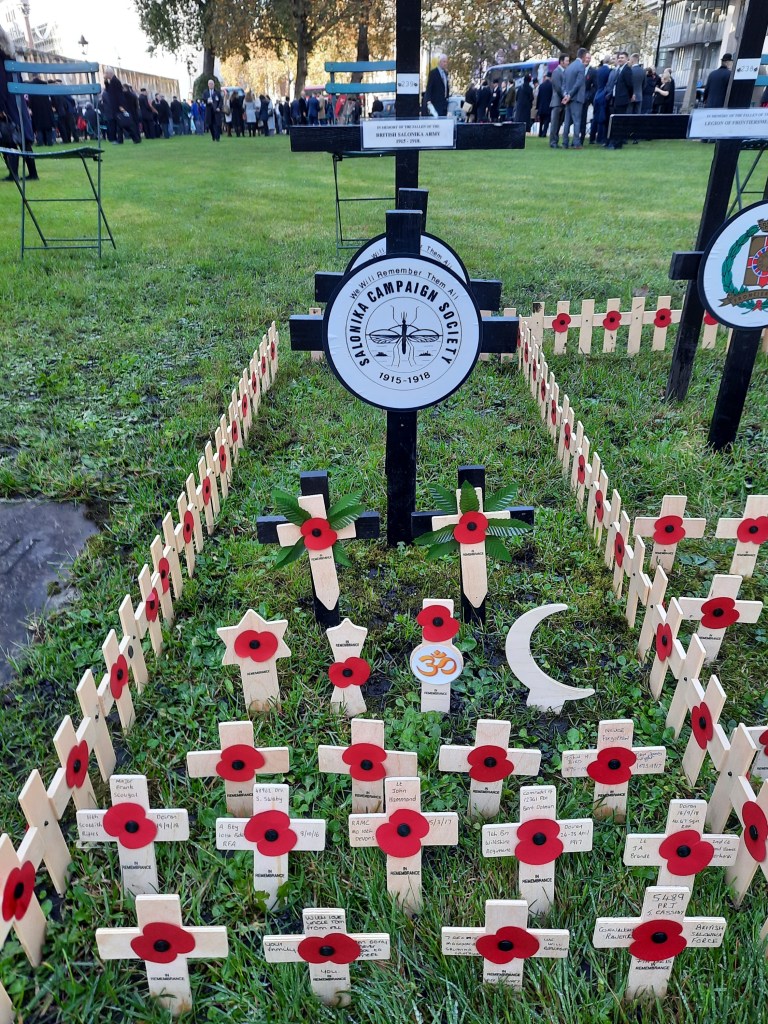
At Sandham Memorial Chapel (2021) …
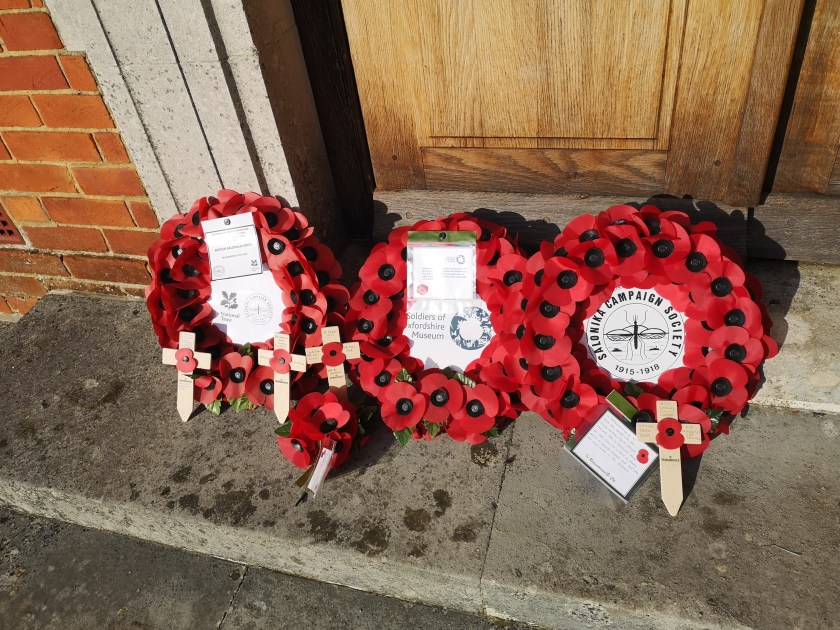
At Polykastro, Greece (2010) …

They shall grow not old …

Pillar Hill Cemetery, Doiran Front, Salonika. © IWM Q 64343
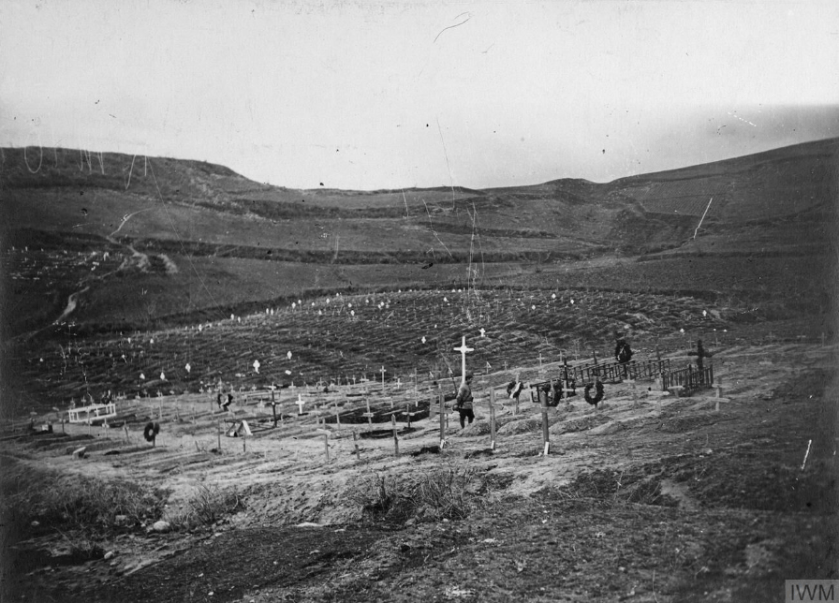
Allied war cemeteries at Monastir, the cemetery in the foreground is French, 17 January 1917. © IWM Q 78321
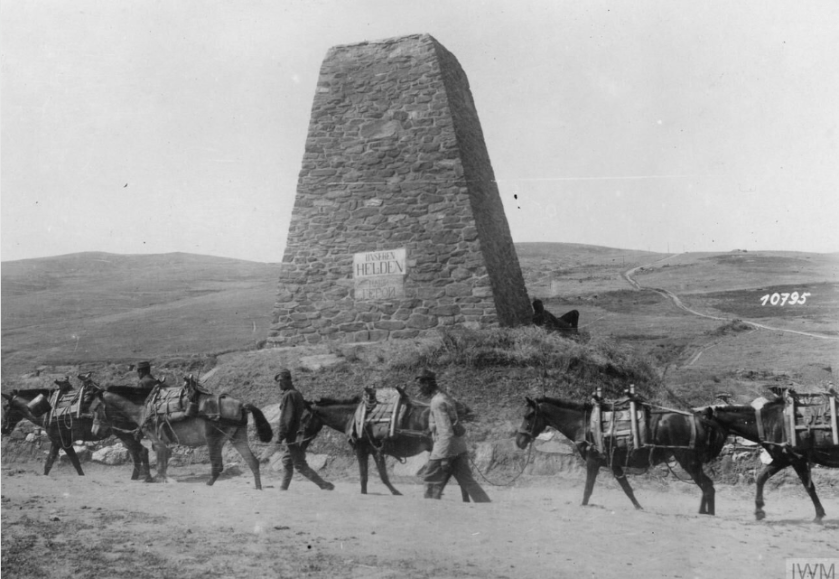
An Austro-Hungarian mule train passing by a monument to German and Bulgarian dead. The inscription reads “Our Heroes” in German and Cyrillic alphabet. © IWM Q 86225
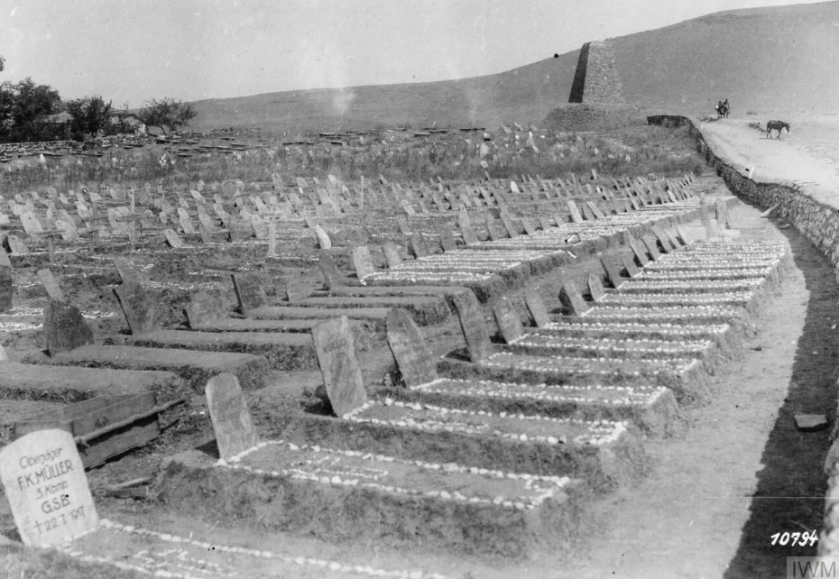
A German military cemetery near Cericani, Bosnia and Hercegovina, 1917. The nearest grave belongs to Oberjager F. K. Muller of the 3rd Company, Guard-Schutzen Battalion, died on 22 July 1917. © IWM Q 86565

A military cemetery of Austro-Hungarian prisoners near Uskub (Skopje), 1917. Note a cross with a word “Swabia”, frequently written on other crosses. © IWM Q 86467
… we will remember them!
Remembrance
With Bonfire Night a rather damp memory we are now very firmly in the season of remembrance, although for our Society remembrance of the achievements, suffering and sacrifice of the British Salonika Force – and associated organisations, individuals and even animals in the campaign – is ongoing and not restricted to a specific time of year. Even so, members and friends will be gathering at war memorials across the country and at CWGC cemeteries further afield in the coming week.
I’ve long been fascinated by war memorials, which come in different shapes and styles: the one where I grew up (Barnet) has a splendid ‘winged victory’, but as she’s topless it was a bit embarrassing!; my local one (Dereham, Norfolk) is a sober Cenotaph lookalike; Bishop’s Stortford memorial once caught my eye because it has items of soldiers’ kit carved in stone; I rather like the one in Cambridge, showing a fully equipped ‘Tommy’ swinging along in fine style with victors’ laurels slung on his rifle. I think, though, that my favourite is in Rawtenstall, Lancashire.
I have mentioned it before, but make no excuse for including it again. What makes it so interesting is that it isn’t just about the army, or even the wider armed services in the First World War, nor is it dedicated to ‘The Glorious Dead’ alone, but has a much wider dedication. Entitled Tribute of Honour, it reads as follows:
To the men who made the supreme sacrifice, to the men who came back and to those who worked at home to win safety for the Empire. 1914-1918.
No mention of women specifically in the dedication, but they certainly feature in the friezes around the base of the memorial, which I shared with you on an International Women’s Day. For this remembrance season here are all the friezes, showing many aspects of the war effort at home and overseas.
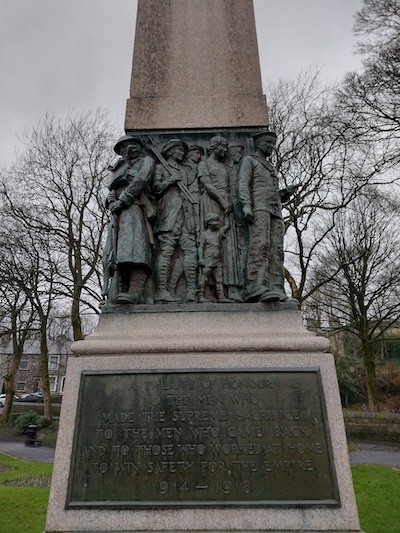
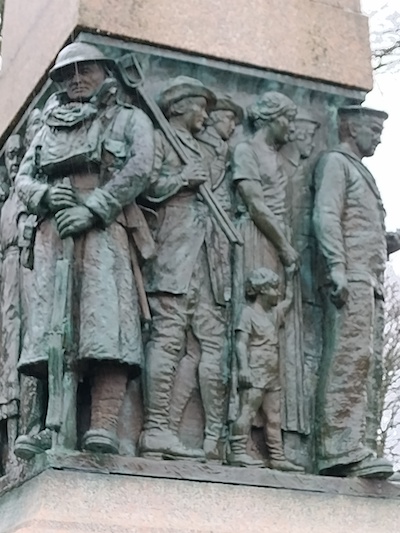
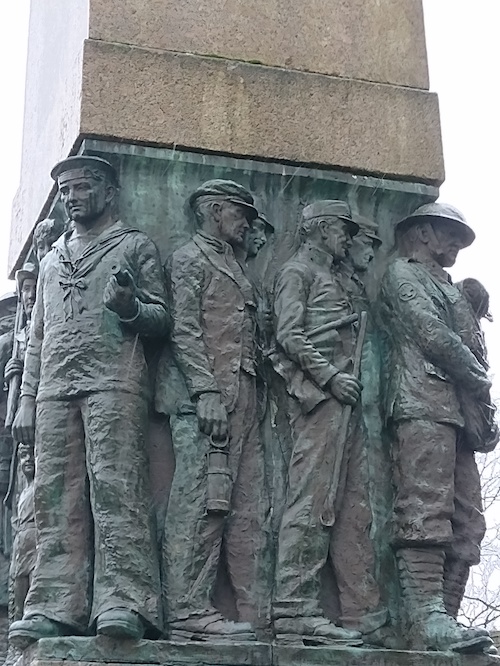

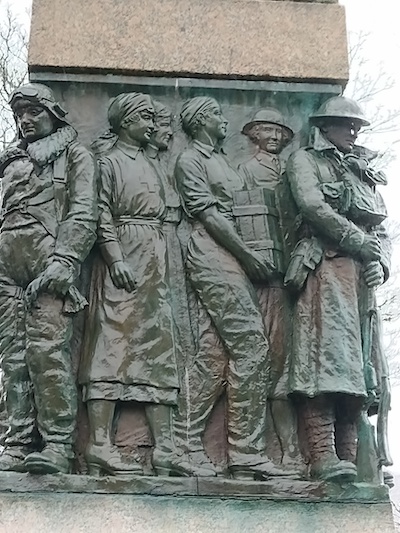

We will remember them all.
Heritage Open Days 9-18 September 2022
Many readers will know of Sandham Memorial Chapel and Stanley Spencer’s stunning paintings reflecting his experiences of Salonika. If you haven’t visited before, there is a great opportunity to do so this September as part of a programme that offers over 3,000 free in-person or virtual visits to sites in the UK.
The sites open this September include several military museums and other sites of relevant interest. For example, the Commonwealth War Graves Commission has created a number of open days and tours across the country.
To find out more about the sites open across the UK, use these links:
https://www.heritageopendays.org.uk/
https://discovernorthernireland.com/things-to-do/arts-culture-and-heritage/european-heritage-open-days
https://www.doorsopendays.org.uk/
https://cadw.gov.wales/visit/whats-on/open-doors-events
Featured image: Commonwealth War Graves Commission
Would you like to write an article for ‘The New Mosquito’ ?
I always look forward to the thump of the society’s journal, The New Mosquito, falling through the letter box onto the floor beneath. I also look forward to the tactile pleasure of holding a printed publication and reading with more leisure and a slower pace than I tend to do with online materials.
It may be that you have something that you would like to share, via the journal, with fellow members of the society. Perhaps you have a story of a relative who served in Salonika, results of research, or letters and photographs from the time. If so, we would be delighted to hear from you and, to help the process, we have put together a simple webpage which you can find here. We look forward to hearing from you!

Remembering William Hernaman
On a recent visit to Walthamstow I took a look at the Vestry House Museum. A former workhouse – built in 1730 – it has a chilling message over the front door: If any would not work neither should he eat. Well, it was chilling for this retired gentleman! Anyway, the building has changed use many times since then – including a spell as the armoury for the local volunteers – but is now the museum for the local area, under the care of Waltham Forest Council, for which it is also the archive and local study area.
Continue reading “Remembering William Hernaman”Gas! 22 April 1915
Continue reading “Gas! 22 April 1915”Thursday, 22 April, was a beautiful spring day: warm, sunny, with a faint breeze. German guns shelled French and Canadian trenches throughout the morning but fell silent in the afternoon. The brief period of peace suddenly ended at 4:00 p.m. when the Germans unleashed a violent bombardment, first on the salient and then gradually extending to nearby roads and Ypres, turning the town into a flaming inferno and causing its citizens to flee. An hour later an ominous greenish-yellow wall of fumes was seen drifting slowly across no-man’s-land toward the French line.
Cassar, G.H. (2014), Trial By Gas – The British Army at the Second Battle of Ypres; Potomac Press, University of Nebraska Press.
 Salonika Campaign Society, 1915-1918