The Society’s 2025 tour (Sunday 21st to Tuesday 30th September) of the British Salonika Force battlefields is now well underway – with battlefield studies, cemetery visits and acts of commemoration. This year the tour has a special focus on artillery and small-scale operations.
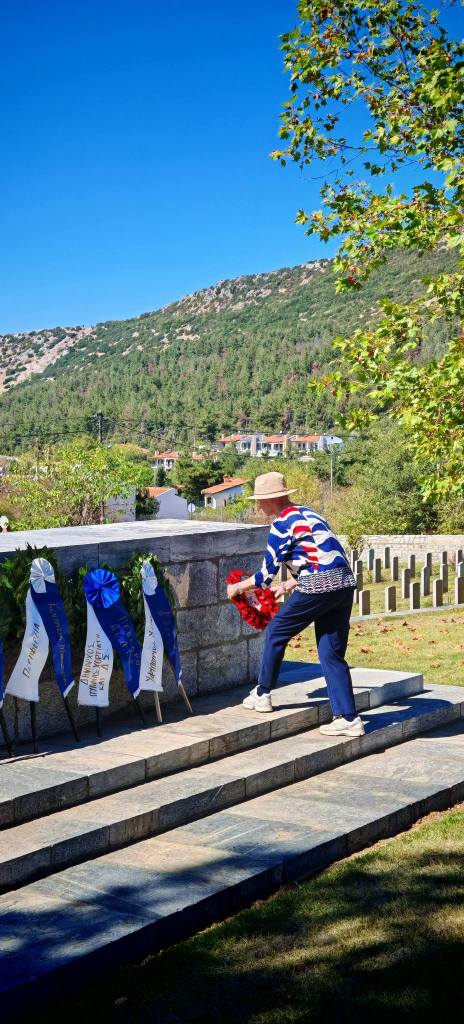
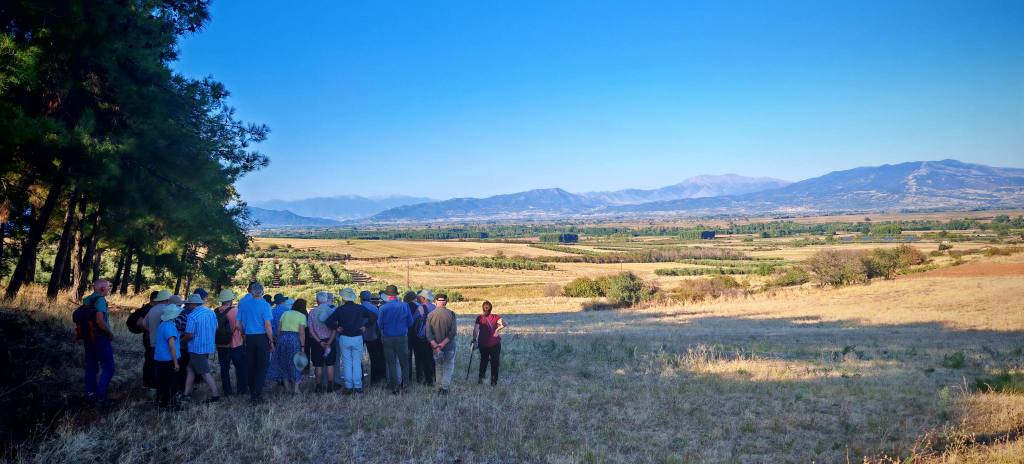
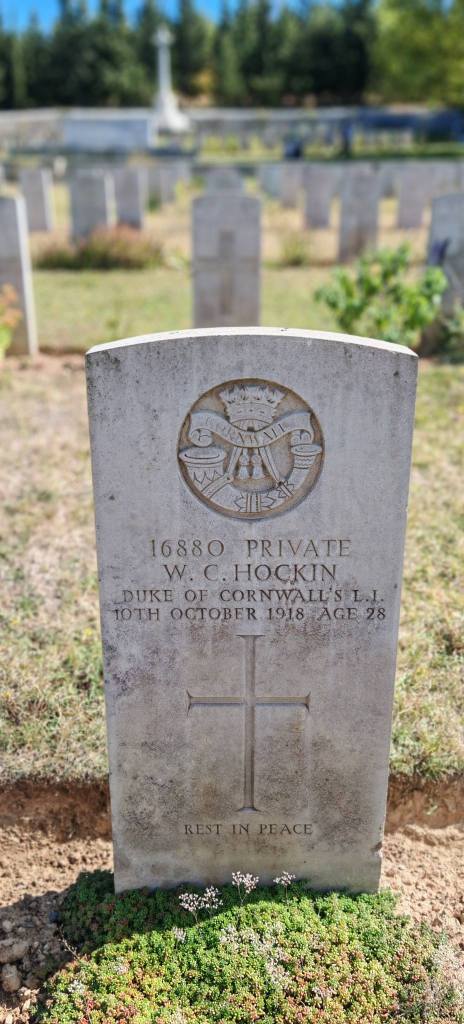
The tour began with a Ceremony of Remembrance at Kirechkoi-Hortkoi cemetery, with a wreath laid by Patron of the Society, the Honourable Ann Straker, before moving on to Triada village for an introduction on the BSF in the Struma Valley and the role of artillery on that part of the front.
You can follow the progress of the tour on Facebook here.
Patron of the Society, the Honourable Ann Straker, lays a wreath at the Ceremony of Remembrance at Kirechkoi-Hortkoi cemetery
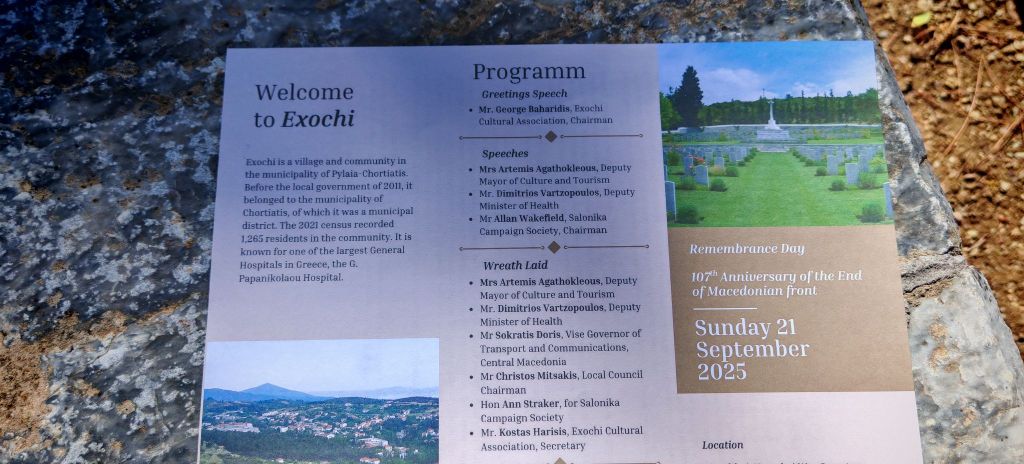
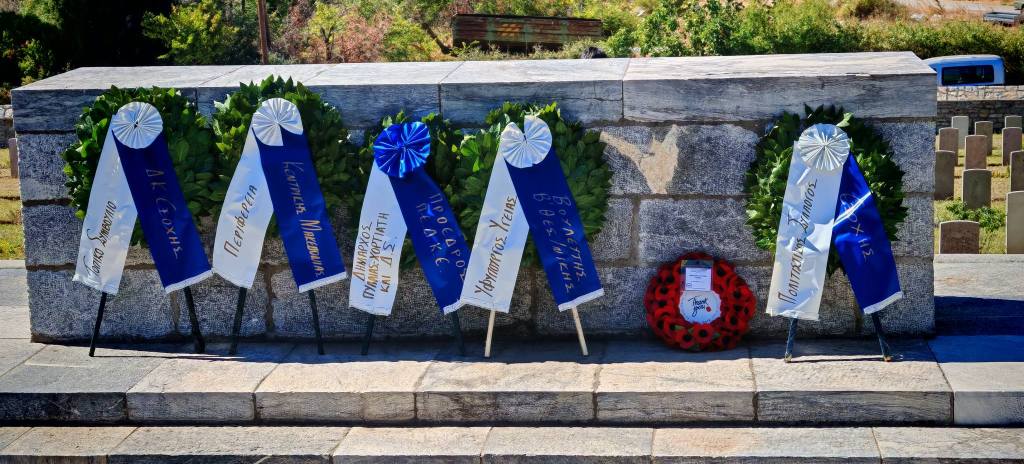
Programme for the Ceremony of Remembrance at Kirechkoi-Hortkoi cemeteryMemorial Wreaths at Kirechkoi-Hortkoi cemeteryTour members begin their site visits
The ‘Artillery & Small Operations’ Tour – Sunday 21 to Tuesday 30 September 2025
Explore the key locations of the British Salonika Force during the 2025 battlefield tour, with a special focus on artillery and the small-scale but intense operations that defined the campaign—raids, ambushes, and offensive patrols.
At Doiran, we’ll examine the crucial role of both British and Bulgarian artillery during the First and Second Battles of Doiran. On the Kosturino battlefield, we’ll revisit the desperate December 1915 fighting of the 10th (Irish) Division. In the Struma Valley, we’ll explore the sites of XVI Corps’ limited offensives between 1916 and 1918, as well as the defensive positions held by British forces.
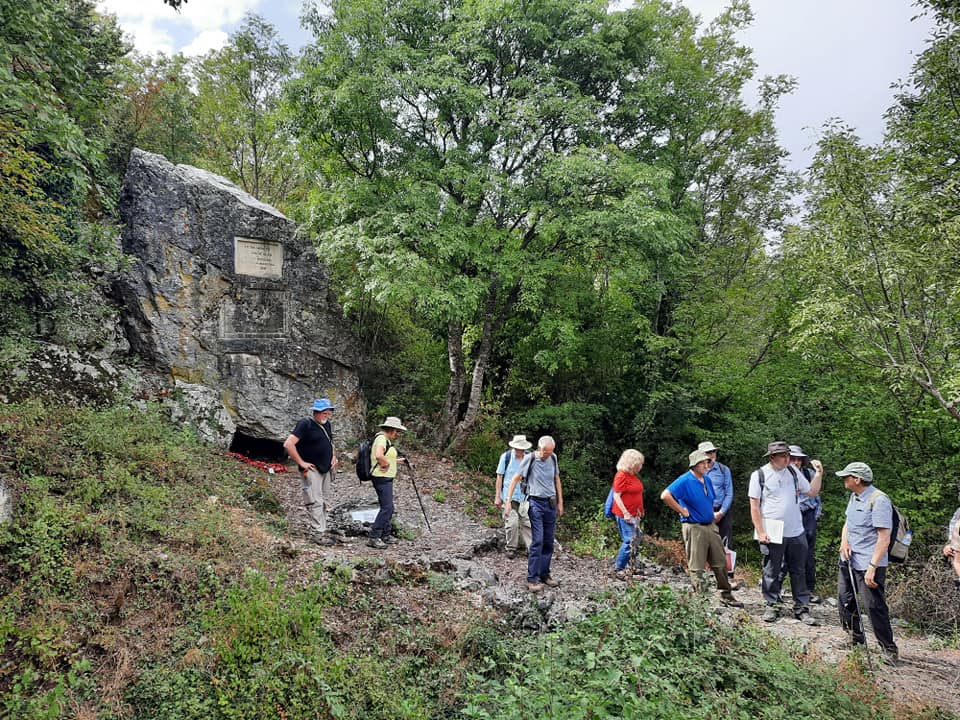
Exploring sites during the 2024 tour
Our journey continues to Bowls Barrow and Smol (now Micro Dassos) in the Vardar sector, where we’ll see firsthand how operations were often designed to divert Bulgarian attention from Doiran. We’ll also visit sections of the Birdcage Line defences and the village of Mavroplagia (formerly Karamudli) in the Krusha Balkan Hills.
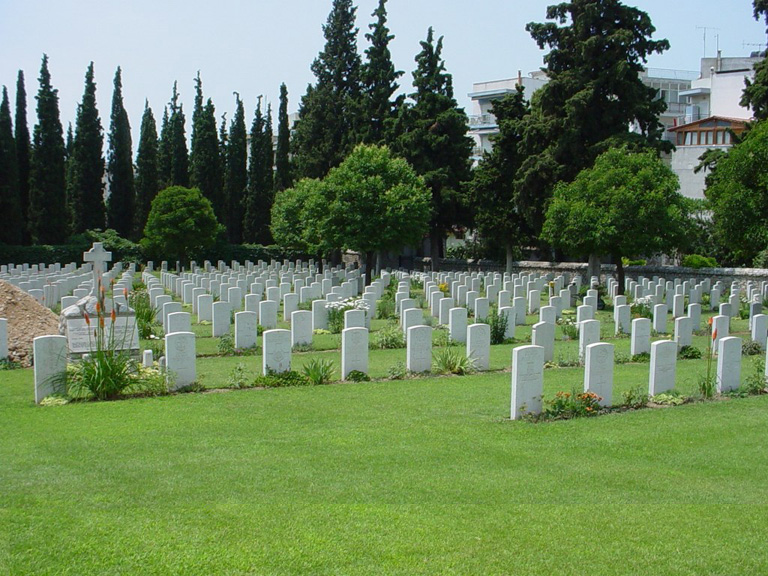
The tour will include visits to several Commonwealth War Graves Commission cemeteries, including Doiran (with the Memorial to the Missing), Karasouli, Kirechkoi-Hortakoi, Lembet Road, and Struma.
Running from Sunday 21 to Tuesday 30 September 2025, the tour is timed to coincide with the official commemorations marking the end of the Salonika Campaign, held over the last full weekend of September.
Led by SCS Chair, Alan Wakefield, this is a great opportunity to walk in the footsteps of BSF history.
To register your interest and receive further details, contact Alan Wakefield via email.
SCS Secretary, Chris Loader, has just released a new episode of his podcast Salonika Secrets (mentioned here in April, 2024).
In Episode 4 of the podcast, Chris begins a new series dedicated to sharing the stories of the fallen officers of the 10th Hampshire Regiment during the Salonika Campaign.
The series begins with the story of Lieutenant John Howard Tanner, who was killed on September 15, 1916, and is buried in the Struma Military Cemetery in Greece.
As much as the malaria, harsh climate, and isolation of soldiering up-country, what came to define the Salonika Campaign in the eyes of British soldiers was the variety of Allied armies deployed to Macedonia. British, French, Italian, Serbian, Russian, and Greek troops (not to mention contingents from across the British and French colonial empires) all served alongside one another in the ranks of the French-led Armées Alliées en Orient (Allied Armies in the East). The sheer diversity of this multinational force made interallied friction an inevitability; from the generals and politicians responsible for directing the campaign down to the rank and file, who had to overcome differences in language, race, and culture to live and fight together – not to mention weather the effects of the high-level political disputes and battlefield defeats which marred the campaign.
The Salonika Army Christmas Card 1916 displaying soldiers of all Allied nations taking part in the campaign. From left to right standing: Montenegrin, British, Serbian, Italian, French Colonial Zouave, Indian, Greek. Kneeling: French Colonial Cochin Chinese, Russian, French, French Colonial. Image source IWM
When the British Salonika Force attacked either side of Lake Doiran on 18 and 19 September 1918, in what would become known as the Second Battle of Doiran, British troops did not go over the top alone. The Greek Serres and Cretan Divisions spearheaded the assaults of XII and XVI Corps. Both were formations of Venizelist volunteers raised by the Provisional Government of National Defence prior to Greece’s formal entry into the war the previous summer. Lieutenant General Sir Henry Fuller Maitland Wilson, the commander of XII Corps, was also assigned the French colonial troops of the 2ndBis Regiment of Zouaves. While part of the French Armée d’Afrique rather than the metropolitan French army, this designation reflected their institutional organisation rather than composition, with the ranks drawn from the white population of North Africa and supplemented by volunteers and drafts from France itself. After serving in some of the fiercest battles of 1914-15 on the Western Front, the 2ndBis Regiment had served at Salonika from the inception of the campaign, participating in the Serbian campaign in 1915, as well as the defensive and counteroffensive operations of 1916 around Florina and in the Cerna Bend.
General Bailloud, G.O.C. 156th French Division, helping Lieutenant General Sir Bryan Mahon fix a medal on a Zouave’s Coat. Lieutenant Colonel Bernard Forbes, 8th Earl of Granard is also present. Salonika, February 1916. Image source IWM
At Doiran, the Zouaves remained in Corps Reserve during the bloody repulse of the 22nd and Serres Divisions on the first day of the battle. The heavy losses suffered by the assaulting formations of XII Corps left only the 77th and 65th Brigades available to renew the assault, despite the latter having been ravaged by the Spanish Flu. One battalion of the 65th Brigade, the 9th King’s Own Royal Lancaster Regiment, was tasked with attacking Pip Ridge in conjunction with the Zouaves. In eventuality, the 9th King’s Own attacked entirely unsupported. While moving up to their assembly point in Jackson Ravine, the main column of Zouaves came under harassing artillery fire in Doljeli Ravine, which inflicted 50 casualties, including the commander of one battalion, and led the Zouaves to scatter. Because the new battalion commander refused to advance until the shelling of Jackson Ravine had ceased, few reached their assembly point, and the 2ndBis Regiment played no part in the attack. Major General Sir John Duncan, commander of the 22nd Division, attempted to halt the assault of the 9th King’s Own but his orders failed to reach the battalion in time, who proceeded to attack through the British barrage and suffered 233 casualties.
Overall, the renewed assault on 19 September ended in another bloody failure. In all, the losses sustained by the British units of XII Corps totalled 349 officers and 5,891 other ranks. Although their efforts around Doiran tied down Bulgarian troops, enabling Allied forces elsewhere to land the knockout blow, British soldiers searched for scapegoats for their defeat. Some blamed the Greeks, but others serving in units under XII Corps severely criticised the Zouaves for failing to attack. In his report to XII Corps after the attack, Major-General Duncan noted that their failure to advance had left the left flank of the 77th Brigade dangerously exposed. As a result, the 12th Battalion Argyll and Sutherland Highlanders, who had captured the position known as the Tongue, suffered from heavy machine gun fire as well as faced a Bulgarian counterattack from this direction.
Attributing blame to the Zouaves became an increasingly entrenched view in the interwar years. Cyril Falls, the British Official Historian, considered that their failure to reach their assembly positions had ‘made the task of the British troops impossible.’ In his anonymous memoir Fusilier Bluff: The Experiences of an unprofessional soldier in the Near East, 1918 to 1919, Colwyn Edward Vulliamy. labelled the Zouaves ‘unreliable’, a charge repeated when his account of the Second Battle of Doiran was republished by Sir John Alexander Hammerton in his series The Great War: ‘I Was There!’ under the title ‘I Saw the Futile Massacre at Doiran: A Plan that was Doomed to Failure’.
Almost fifty years after the Second Battle of Doiran, the culpability of the Zouaves resurfaced in the pages of The Mosquito. In 1968, Number 161 of the journal witnessed a fierce defence of the Zouaves sparked by a reprint in the previous edition of Vulliamy’s article from The Great War: ‘I Was There!’. A Colonel H.F. Heywood, who had served at XII Corps Headquarters during the battle, wrote furiously to the editor, enraged by “the slurs cast anonymously by ‘Unprofessional Soldier’ on a regiment of Zouaves”, as well as his criticisms of British officers and Milne specifically. He considered the charge of unreliability groundless given their heavy losses, having suffered severely from Bulgarian artillery fire:
“The floor of the ravine was so thickly carpeted with their corpses that two regiments which late had to cross the ravine reported that they had to walk on the bodies in order to get across.“
Heywood also invoked the example of one Zouave whose body he had come across after visiting the Devil’s Eye atop the Grand Couronné:
“His throat was slit from ear to ear. Had he refused to ‘talk’? Does ‘Unprofessional Soldier’ think him unreliable?”
Colonel H.F. Heywood’s letter rebutting the claim of ‘unreliable Zouaves’ – The Mosquito, Number 161, 1968
Ultimately, the British and their allies had emerged victorious in Macedonia. But such an exchange in The Mosquito reveals the persistent and deep-seated tensions evident in the conduct of coalition warfare. That alliances during the First World War extended far beyond the remit of political and military leaders is often undeservedly overlooked. On the ground, officers and soldiers had to grapple with the formidable task of turning strategic and operational decisions into battlefield success, the aftershocks of which persisted long after the guns had fallen silent.
*Dr Jake Gasson is a National Army Museum Fellow based at King’s College London, where he is a postdoctoral researcher. He obtained a DPhil from Pembroke College, Oxford, specialising in the Macedonian front of the First World War. Jake is the first recipient of the Salonika Campaign Society’s Philip Barnes Bursary.
In December of last year, we posted about a podcast series that featured an interview with Society member Chris Loader who had travelled with the Society on the September 2023 SCS Battlefield Tour to visit the grave of his great-great-grandfather, Henry Albert Obadiah Loader.
Inspired by a visit to Doiran Military Cemetery during the tour, Chris has now branched out to record his own podcast series: Salonika Secrets.
‘Salonika Secrets’ – a new podcast from Society member Chris Loader
The podcast tells of Chris’s search to identify an unknown British officer commemorated at Doiran. Without giving too much away, Chris has so far managed to narrow down the identity to an officer who served in the 12th Hampshire Regiment. You can listen to the podcast free on Spotify, Amazon and Apple and, no doubt, other podcast providers. Chris also posts updates and extra information on ‘X’ (formerly Twitter) here.
It was five o’clock in the morning on the edge of hell. Captain Jimmy Eynon looked up through the goggles of his gas mask at Grande Couronne, cursed savagely, and kicked a rugby ball high into the air. Before it fell, a Welshman had been shot to pieces … and another … and another.
from ‘Now the Agony!’ by Gareth Bowen in ‘The South Wales Echo‘, 1964
Tales from the Battlefields is a free podcast from battlefield guide and researcher Terry Whenham. It focuses on “the unheard stories of men who served on the Western Front during World War 1.”
However, in Episode 68 of the podcast, Terry interviews Chris Loader who travelled with the Society on the SCS Battlefield Tour in September this year. Chris describes the background to the campaign and his visit to the location where his two-times grandfather on his father’s side, Private Henry Loader of the 10th Hampshire’s, was mortally wounded in September 1918. I listened with a lot of interest to the story of Henry – and Chris’s research and visit – and I’m sure you will find it a worthwhile use of your time too. In my humble opinion of course!
You can listen to the podcast for free on Apple, Amazon Music, Spotify and directly from thispage.
Lembet Road Cemetery – final resting place of Henry Loader. Image from CWGC
The tower most associated with the Salonika campaign is Thessaloniki’s iconic White Tower but, on a recent trip to London, I discovered connections with the campaign at another iconic landmark – The Tower of London. During a visit we took a look in the Chapel of St Peter ad Vincula which, not surprisingly, remembers significant figures at the Tower over the centuries.
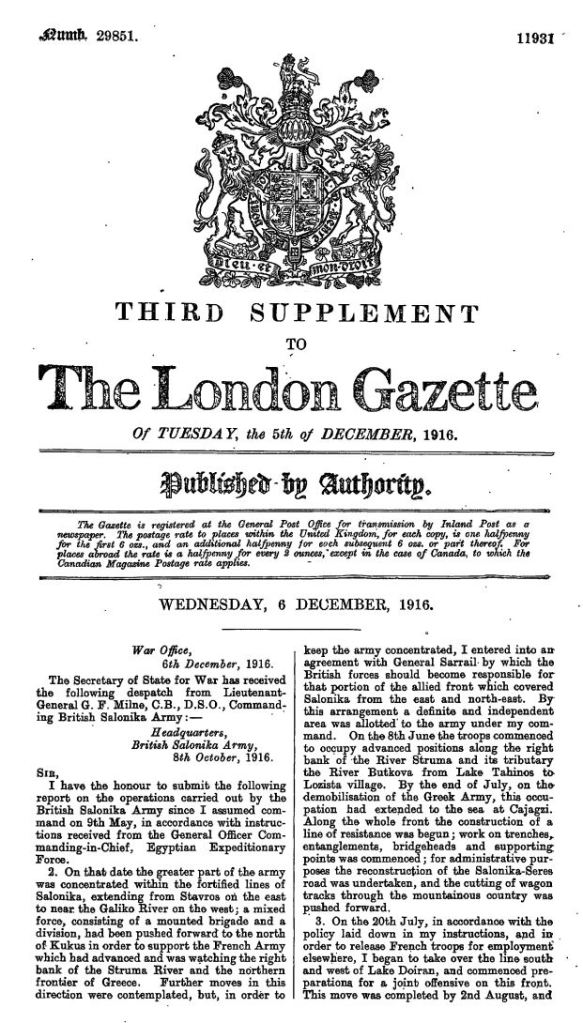
On this day, May 9th 1916, Lieutenant General George Francis Milne succeeded Lieut-General Bryan Mahon to become overall Commander-in-Chief of British Troops in Macedonia. Five months later, in October 1916, Milne submitted a report (published in The London Gazette of December 6th) summarising “the operations carried out by the British Salonika Army since I assumed command.”
To begin with, Milne states, “…in order to keep the army concentrated, I entered into an agreement with General Sarrail [French general and overall commander of the Allied forces in Salonika] by which the British forces should become responsible for that portion of the allied front which covered Salonika from the east and north-east. By this arrangement a definite and independent area was allotted to the army under my command.”
It’s interesting to read primary sources such as this against a wider background of historical perspective and analysis. In, ‘Under the Devil’s Eye’ Alan Wakefield and Simon Moody provide the context for Milne’s comments, “The new British commander was soon tested by the Frenchman’s brinkmanship when Sarrail stated that he had orders from Paris to launch an offensive and was prepared to do so with or without British assistance. Milne realised that, with his forward troops in close contact with the French, the BSF would either be dragged into an attack, which was beyond his operational remit, or, by holding back, risk accusations of failing to support an ally. He skilfully sidestepped the issue by asking for a separate British zone of operation… Sarrail agreed to the proposal and at a stroke Milne had disengaged his troops from the French.”
That analysis gives another layer of understanding to Milne’s report of how, “…in accordance with the policy laid down in my instructions, and in order to release French troops for employment elsewhere, I began to take over the line south and west of Lake Doiran…” and explains how actions in the area made it possible, “to shorten considerably the allied line between Doiran Lake and the River Vardar and on 29th August, in agreement with General Sarrail, I extended my front as far as the left bank of the river so as to set free more troops for his offensive operations.”
Politics aside, the rest of Milne’s report is a readable account of the first few months of his command in which he gives credit to the sections of his command and the men – and women – involved in the British side of the campaign.
You can download and read Milne’s entire report here. ‘Under the Devil’s Eye’ is available here.
Featured image, General Sarrail, commander of Allied forces in Macedonia (16 January 1916 – 22 December 1917), with General Sir George Milne, commander of the British Salonika Force from 9 May 1916. Source, IWM
Q: What does a Swedish heavy metal group have in common with the Salonika Campaign Society ? A: A mission to increase awareness of the lesser known events in military history.
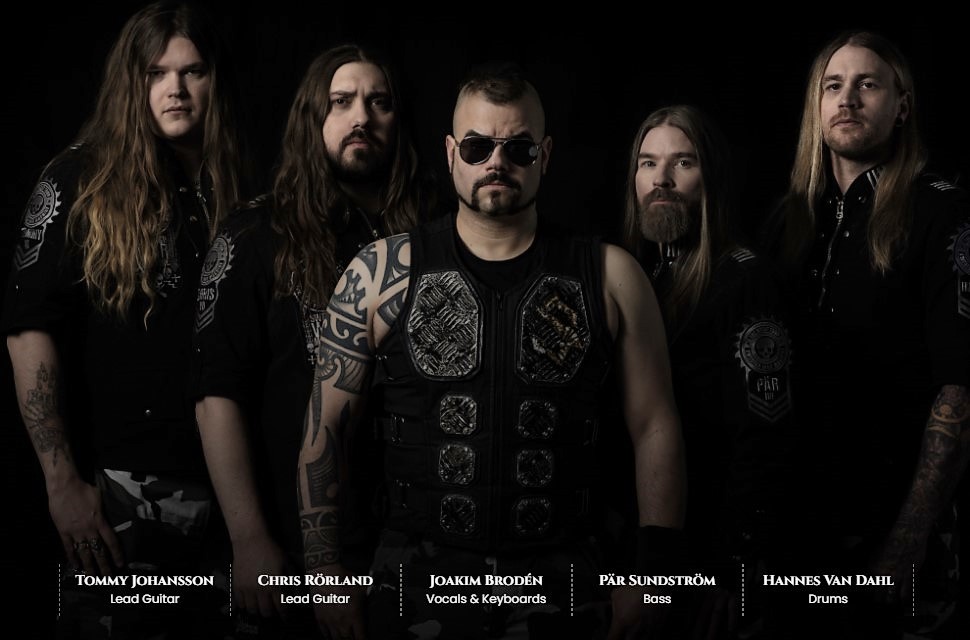
Sabaton, a five-piece heavy metal band from Sweden, has been playing its brand of very loud, fast, intense, military-style rock for nearly 20 years. They have built a sizable following of dedicated fans world-wide and have headlined rock festivals throughout Europe. They have released over a dozen albums and their most recent releases, ‘The War to End All Wars’, and ‘The Great War’, have concentrated entirely on recounting specific events and features of the world wars, on a mission to inform as well as entertain. Indeed, the band has its own YouTube channel (Sabaton History) that presents documentary-style shows using their music as the context.
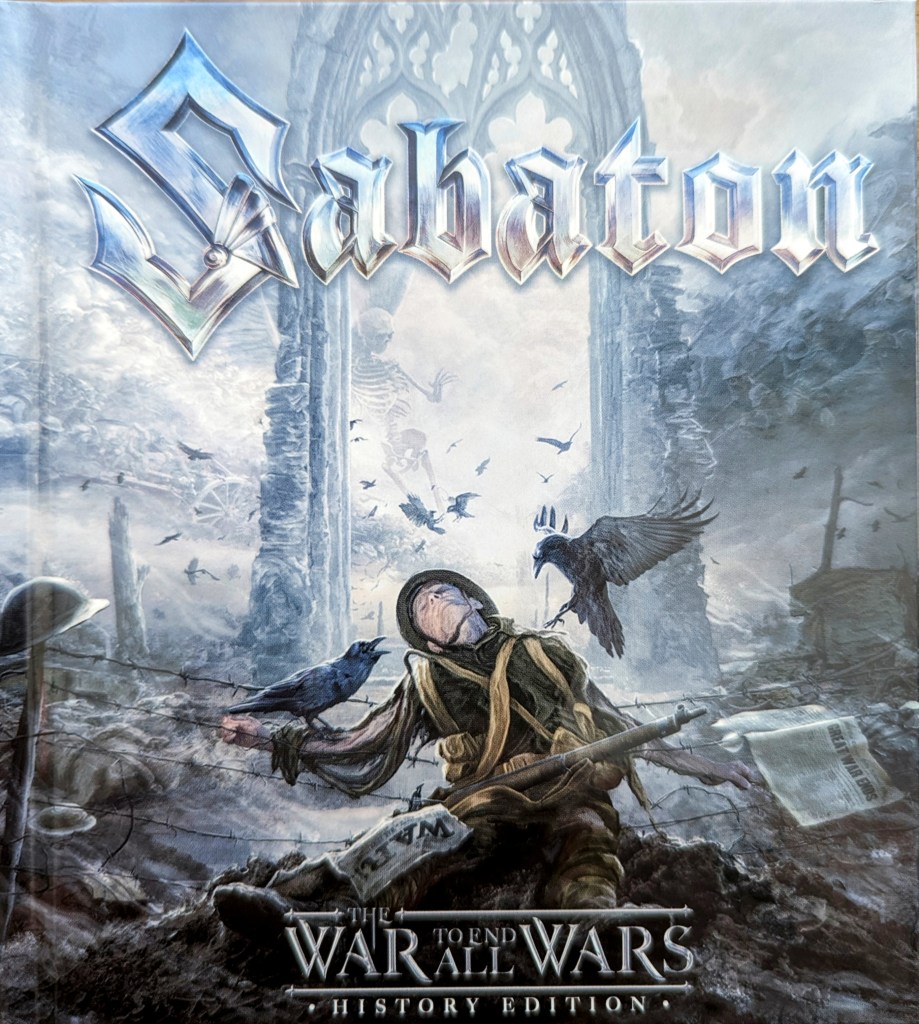
I recently agreed to accompany my teenage son, a keen heavy metal fan, to an upcoming concert by Sabaton, in Cardiff. In addition to securing a good pair of ear plugs, I decided to read up on the band and subsequently ended up being thoroughly immersed in their website. Of particular interest from the SCS perspective is track no.9 on ‘The War to End All Wars’ album which is entitled ‘The Valley Of Death’. As I discovered, it is based on the Battles of Doiran and, interestingly, the story-through-song is told mainly from the perspective of the Bulgarian defenders. In particular it highlights their great skill, resourcefulness and bravery in what are considered great victories in Bulgarian military history against a stronger Allied force.
The detailed information on the Sabaton website is supplemented by a link to, and transcription of, a special edition of the Sabaton History Channel which focuses on the ‘The Valley of Death’ , and the events that it refers to. The fifteen-minute show is presented by an actor/historian called Indy Neidell who has an extensive repertoire in this field. His account seems to be well researched and he presents very enthusiastically with a number of interesting graphics and photos. Towards the end, he is joined by Sabaton’s bass guitarist, Par Sundstrom, and he explains that the song was written partly in response to the demands of their Bulgaria-based fans. Subsequently, the band performed the song live for the first time ever when they headlined the ‘Hills of Rock Festival’ in Plovdiv, Bulgaria on 23 July 2022.
YouTube clips show that the song went down a storm with the partisan crowd, unsurprisingly. The closing lines of “The Valley of Death” summarise what is regarded as a triumph of defence:
For white, green and red, For the nation they’re fighting for, The British are done, Three times the defence of Doiran has been won.
In addition, the Sabaton website and the YouTube video make an appropriate reference to the poetry of Owen Rutter, “Tiadatha”, which was partly based on his experiences at Doiran. The extract used is as follows:
Had you been there when the dawn broke, Had you looked out from the trenches, You’d have seen that Serbian hillside, Seen the aftermath of battle, Seen the scattered picks and shovels, Seen the scraps of stray equipment, Here and there a lonely rifle, Or a Lewis gun all twisted. Seen the little heaps of khaki, Lying huddled on the hillside, Huddled by the Bulgar trenches, Very still and very silent.
Nick Palmer
Our thanks go to SCS member Nick Palmer for researching and writing this article. Thanks Nick!
YouTube video: ‘The Valley of Death – The Battles of Doiran – Sabaton History 115 [Official]’
The blurb accompanying the video: “The Bulgarian defences in the Lake Doiran region were pretty much the best defences any country had anywhere in the Great War, which the Entente forces discovered as they tried time and again and failed time and again – to break the front. “
Hills of Rock Festival, Plovdiv, 23 July 2022, with introduction from the singer about the song:




 Salonika Campaign Society, 1915-1918