
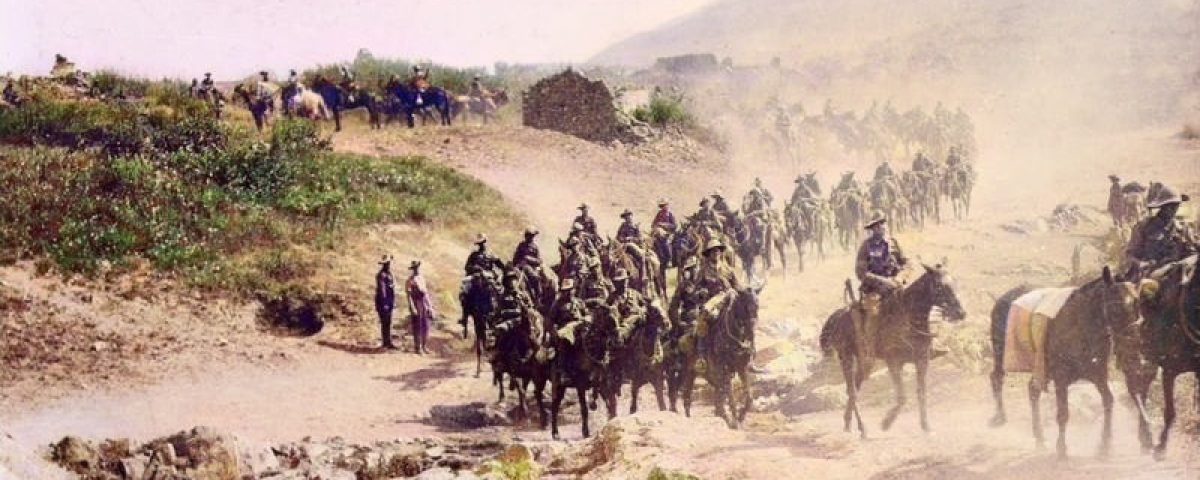
My thanks go to Rob Elliott and Andy Hutt who have both provided further information on 22nd Division’s production of The Chocolate Soldier. Before I share their pearls of wisdom, here is a link to a page with photos (scroll down!), which I found AFTER posting my article. I added it as a comment, but that may have been missed and the photos are certainly worth seeing:
Continue reading “More Chocolate Soldiers!”Tag: 22nd Division
22nd Division. An infantry division of the British Salonika Force.
The Chocolate Soldier
Wilton’s Music Hall is a fascinating theatrical venue in the heart of the East End of London, close to Cable Street where, in 1936, at least one Salonika veteran – PC Fred Braysher – took part in the infamous ‘Battle of Cable Street’.
Continue reading “The Chocolate Soldier”‘Topical Budget’ – newsreels
Topical Budget was one of the biggest British newsreels during the silent film era, competing with Gaumont Graphic and Pathé Gazette. It was produced by William Jeapes’ Topical Film Company and first released in 1911. Although several newsreels existed at the time, only Topical, Gaumont, and Pathé remained by the middle of World War I.
Topical had fewer resources than its competitors, and it might not have survived if not for a deal with the War Office, which needed an outlet for its official war films. In 1917, the War Office Official Topical Budget was launched, giving the newsreel exclusive footage from the front lines. Later that year, the War Office Cinematograph Committee (WOCC) bought the Topical Film Company, turning the newsreel into a useful propaganda tool.
After the war, the newsreel once again became the Topical Budget under the ownership of newspaper magnate Edward Hulton. Finally, never having adopted sound, the newsreel ceased production in March 1931.
A significant portion of Topical Budget’s wartime footage is preserved at the Imperial War Museum (IWM), where, after a little searching, you can discover many fascinating films from the Salonika Front.
Object description (IWM)
British troops, mainly 22nd Division, on the Salonika Front, 1917-1918 (?).
Full description (IWM)
(Reel 1) Wounded soldiers with mule transport, snow-covered mountains filmed from an aircraft (Mount Olympus ?). A 13-pounder anti-aircraft gun showing the rangefinder in use. A British Army camp, with a bakery and soldiers washing and eating. Three soldiers in a trench fusing Mills grenades. A Royal Engineers wagon laying a line. A view from the rear gunner’s position of a two-seater aircraft taking off, flying over Salonika harbour, the nearby mountains, and a military camp. (Reel 2) Brigadier-General F S Montague-Bates (66th Brigade, 22nd Division) in a posed position. A return shot of the three soldiers fusing Mills grenades. They change to fitting magazines on Lewis machine guns and using a trench periscope. General Guillaumat inspects a British battalion. General scenes of the British Army camp. A Red Cross wagon on the move. A heavily camouflaged gun (possibly a 60-pounder) and a 6-inch howitzer. More soldiers in trenches. Major-General J Duncan, commanding 22nd Division, and Lieutenant-General H F M Wilson posed together. British soldiers at bayonet practice. (Reel 3) A Highland battalion, probably Black Watch, with its pipe band, and a single piper playing. A French general decorates British troops, who march past.
Video source, all rights acknowledged
Remembering Great Uncle David and 11/Welsh
Continue reading “Remembering Great Uncle David and 11/Welsh”It was five o’clock in the morning on the edge of hell. Captain Jimmy Eynon looked up through the goggles of his gas mask at Grande Couronne, cursed savagely, and kicked a rugby ball high into the air. Before it fell, a Welshman had been shot to pieces … and another … and another.
from ‘Now the Agony!’ by Gareth Bowen in ‘The South Wales Echo‘, 1964
Mind the mozzies!
With family members heading off to tropical climes, I was quick to share my ‘specialist knowledge’ of anti-mosquito precautions – based entirely on reading about the BSF – and shared this splendid photo with the travellers:
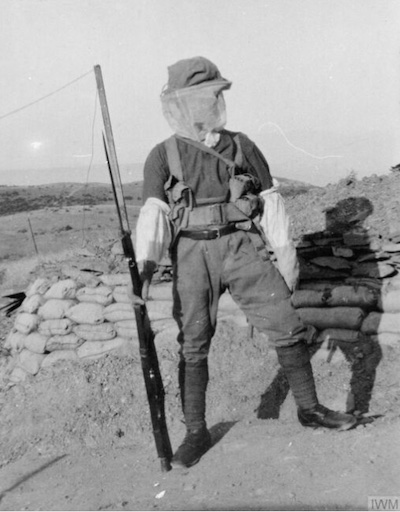
Lance Corporal Harrison, 12th Battalion, Lancashire Fusiliers, wearing protective anti-mosquito clothing as issued to troops on night duty during the summer months. Photograph taken at Bowls Barrow, 2 June 1918. © IWM HU 82035
I’m not sure how impressed they were, but I thought it gave an excellent impression of the precautions to take. So I was especially pleased to see anti-mosquito face veils at a reasonable price in a well-known hiking and outdoors shop and promptly bought one for each member of the party. I have seen them in use, although this was in the UK and – I suspect – more to humour me than a serious indication of an intention to wear them in foreign parts.
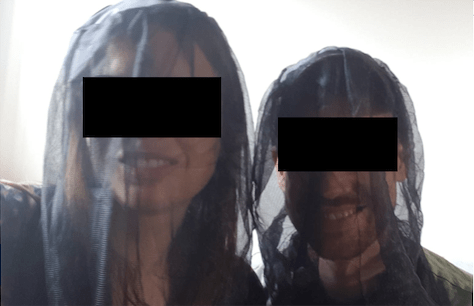
Just think how chuffed members of the BSF would have been to have these – they even look great with a slouch hat …
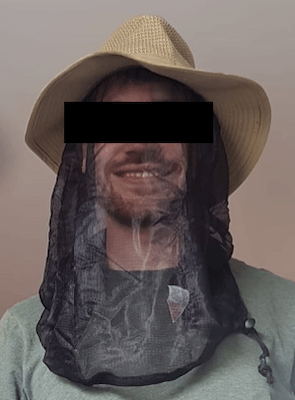
(of course, in proper use the veil should be tucked in at the neck!)
Well, they are on their travels and I don’t like to ask if they’ve used them yet, but I will be looking out for traces of mosquito bites on their faces when they return!
If you are travelling this summer, I hope you manage to avoid mosquitoes and midges. If not, maybe you should invest in one of these veils as a practical tribute to the BSF!
More on shorts!
The nice thing about doing these web posts is that sometimes people reply to them and so it has been with last week’s post on the shorts worn by the BSF.
Continue reading “More on shorts!”It’s St George’s Day!
Having celebrated the Welsh battalions of the BSF on St David’s Day and the Irish ones on St Patrick’s Day, how should I mark St George’s Day? I feel writers’ cramp coming on just thinking about typing out the names of the 52 or so English battalions of the BSF (see NM 11, April 2005) so, instead, will go for an easier option. The Royal Regiment of Fusiliers was formed on 23 April 1968, celebrates St George’s Day and, indeed, has an image of St George slaying the dragon on its cap badge. It was created by amalgamating four English fusilier regiments: Royal Northumberland Fusiliers, Royal Warwickshire Fusiliers, Royal Fusiliers (City of London Regiment) and Lancashire Fusiliers. Three of these regiments provided battalions for the BSF.
Continue reading “It’s St George’s Day!”‘Dydd Gŵyl Dewi Hapus’
… or, for non-Welsh speakers, that’s ‘Happy St David’s Day’! St David’s Day seems the perfect opportunity to remember the six Welsh battalions which served in Macedonia with the British Salonika Force.
Continue reading “‘Dydd Gŵyl Dewi Hapus’”Celebrating a Salonika VC Winner
The Victoria Cross was first introduced on 29th January 1856 to honour acts of valour during the Crimean War. Two VCs were awarded in the Macedonian campaign, one in 1916 and one in 1918. It’s the first of these, to Private Hubert William Lewis of 11/Welsh, that I want to celebrate today.
Continue reading “Celebrating a Salonika VC Winner”RIP Harlequin
I’ve just come across this fascinating story related to 9/Border Regiment (Pioneers), although it pre-dates their time with the BSF (22nd Division):
Continue reading “RIP Harlequin” Salonika Campaign Society, 1915-1918