
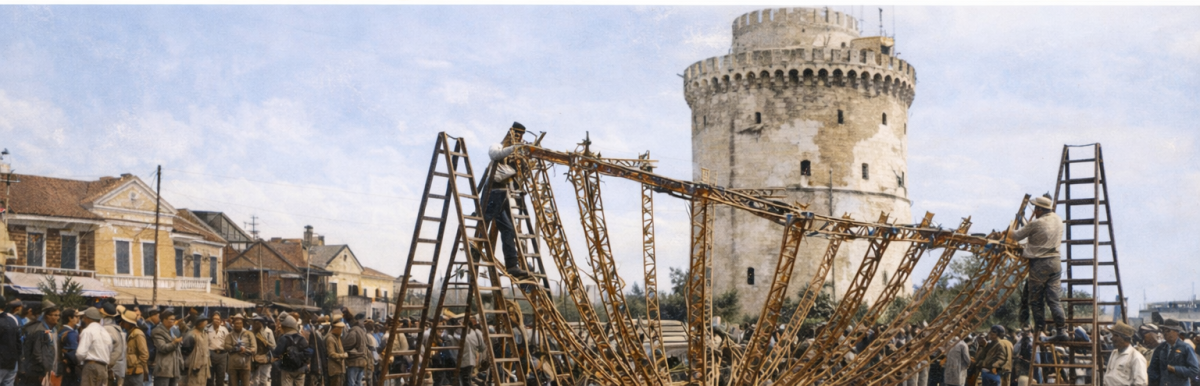
In January 1918 General Headquarters (GHQ) in Salonika felt the need to issue memoranda reminding commanders of formations that they were responsible for the efficiency of their units and for the training of all officers and men in them. In certain technical fields training had to be done at army schools but, generally, the purpose of these schools was to support units by training the trainers who would share, what we would now call ‘best practice’, within them. By this time GHQ Salonika had a number of schools under its control, covering subjects such as infantry training, artillery, signals, the Lewis Gun and anti-gas precautions. A School of Physical and Bayonet Training was also set up, with an Assistant Superintendent authorised by the War Office to coordinate and supervise this training, with a staff of 10 NCOs from the Army Gymnastic Staff (Official History vol. 2, chap. III). Our next sight of William Richmond is as a student at this School.
Continue reading “William Richmond and 10/Black Watch (3)”Tag: 1918
Events during the year 1915.
Mind the mozzies!
With family members heading off to tropical climes, I was quick to share my ‘specialist knowledge’ of anti-mosquito precautions – based entirely on reading about the BSF – and shared this splendid photo with the travellers:
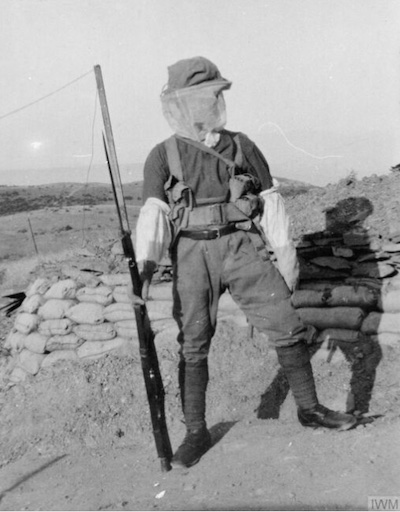
Lance Corporal Harrison, 12th Battalion, Lancashire Fusiliers, wearing protective anti-mosquito clothing as issued to troops on night duty during the summer months. Photograph taken at Bowls Barrow, 2 June 1918. © IWM HU 82035
I’m not sure how impressed they were, but I thought it gave an excellent impression of the precautions to take. So I was especially pleased to see anti-mosquito face veils at a reasonable price in a well-known hiking and outdoors shop and promptly bought one for each member of the party. I have seen them in use, although this was in the UK and – I suspect – more to humour me than a serious indication of an intention to wear them in foreign parts.
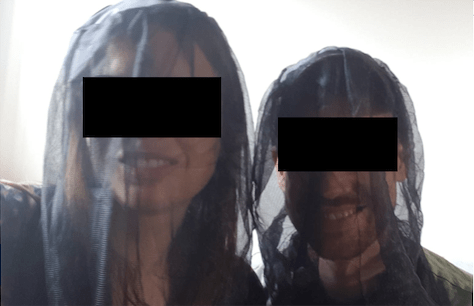
Just think how chuffed members of the BSF would have been to have these – they even look great with a slouch hat …
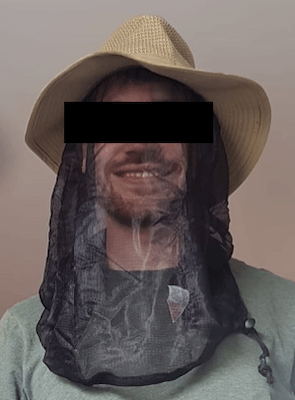
(of course, in proper use the veil should be tucked in at the neck!)
Well, they are on their travels and I don’t like to ask if they’ve used them yet, but I will be looking out for traces of mosquito bites on their faces when they return!
If you are travelling this summer, I hope you manage to avoid mosquitoes and midges. If not, maybe you should invest in one of these veils as a practical tribute to the BSF!
Remembered at the Tower
The tower most associated with the Salonika campaign is Thessaloniki’s iconic White Tower but, on a recent trip to London, I discovered connections with the campaign at another iconic landmark – The Tower of London. During a visit we took a look in the Chapel of St Peter ad Vincula which, not surprisingly, remembers significant figures at the Tower over the centuries.
Continue reading “Remembered at the Tower”Rough Riders Remembered
Whilst in London recently we were passing through Smithfield on our way to St Paul’s, when I came across a hidden church: St Bartholomew the Great. It was open so we couldn’t resist going in for a nosey around and I’m very glad we did. It was especially atmospheric as it had some lighting on (it was going dark outside), a choir was practising for a concert and I’m sure there was a lingering smell of incense. With a long history – founded in 1123 – there is much of interest inside, but the item that especially caught my eye was comparatively recent: a memorial to the fallen of the City of London Yeomanry (Rough Riders) in the world wars.
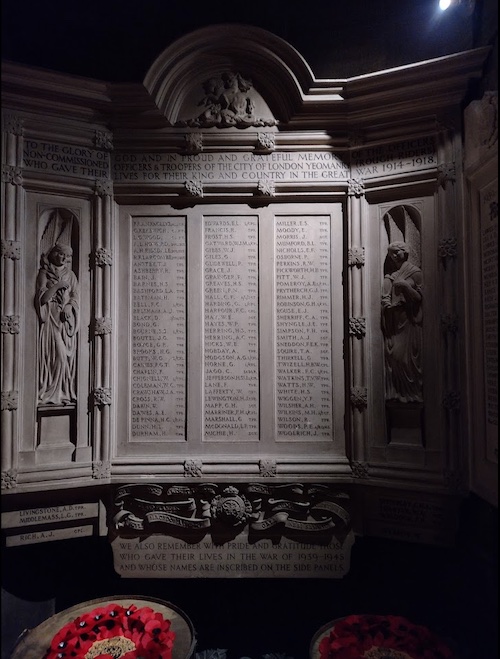
One of the Regiment’s battle honours is ‘Macedonia 1916-17’.
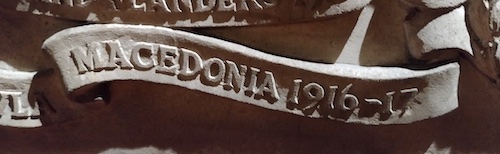
1/1st City of London Yeomanry (Rough Riders) arrived in Salonika from Egypt – having earlier been in Gallipoli – in November 1916 as part of 8th Mounted Brigade. Its sojourn in Macedonia was relatively brief and the Brigade returned to Egypt in June 1917, where it became part of the Yeomanry Mounted Division which took part in the campaign in Palestine. In mid-1918 the Regiment moved to France as part of the Machine Gun Corps.
These are most of the dead from the First World War – several more are on a side panels:

According to the CWGC website, just five are buried in Greece. All are described as ‘died’, which suggests to me that the cause was disease or accident, but I know that’s not conclusive. From the dates of death, just one of the casualties is from the time the Regiment spent in Macedonia:
Two are casualties from the Gallipoli campaign, buried on the island of Lemnos
- 24 October 1915 – 2240 Private Horatio Cortissos De Pinna, aged 27; buried at East Mudros Military Cemetery (III.C.67);
- 1 December 1915 – 2824 Private Y F Wiggen; buried at Portianos Military Cemetery (V.A.83).
Just one is from the regiment’s time in Macedonia:
- 4 March 1917 – 3178 Private Thomas Victor Wilmott Watkins, aged 29; buried at Salonika (Lembet Road) Cemetery (937).
The other two died after the regiment left for Egypt, so stayed on in Macedonia for some reason:
- 13 October 1917 – 41436 Private W R S Wybrow, aged 45 (possibly a victim of influenza); buried at Kirechkoi-Hortakoi Military Cemetery (21);
- 15 March 1918 – 7436 Private W Laffeaty, aged 36; buried at Mikra British Cemetery, Kalamaria (232).

To find out more, please visit:
- The Yeomanry pages on The Long, Long Trail website
- The Inns of Court and City Yeomanry website (which includes the museum)
Grand International Charity Football Match, Boxing Day 1918
One of the amazing survivals from the collection of Herbert Price (ASC) – which has been donated to the Society – is this football programme from a ‘Grand International Charity Football Match’ played on Boxing Day, 1918.
Continue reading “Grand International Charity Football Match, Boxing Day 1918”NEW BOOK : The Bulgarian Contract
The Bulgarian Contract: the secret lie that ended the Great War
By Graeme Sheppard
SCS members will already appreciate the pivotal role the Macedonian front played during the end-stage of the Great War, and how a mere six weeks after Bulgaria’s collapse the entire conflict was over. But what they will not know, and will be surprised to learn, is that the success of the Balkan breakthrough that September depended upon a secret and hitherto unknown act of political deception, a masterly and cunning piece of misinformation known as the contract, archival evidence for which has only recently been discovered in the UK by the author.
Continue reading “NEW BOOK : The Bulgarian Contract”A DSO from Salonika, July 1918
My thanks go to Lucy London (again!) for bringing to my attention this fascinating set of medals which was offered for sale by Dix Noonan and Webb Ltd of Mayfair in July 2019.
The New Mosquito #41 : April 2020
Members should have received this latest edition of The New Mosquito by now. Please contact the Society if you are expecting a copy, but haven’t received it.
International Nurses Day
Here are some pictures for International Nurses’ Day …
Lt Vincent Drew
My thanks go to Ben Drew who, some months ago, sent us this fascinating account of his great uncle’s service in the Salonika campaign.
 Salonika Campaign Society, 1915-1918