
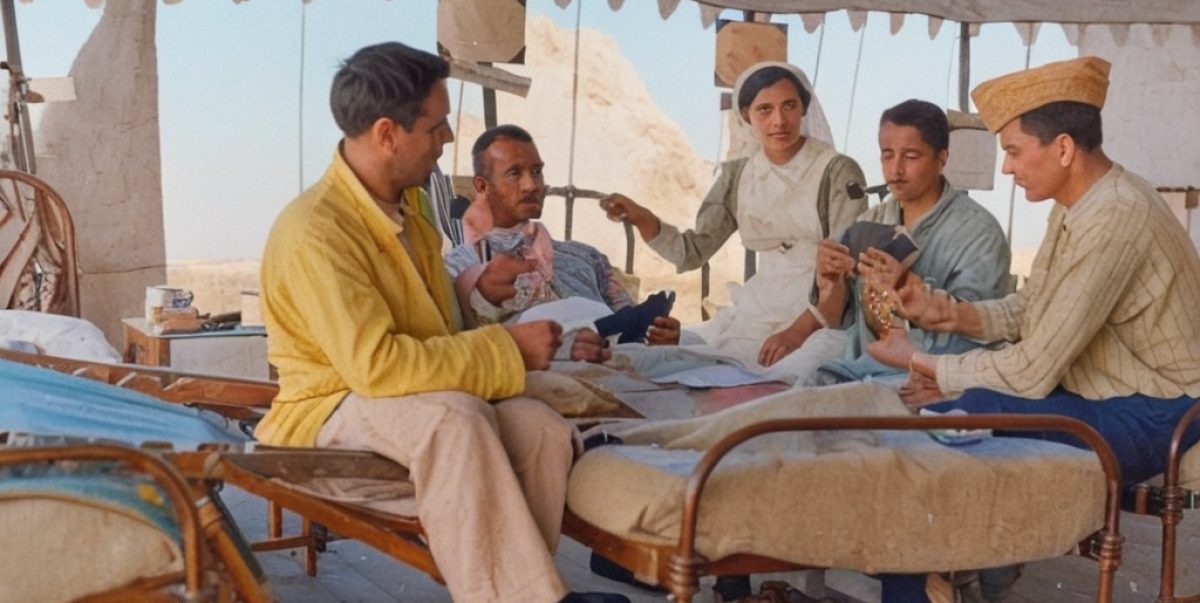
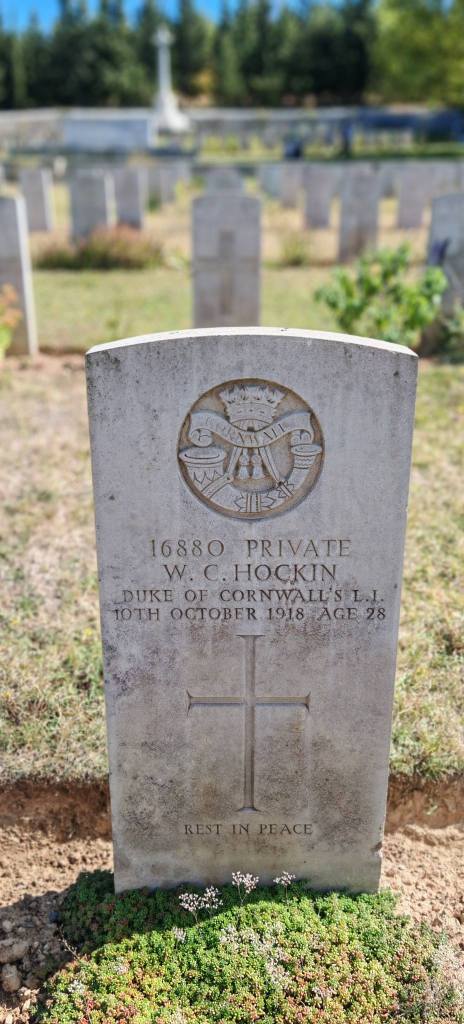
I doubt that members of the Salonika Campaign Society really need International Women’s Day to remember the service and sacrifice of the women of the Scottish Women’s Hospital who served in the Balkans. The Society has remembered them in books, in talks and presentations, at events and in articles, both printed and online. Even so, it may be helpful to have a reminder of these redoubtable women and their noble enterprise, through the graves of just four of their number. I photographed these on a visit to Thessaloniki ten years ago, at the CWGC Lembet Road Military Cemetery. They are: Sister Mary de Burgh Burt, Sister Florence Missouri Caton, Masseuse Olive Smith and Alice Annie Grey.
Continue reading “Remembering …”Tag: 1917
Events during the year 1917.
2025 Salonika Tour now underway
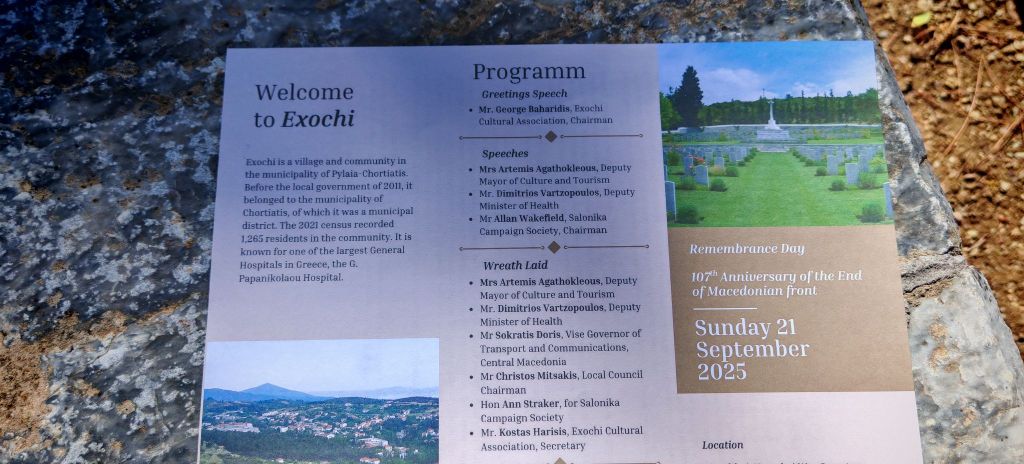
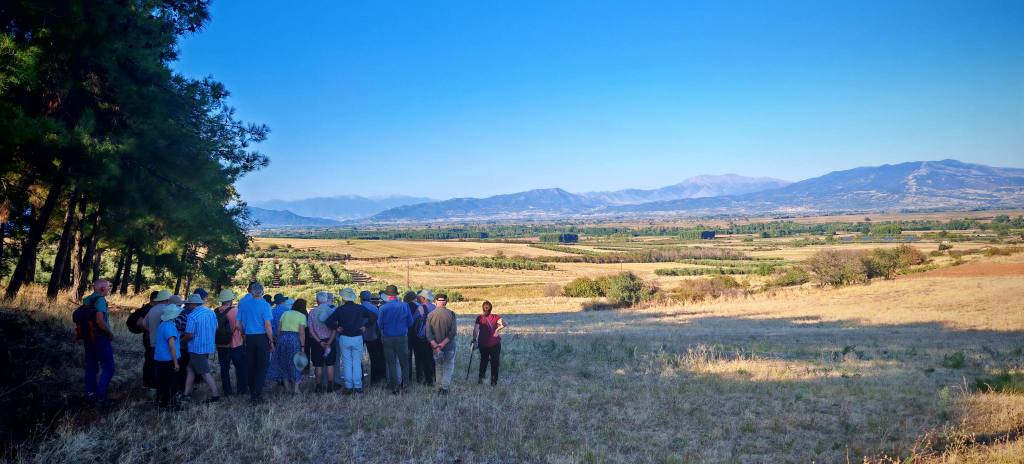
The Society’s 2025 tour (Sunday 21st to Tuesday 30th September) of the British Salonika Force battlefields is now well underway – with battlefield studies, cemetery visits and acts of commemoration. This year the tour has a special focus on artillery and small-scale operations.
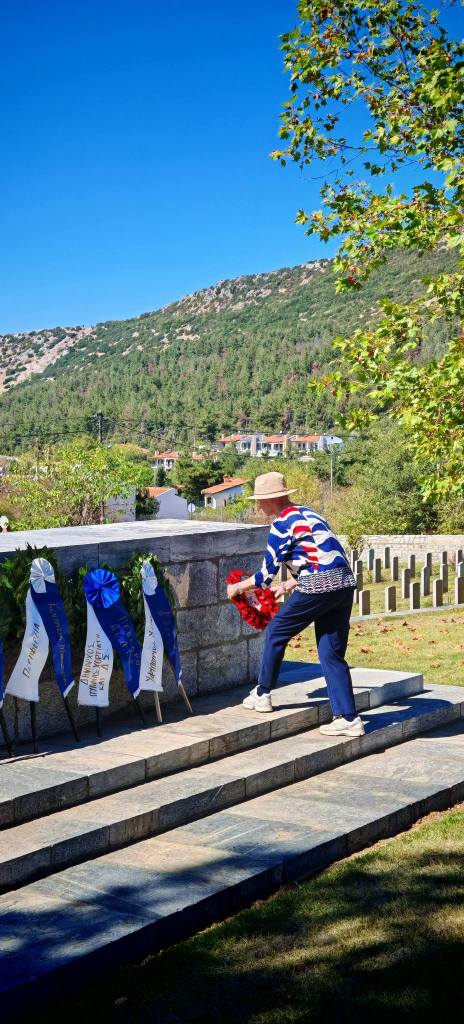
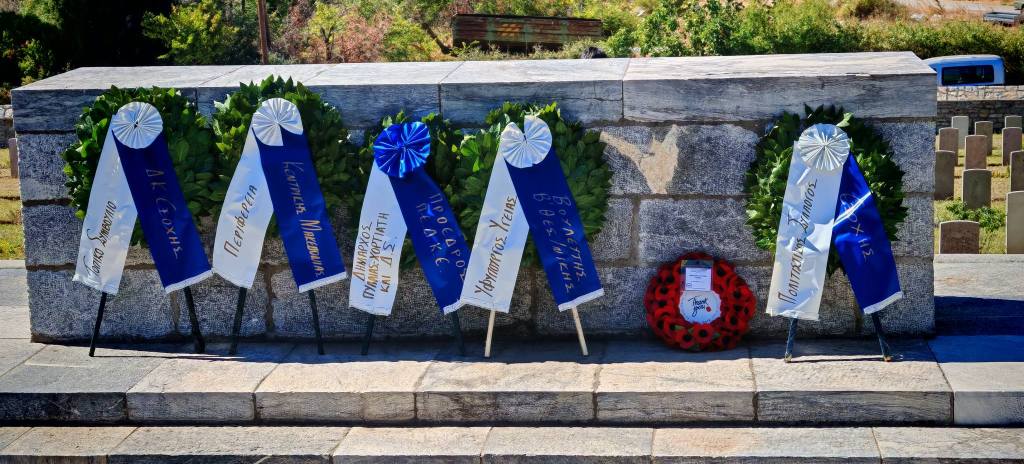
The tour began with a Ceremony of Remembrance at Kirechkoi-Hortkoi cemetery, with a wreath laid by Patron of the Society, the Honourable Ann Straker, before moving on to Triada village for an introduction on the BSF in the Struma Valley and the role of artillery on that part of the front.
You can follow the progress of the tour on Facebook here.
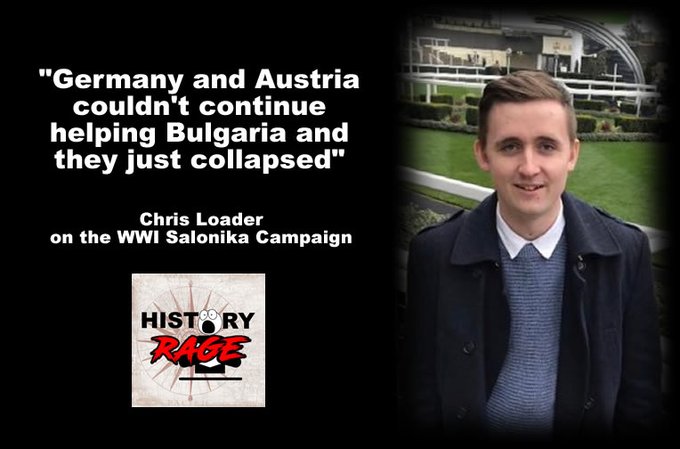
Podcast: “Lost in the Balkans: The Salonika Campaign of World War I with Chris Loader”
SCS Secretary Chris Loader recently recorded (on July 28th) a new podcast as part of the History Rage series in which he shares his personal connection to the Salonika Campaign, through his family history, and discusses the background and complexities of the war in Greece.
You can listen to the podcast here (or via the image below):
The podcast is also available via these other podcast channels:
Two videos that might be of interest…
Awarded the first SCS Philip Barnes Bursary in 2024, Dr Jake Gasson* recently spoke on ‘The Battle Against Boredom‘ at the National Army Museum. The topic was explored in August this year in this YouTube video for Redcoat History.
And earlier in the year, Jake also explained the background to the Salonika Campaign for Redcoat History.
*Dr Jake Gasson is a National Army Museum Fellow based at King’s College London, where he is a postdoctoral researcher. He obtained a DPhil from Pembroke College, Oxford, specialising in the Macedonian front of the First World War.
Join the 2025 Tour of the British Salonika Force Battlefields
The ‘Artillery & Small Operations’ Tour – Sunday 21 to Tuesday 30 September 2025
Explore the key locations of the British Salonika Force during the 2025 battlefield tour, with a special focus on artillery and the small-scale but intense operations that defined the campaign—raids, ambushes, and offensive patrols.
At Doiran, we’ll examine the crucial role of both British and Bulgarian artillery during the First and Second Battles of Doiran. On the Kosturino battlefield, we’ll revisit the desperate December 1915 fighting of the 10th (Irish) Division. In the Struma Valley, we’ll explore the sites of XVI Corps’ limited offensives between 1916 and 1918, as well as the defensive positions held by British forces.
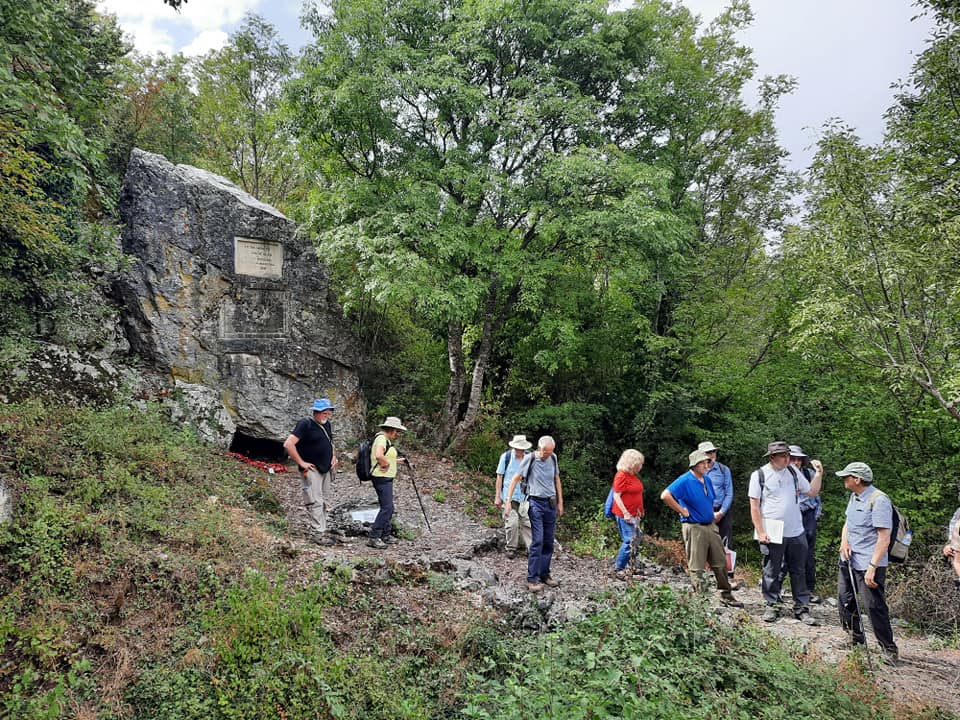
Our journey continues to Bowls Barrow and Smol (now Micro Dassos) in the Vardar sector, where we’ll see firsthand how operations were often designed to divert Bulgarian attention from Doiran. We’ll also visit sections of the Birdcage Line defences and the village of Mavroplagia (formerly Karamudli) in the Krusha Balkan Hills.
The tour will include visits to several Commonwealth War Graves Commission cemeteries, including Doiran (with the Memorial to the Missing), Karasouli, Kirechkoi-Hortakoi, Lembet Road, and Struma.
Running from Sunday 21 to Tuesday 30 September 2025, the tour is timed to coincide with the official commemorations marking the end of the Salonika Campaign, held over the last full weekend of September.
Led by SCS Chair, Alan Wakefield, this is a great opportunity to walk in the footsteps of BSF history.
To register your interest and receive further details, contact Alan Wakefield via email.
A Night at the Palace Cinema
Amongst the souvenirs of the campaign collected by Private Herbert Price of the ASC Supply Department is a rather fragile flyer for Salonika’s Palace Cinema for the week beginning Monday 30 October 1916. Two films were on offer, the first a French silent film from the previous year, Strass & Compagnie, described as ‘a grand patriotic and poignant drama … in four long parts’, which doesn’t seem a great choice for men seeking escapism from war. In which case, maybe Herbert’s preference was for the 1912 American short, A Millionaire for A Day. Described by one US paper as ‘a screaming comedy’, this 1912 American silent short – based on a true story – is about a mechanic who goes to New York City and squanders his inheritance in a single day, returning home broke but wiser (Wikipedia). On the coming Friday, the film Pont du Diable (Devil’s Bridge) was promised, although this sounds uncomfortably like a location in the Struma valley!
Continue reading “A Night at the Palace Cinema”Once Through The Alphabet
Whilst the BSF did not produce a poet of the stature of Wilfred Owen, it did have Rifleman T. B. Clark of the King’s Royal Rifle Corps whose poetry was published in a small volume – Rhymes of A Rifleman – by William Nicholson & Sons Ltd of London. Whilst this has not been perpetuated through exam syllabuses, from it we get an interesting view of the campaign from a thoughtful, pre-war private soldier. So, for National Poetry Day, here is Rifleman Clark’s poem, Once Through The Alphabet – Tommy’s Version, composed in the trenches in Macedonia, October 1917.
Continue reading “Once Through The Alphabet”South Asian troops in the BSF
South Asian Heritage Month seems as good a time as any to consider the, often overlooked, South Asian contribution to the Macedonian campaign. Indeed, had the campaign continued into 1919, this contribution would have been even greater as plans were well underway to “Indianize” the BSF as had already happened in Palestine, but on an even greater scale.
Continue reading “South Asian troops in the BSF”William Richmond and 10/Black Watch (2)
On Burn’s Night (25 January) I introduced William Richmond who, at the age of 20, enlisted in the 10th (Service) Battalion of the Royal Highland Regiment (Black Watch) on 11 September 1914. After finding themselves in various English camps during 1915 and spending two months in France the Battalion, with the rest of 26th Division, started heading off for Salonika – via Marseille – in November 1915.
Continue reading “William Richmond and 10/Black Watch (2)”A narrow squeak …
Today is my grandfather’s birthday. Were he still alive, Fred would be 133 years old! Back in 1982 I was working abroad, but took the opportunity of a short trip home to spend some time with Fred and we talked about his army service and I made notes. I am so glad I did as he died a few months later. Whilst there is so much more that I could have found out, I am pleased that I do have some first-hand accounts and it’s one of these I want to share with you today.
Continue reading “A narrow squeak …” Salonika Campaign Society, 1915-1918