Tales from the Battlefields is a free podcast from battlefield guide and researcher Terry Whenham. It focuses on “the unheard stories of men who served on the Western Front during World War 1.”
However, in Episode 68 of the podcast, Terry interviews Chris Loader who travelled with the Society on the SCS Battlefield Tour in September this year. Chris describes the background to the campaign and his visit to the location where his two-times grandfather on his father’s side, Private Henry Loader of the 10th Hampshire’s, was mortally wounded in September 1918. I listened with a lot of interest to the story of Henry – and Chris’s research and visit – and I’m sure you will find it a worthwhile use of your time too. In my humble opinion of course!
You can listen to the podcast for free on Apple, Amazon Music, Spotify and directly from thispage.
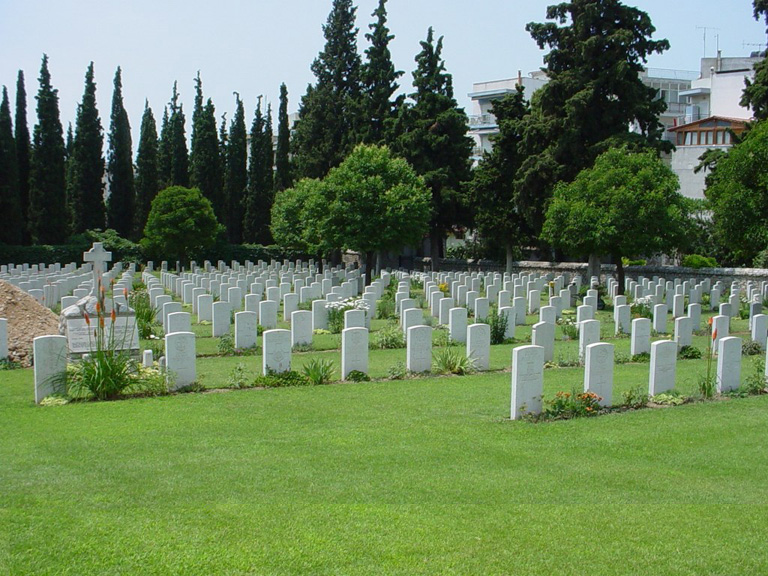
Lembet Road Cemetery – final resting place of Henry Loader. Image from CWGC
I imagine BBC Radio Three’s long-running programme ‘Composer of the Week’ has looked at English composer, Ralph Vaughan Williams and his career, many times. I remember listening to a previous episode some time ago and being irritated as his First World War army service was glossed over and no mention made of his time with the BSF. I am pleased to say, though, that last week’s series – A Vaughan Williams Christmas – mentions Christmas 1916 which he spent beneath Mount Olympus with his 60th Division Field Ambulance unit. You can listen to the programme for a while longer online here:
Although Vaughan Williams apparently noted down Greek tunes, none is played in the programme, but you do get performances of his lovely seasonal music and symphonies, plus a full performance of his much-loved The Lark Ascending.
I can only think of one way to finish this post and that is with this Greek Christmas tune, which has featured in previous Christmas posts and featured in Aladdin in Macedonia – the first of the 85th Field Ambulance pantomimes:
It is with great grief that I wish to tell you your son has died of wounds received in the recent attack. Our company was ordered to take up a position on the left flank of a brigade which was taking a village a mile to our front. We know the Bulgars were entrenched there. It was successfully carried out and the trenches taken and held. Your son was hit in the charge gallantly leading his men. I saw him at once and had him taken back. He was hit in the side but was not in great pain. We had great hopes of his recovery but last Saturday he had a relapse and died on Sunday morning. We buried him in a small cemetery where other are laid who in like manner have given their lives for their Country
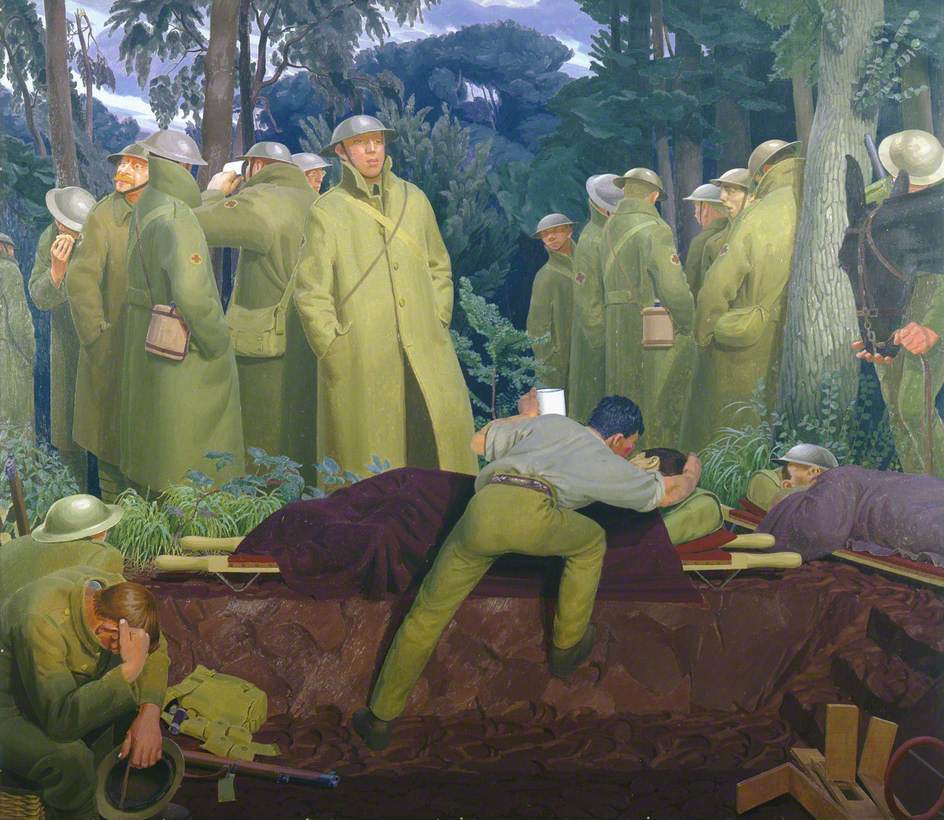
I’m grateful to a recent correspondent with the Society for bringing to attention (to me at least!) the work of artist Henry Lamb. In 2014, the Whitworth Art Gallery in Manchester had an exhibition, The Sensory War, to mark the 100th anniversary of WW1. One of the works exhibited was by Lamb: Advanced Dressing Station on the Struma 1916
Ana Carden-Coyne, who co-curated the exhbition Visions of the Front 1916-18, for the Somme centenary also featured the painting and describes it in this way:
“The scene of a dressing station focuses on the relationship between a wounded man and a stretcher-bearer, who attends him with a cup of water, a great relief that many soldiers wrote about as the comfort given between men. Thirst and cold were understood much later in the war as signs of hemorrhage and shock. The bearer’s hand gently touches the wounded man’s head, providing comfort symbolic of the pietà (Christian iconography of Mary cradling Jesus’ corpse). Indeed, the pietà was often used in war-time humanitarian images of nurses caring for wounded men. But Lamb transforms the theme into an effigy of masculine care and the intimate brotherhood of shared suffering. Placed on the ledge of a shallow trench, the stretcher resembles an altar. In the right hand corner is a Thomas splint used for compound fractures, from which soldiers could die. Pathos is also created by the figure on the left, head in hand, perhaps affected by malaria, a common disease of this front, or perhaps a reference to psychological suffering. The central figure stands over the patient, staring pensively into the distance. Made three years after the end of the war, the composition of this painting symbolises the pain and succour of the entire conflict.”
There’s also discussion of the painting by one of the team at The Whitworth here:
Henry Lamb was born in Australia in 1883 and educated at Manchester Grammar School, before studying medicine at Manchester University Medical School and Guy’s Hospital in London. He abandoned medicine in 1906 to study painting at the Chelsea School of Art but “with the outbreak of the first world war Lamb returned to his study of medicine and served as a doctor in the Royal Army Medical Corps in France, Salonika and Palestine where he was awarded the Military Cross. He was not an official war artist but was always sketching and drawing in spare moments. These sketches with memories from his time on the Macedonian Front and the Palestine campaign formed the basis of large-scale paintings made after the war. ‘Irish Troops in the Judaen Hills’, now in the Imeperial War Museum, and ‘Advanced Dressing Station on the Struma’ for Manchester City Art Gallery are amongst the most extraordinary of his career. In 1928 he married Lady Pansy Pakenham and moved to the quiet Wiltshire village of Coombe Bissett where they would remain for the rest of their lives. Lamb was appointed an official war artist for the second world war and after first wanting to document the war cabinet decided on portraits of soldiers and studies of servicemen at work across the South of England. At the same time as his appointment as a war artist Lamb was elected as an associate of the Royal Academy and a Trustee of both the National Portrait Gallery and the Tate. He was finally awarded full membership of the Royal Academy in 1949.” Sources here and here.
That infallible organ of facts and certainty, Wikipedia, has this to say about the ‘Illustrated War News’, At the outbreak of the war, the magazine ‘The Illustrated London News’ began to publish illustrated reports related entirely to the war and entitled it ‘The Illustrated War News’. The magazine comprised 48 pages of articles, photographs, diagrams and maps printed in landscape format. From 1916 it was issued as a 40-page publication in portrait format. It was reputed to have the largest number of artist-correspondents reporting on the progress of the war. It ceased publication in 1918.Source
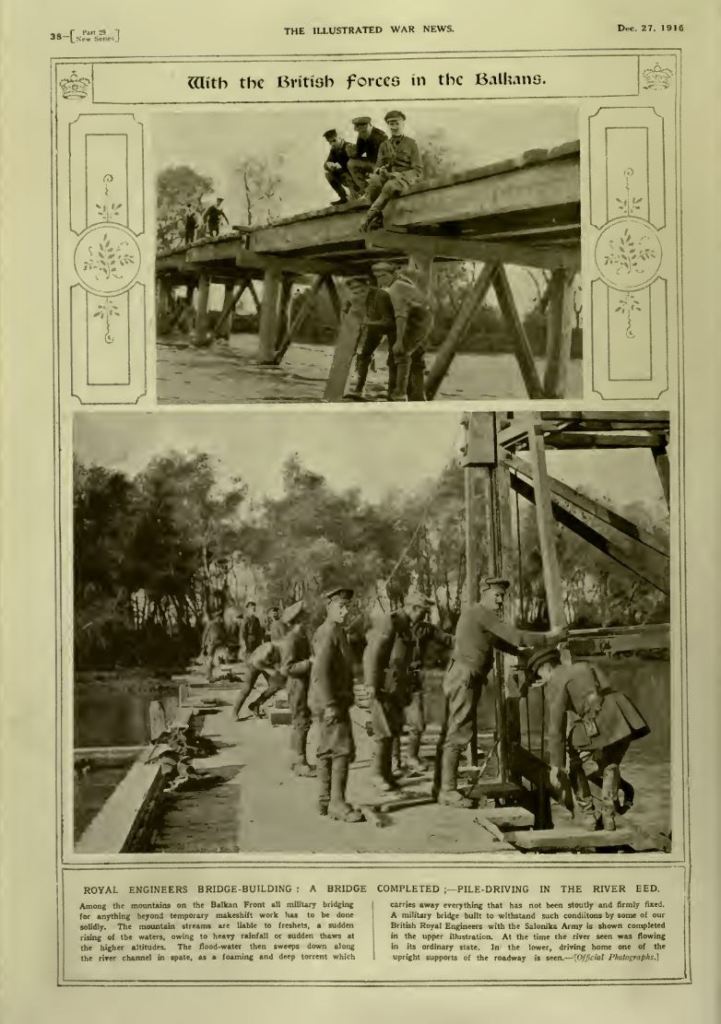
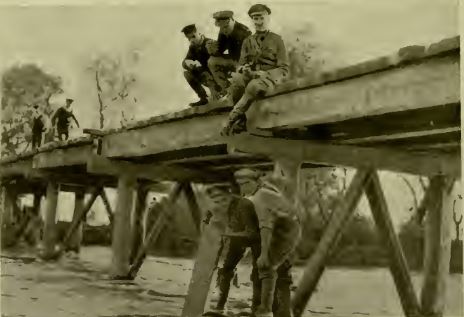
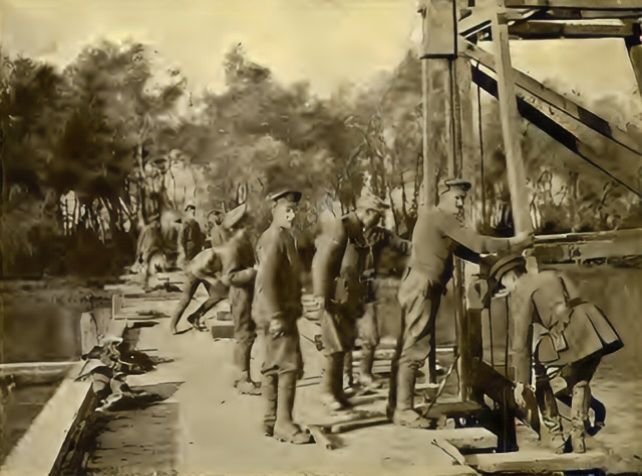
There are digitised copies of ‘The Illustrated War News’ on our SCS Digital Collection DVDs. I thought it might make an interesting occasional series to draw on the magazine and take a look at how the Salonika Campaign was reported. This report from December 27, 1916, for example, shows the Royal Engineers at work, “Among the mountains on the Balkan Front…”
The text reads: Among the mountains on the Balkan Front all military bridging for anything beyond temporary makeshift work has to be done solidly. The mountain streams are liable to freshets, a sudden rising of the water, owing to heavy rainfall or sudden thaws at the higher altitudes. The flood-water then sweeps down along the river channel in spate, as a foaming and deep torrent which carries away everything that has not been stoutly and firmly fixed. A military bridge built to withstand such conditions by some of our British Royal Engineers with the Salonika Army is shown completed in the upper illustration. At the time, the river seen was flowing in its ordinary state. In the lower, driving home one of the upright supports of the roadway is seen.
Today is my grandfather’s birthday. Were he still alive, Fred would be 133 years old! Back in 1982 I was working abroad, but took the opportunity of a short trip home to spend some time with Fred and we talked about his army service and I made notes. I am so glad I did as he died a few months later. Whilst there is so much more that I could have found out, I am pleased that I do have some first-hand accounts and it’s one of these I want to share with you today.
The Victoria Cross was first introduced on 29th January 1856 to honour acts of valour during the Crimean War. Two VCs were awarded in the Macedonian campaign, one in 1916 and one in 1918. It’s the first of these, to Private Hubert William Lewis of 11/Welsh, that I want to celebrate today.
Modern Thessaloniki seems a quintessentially Greek city but, during the First World War, it was a multi-ethnic and multi-cultural city which, just a few years before, had been part of the Ottoman empire. It was especially a Jewish city.

 Salonika Campaign Society, 1915-1918