
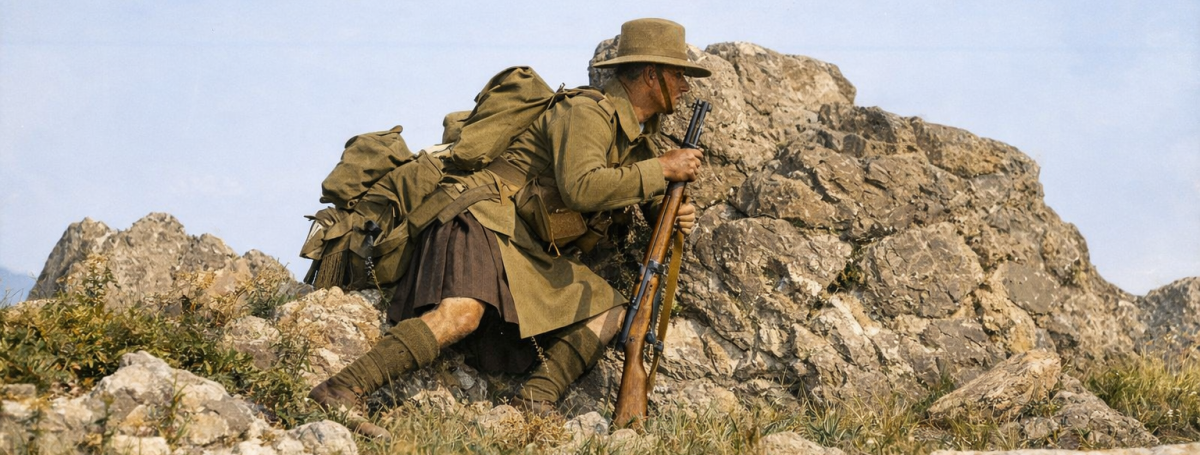
On this, the 110th anniversary of the Britain’s entry into the Great War, it seems appropriate to look at a connection between the British Salonika Force and the assassination of Archduke Ferdinand in Sarajevo. This is to be found in issue 45 of The Mosquito – ‘The Official Journal of the Salonika Re-Union Association’ – published in March 1939, not very long before Britain’s entry into the next world war!
Continue reading ““The League of Death” and the BSF”Category: Salonika Stories
Stories from or about the Macedonian campaign, 1915-1918.
The Salonika campaign’s so boring!
No, this isn’t a sudden cri de couer after twenty years of reading about and studying the Salonika campaign, but rather an acknowledgment of the tedium experienced by many of those who served in Macedonia between 1915 and 1919. This was the subject of a fascinating podcast I recently came across.
Continue reading “The Salonika campaign’s so boring!”On Yer Bike!
With my particular interest in the Army Cyclist Corps in the Macedonian campaign, I could hardly let ‘World Bicycle Day’ go unnoticed!
Continue reading “On Yer Bike!”Tiny Takes Tea!
On International Tea Day, here’s a cute photograph of Tiny, the donkey mascot of the 26th Divisional Train, drinking tea.
“Tiny”, a small donkey, was found dying by the roadside by men of 26th Divisional Train. They took care of him and he became their mascot. “Tiny” would walk into any tent – including the officers’ mess – and help himself to any dainty lying about. As can be seen from the photo, he liked his tea from a mug, and was known to take as many as take nine mugs in succession! I hope they also treated him to ginger biscuits.
Continue reading “Tiny Takes Tea!”‘Salonika Secrets’ – a new podcast
In December of last year, we posted about a podcast series that featured an interview with Society member Chris Loader who had travelled with the Society on the September 2023 SCS Battlefield Tour to visit the grave of his great-great-grandfather, Henry Albert Obadiah Loader.
Inspired by a visit to Doiran Military Cemetery during the tour, Chris has now branched out to record his own podcast series: Salonika Secrets.

‘Salonika Secrets’ – a new podcast from Society member Chris Loader
The podcast tells of Chris’s search to identify an unknown British officer commemorated at Doiran. Without giving too much away, Chris has so far managed to narrow down the identity to an officer who served in the 12th Hampshire Regiment. You can listen to the podcast free on Spotify, Amazon and Apple and, no doubt, other podcast providers. Chris also posts updates and extra information on ‘X’ (formerly Twitter) here.
Good luck with the search Chris!
Ribbit! Ribbit!
When I discovered that today is World Frog Day, I doubted that I could find any frogs with a Salonika connection. Then a memory stirred of a story read in The Mosquito – the journal of the Salonika Reunion Association – but would I find it again … ?
Continue reading “Ribbit! Ribbit!”Soles of boots were tied on with rags
Although women who had served in Salonika – in whatever capacity – were eligible to join the SRA from the very start, they didn’t gain their own specific section in The Mosquito until September 1931 (issue 15), with Eileen Moore’s ‘Woman’s Page’. Later, this was expanded to ‘Women’s Pages’ and continued for the rest of The Mosquito’s long existence. So it was only right and proper that the final issue in May 1969 – a longer, glossier souvenir album, entitled Salonika Memories 1915-1919 – included it’s own ‘Women’s Pages’. By now this was edited by Miss N. M. Simcox. In her final editorial, she had this to say:
Continue reading “Soles of boots were tied on with rags”A lost world …
Although the White Tower would have been familiar, my late grandfather would not have recognised modern Thessaloniki – the vibrant Greek city rebuilt after the great fire of 1917 and developed in the decades after that. To him and other members of the British Salonika Force who passed through it was very much an eastern city – not always remembered fondly – populated by a multiplicity of different peoples. Notable among the inhabitants was the strong Jewish community, but the fire of 1917, subsequent upheavals and the appalling events of the Holocaust changed the city forever.
Continue reading “A lost world …”That song!
As I suspected, the song that Andy gave us on 7 January – Salonika – has been going round and round in my head. It’s also been leading me down various rabbit holes on the internet. The lyrics are available on a range of websites, alongside some very earnest discussions about the meaning of the song, including some rather fanciful descriptions of the role of Salonika in the First World War: a supply base for the Gallipoli campaign. Really?
Continue reading “That song!”Jimmy Crowley ‘Salonika’
In Episode 68 of Tales from the Battlefields (see previous post) the podcast starts with part of a song by Irish musician Jimmy Crowley. I was intrigued to find out more about the tune…
According to an article in The Irish Examiner the song was popular around the time of the First World War but had fallen out of use in later decades before being discovered by Crowley, “The jaunty ballad is sung from two different female perspectives — the first, a woman whose husband has enlisted in World War I, the title referring to the Greek city of Thessaloniki, which was home to a British military base. These women were known as ‘seperas’ as they were paid separation allowance by the British government when their husbands went off to fight. The other woman in the song is the wife of a ‘slacker’, the term given to men who did not join the army. The women in the song swap jibes and sprinkled through the song are references to Cork locations such as the Coliseum and characters including Dicky Glue, a well-known pawnbroker… It would have been popular as a street ballad up to the time of the Second World War. It is a tremendous song because it gives an insight into the lives of women around the time of the First World War. It kind of died out later, when ballads became uncool, because they were associated with the poor and uneducated. They would have started coming back into vogue with the rise of folk music in the 1960s.”
The song has since been recorded by ‘The Dubliners’ and even appeared on Later with Jools Holland in 2015 played by ‘Lynched’:
And here is the ‘original’ Jimmy Crowley version:
 Salonika Campaign Society, 1915-1918