
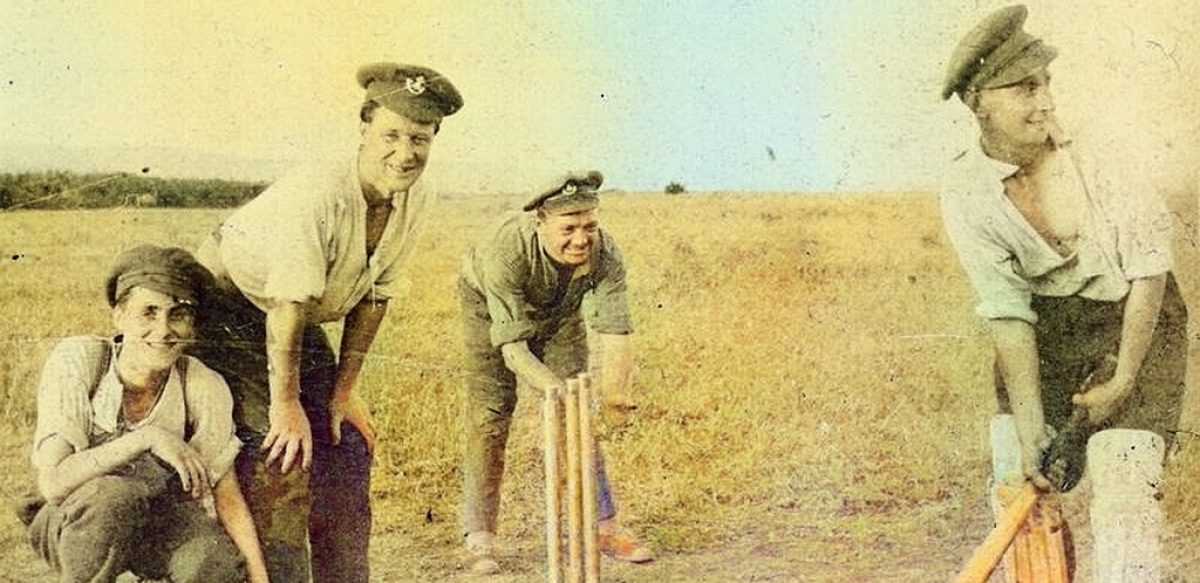
The nice thing about doing these web posts is that sometimes people reply to them and so it has been with last week’s post on the shorts worn by the BSF.
Continue reading “More on shorts!”Category: Researching Salonika
Notes and advice on researching the Salonika campaign (1915-1918), especially individuals who served with the British Salonika Force.
General Milne’s first few months…
On this day, May 9th 1916, Lieutenant General George Francis Milne succeeded Lieut-General Bryan Mahon to become overall Commander-in-Chief of British Troops in Macedonia. Five months later, in October 1916, Milne submitted a report (published in The London Gazette of December 6th) summarising “the operations carried out by the British Salonika Army since I assumed command.”
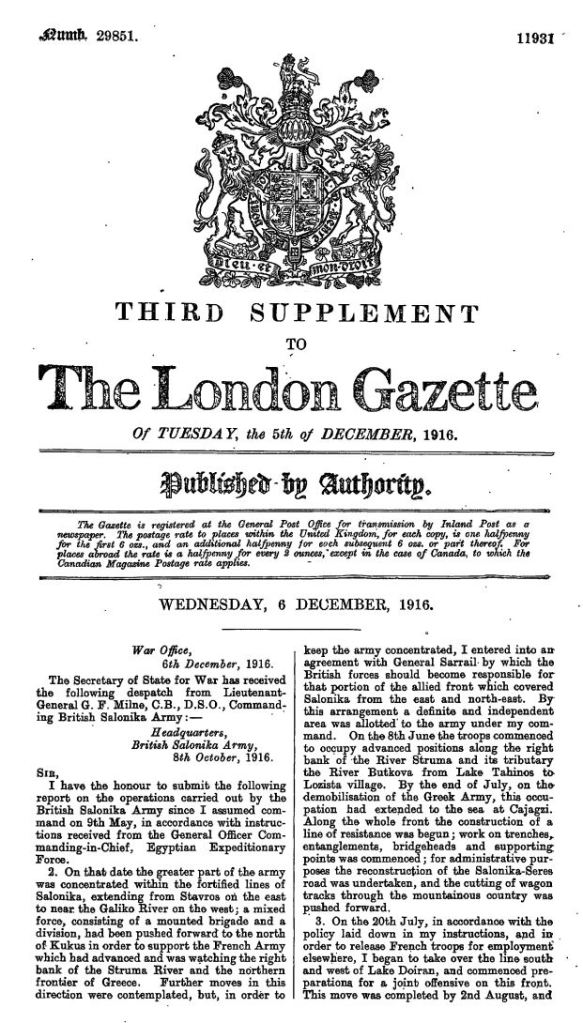
To begin with, Milne states, “…in order to keep the army concentrated, I entered into an agreement with General Sarrail [French general and overall commander of the Allied forces in Salonika] by which the British forces should become responsible for that portion of the allied front which covered Salonika from the east and north-east. By this arrangement a definite and independent area was allotted to the army under my command.”
It’s interesting to read primary sources such as this against a wider background of historical perspective and analysis. In, ‘Under the Devil’s Eye’ Alan Wakefield and Simon Moody provide the context for Milne’s comments, “The new British commander was soon tested by the Frenchman’s brinkmanship when Sarrail stated that he had orders from Paris to launch an offensive and was prepared to do so with or without British assistance. Milne realised that, with his forward troops in close contact with the French, the BSF would either be dragged into an attack, which was beyond his operational remit, or, by holding back, risk accusations of failing to support an ally. He skilfully sidestepped the issue by asking for a separate British zone of operation… Sarrail agreed to the proposal and at a stroke Milne had disengaged his troops from the French.”
That analysis gives another layer of understanding to Milne’s report of how, “…in accordance with the policy laid down in my instructions, and in order to release French troops for employment elsewhere, I began to take over the line south and west of Lake Doiran…” and explains how actions in the area made it possible, “to shorten considerably the allied line between Doiran Lake and the River Vardar and on 29th August, in agreement with General Sarrail, I extended my front as far as the left bank of the river so as to set free more troops for his offensive operations.”
Politics aside, the rest of Milne’s report is a readable account of the first few months of his command in which he gives credit to the sections of his command and the men – and women – involved in the British side of the campaign.
You can download and read Milne’s entire report here. ‘Under the Devil’s Eye’ is available here.
Featured image, General Sarrail, commander of Allied forces in Macedonia (16 January 1916 – 22 December 1917), with General Sir George Milne, commander of the British Salonika Force from 9 May 1916. Source, IWM
It’s St George’s Day!
Having celebrated the Welsh battalions of the BSF on St David’s Day and the Irish ones on St Patrick’s Day, how should I mark St George’s Day? I feel writers’ cramp coming on just thinking about typing out the names of the 52 or so English battalions of the BSF (see NM 11, April 2005) so, instead, will go for an easier option. The Royal Regiment of Fusiliers was formed on 23 April 1968, celebrates St George’s Day and, indeed, has an image of St George slaying the dragon on its cap badge. It was created by amalgamating four English fusilier regiments: Royal Northumberland Fusiliers, Royal Warwickshire Fusiliers, Royal Fusiliers (City of London Regiment) and Lancashire Fusiliers. Three of these regiments provided battalions for the BSF.
Continue reading “It’s St George’s Day!”Erin go Bragh!
Having celebrated the Welsh battalions of the BSF on St David’s Day, I can hardly do less for St Patrick’s Day. So here are the Irish battalions that served with the BSF, in order of seniority.
Continue reading “Erin go Bragh!”‘Dydd Gŵyl Dewi Hapus’
… or, for non-Welsh speakers, that’s ‘Happy St David’s Day’! St David’s Day seems the perfect opportunity to remember the six Welsh battalions which served in Macedonia with the British Salonika Force.
Continue reading “‘Dydd Gŵyl Dewi Hapus’”Rough Riders Remembered
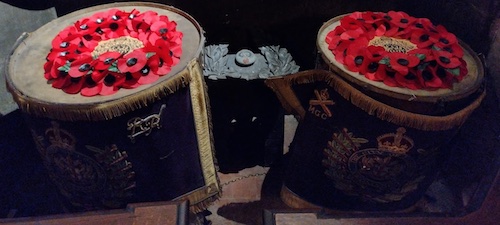
Whilst in London recently we were passing through Smithfield on our way to St Paul’s, when I came across a hidden church: St Bartholomew the Great. It was open so we couldn’t resist going in for a nosey around and I’m very glad we did. It was especially atmospheric as it had some lighting on (it was going dark outside), a choir was practising for a concert and I’m sure there was a lingering smell of incense. With a long history – founded in 1123 – there is much of interest inside, but the item that especially caught my eye was comparatively recent: a memorial to the fallen of the City of London Yeomanry (Rough Riders) in the world wars.
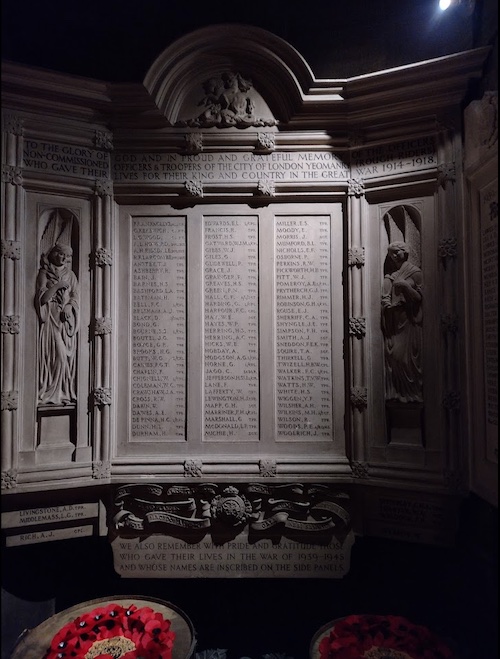
One of the Regiment’s battle honours is ‘Macedonia 1916-17’.
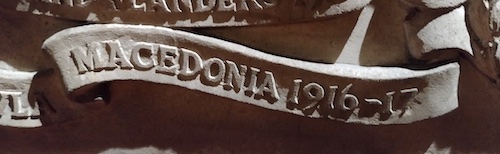
1/1st City of London Yeomanry (Rough Riders) arrived in Salonika from Egypt – having earlier been in Gallipoli – in November 1916 as part of 8th Mounted Brigade. Its sojourn in Macedonia was relatively brief and the Brigade returned to Egypt in June 1917, where it became part of the Yeomanry Mounted Division which took part in the campaign in Palestine. In mid-1918 the Regiment moved to France as part of the Machine Gun Corps.
These are most of the dead from the First World War – several more are on a side panels:

According to the CWGC website, just five are buried in Greece. All are described as ‘died’, which suggests to me that the cause was disease or accident, but I know that’s not conclusive. From the dates of death, just one of the casualties is from the time the Regiment spent in Macedonia:
Two are casualties from the Gallipoli campaign, buried on the island of Lemnos
- 24 October 1915 – 2240 Private Horatio Cortissos De Pinna, aged 27; buried at East Mudros Military Cemetery (III.C.67);
- 1 December 1915 – 2824 Private Y F Wiggen; buried at Portianos Military Cemetery (V.A.83).
Just one is from the regiment’s time in Macedonia:
- 4 March 1917 – 3178 Private Thomas Victor Wilmott Watkins, aged 29; buried at Salonika (Lembet Road) Cemetery (937).
The other two died after the regiment left for Egypt, so stayed on in Macedonia for some reason:
- 13 October 1917 – 41436 Private W R S Wybrow, aged 45 (possibly a victim of influenza); buried at Kirechkoi-Hortakoi Military Cemetery (21);
- 15 March 1918 – 7436 Private W Laffeaty, aged 36; buried at Mikra British Cemetery, Kalamaria (232).

To find out more, please visit:
- The Yeomanry pages on The Long, Long Trail website
- The Inns of Court and City Yeomanry website (which includes the museum)
Directory of WW1 Websites
Canada’s contribution to the First World War cannot be underestimated. More than 650,000 Canadians and Newfoundlanders served in the war with 66,000 killed and over 172,000 wounded. Such was the contribution, Canada had its own signature on the Treaty of Versailles. In Salonika, Canadian medical services provided care at Nos. 4 and 5 General Hospitals, and Nos. 1 and 3 Stationary Hospitals (see this earlier post). It’s of no surprise therefore that Canadians continue to research this significant period of their history.
One such research group is the CEF Study Group – an Internet discussion forum for the study, sharing of information and discussion related to the Canadian Expeditionary Force (CEF) in the Great War.
The CEF Study Group has just published its 2022 ‘List of Recommended Great War Websites’. Our own site is included among a directory of 2000+ websites, grouped into 31 logical sections. We are described thus: “This very detailed and multi-layered Blog site has numerous theme ‘buttons’ which take the reader deeper into the topic. Site is mature and very well organized.” (A recognition of former editor Robin Braysher’s work, I should add).
Readers may well find this a useful resource for research. The directory can be downloaded here.
Malta – the ‘Nurse of the Mediterranean’
According to one contemporary writer, Malta “…assumed the role of nurse, and her breakwaters seem like arms stretched out to receive her burden of suffering. Once the hospital ship has passed within their shelter the rolling ceases, and the wounded feel that they have reached a haven of rest.” So wrote the Rev. Albert MacKinnon in 1916 in “Malta: The Nurse of the Mediterranean” – an early reference to the soubriquet by which the island came to be known during the First World War.
As the war in France began to grind into stalemate, other fronts opened in the Dardenelles and Gallipoli, with disastrous consequences for the allied forces. The scale of casualties was unprecedented and required an urgent response,
“That Malta should become the home of one of the British Empire’s largest systems of war hospitals was not anticipated in the early months of the war. It was not until May 1915 that the first badly wounded casualties from the Gallipoli campaign started to pour into Malta. The first convoy of 600 patients arrived on May 4, followed by a further 400 a day later, and on May 6 another 600 cases were brought ashore. Before the end of May, upward of 4,000 casualties from the Gallipoli campaign had reached Malta…The end of May saw the number of hospital beds catering for the sick and injured rise to over 6,000 in 14 hospitals spread all over the island.” Source: Times of Malta
In Salonika, a hostile climate and serious illness – mainly malaria – were the principle cause of casualties. Malta again provided an immediate solution,
“After January 1916, the number of sick and wounded fell very considerably with the scaling down of the Gallipoli campaign, only to rise again with a vengeance in the summer of 1916, as the Salonika campaign proceeded. However, the number of hospital beds remained in the region of 25,000, and reached a maximum of 25,522 housed in 27 hospitals by April 1917. The number of sick patients, suffering mainly from “dysentery and enteric group of diseases”, always exceeded the number admitted with war wounds. With the end of the Gallipoli campaign and the start of the Salonika campaign in October 1915, this trend in admissions became even more marked as a result of a rush of malaria cases from Salonika. Up until April 30, 1917, Cottonera, a mixed hospital catering for both the sick and injured, received 2,867 sick but only 308 wounded.” Source: Times of Malta
Malta’s strategic location in the Mediterranean – and its history as a British Protectorate – made it an important naval base for the British and, together with its climate, also an important place of rest and healing. But it was also hundreds of miles from Salonika and by April 1917, increasing submarine attacks on hospital ships made it unsafe to continue evacuating casualties to Malta from Salonica. Five General Hospitals, Nos 61, 62, 63, 64 and 65 were therefore mobilized at Malta for duty in Salonica, arriving on 11 July 1917. Malta’s role as the ‘nurse of the Mediterranean’ had, effectively, ended. Source: MaltaRAMC
Further Reading
- Military Hospitals Malta 1914-1918
- Malta in WW1: The ‘Nurse of the Mediterranean’ in the eyes of the ANZACs
- Malta in World War One: The Nurse of the Mediterranean
- Imperial War Museum
Featured image: Times of Malta
“With the Serbs in Macedonia.”
Many thanks to Society member Keith Roberts for information about this book, With the Serbs in Macedonia.

Its author, Douglas Walshe, was an officer in one of the British Army Service Corps Mechanical Transport Companies sent to drive small Ford trucks with equipment, food and ammunition to the Serbian army. The book can be found in digital format on the SCS map disk, and is also free of charge to download on the Internet Archive.
Keith recently took delivery of a printed edition complete with an intact dustjacket. Now rather ‘grubby’, the book is the original 1920 edition and amazingly, says Keith, the “book has never been read. How can I tell? The pages have not been cut.” Says Keith, “it is easy reading, and surely worth an hour or two of anybody’s time.”
I agree with that, having just started it myself. Something of the tone of the writing can be heard in the opening pages, “Here, as far as our men are concerned, there are no records of days and nights in waterlogged trenches under concentrated shell-fire, and no pulse-stirring descriptions of hand-to-hand encounters and bayonet charges. We never fired a shot at anything more exciting than a petrol tin for revolver practice, or a wild goose or duck for a dinner that usually remained in the air. But we did our job, and we saw a little of the Balkans. Mainly married and mostly of inferior physique, we ‘carried on’ – when there was any carrying on to be done.”
The online version of With the Serbs in Macedonia can be found here.
Triumph in the Balkans. Anglo-French Co-operation in Macedonia during the First World War
I am grateful to society member Harry Fecitt for bringing to members’ attention this MA dissertation, Triumph in the Balkans. Anglo-French Co-operation in Macedonia during the First World War.
The work has four chapters: Chapter I. The origins of the Salonika Expedition; Chapter II. In the shadow of Sarrail; Chapter III. Guillaumat’s groundwork for success; and Chapter IV. The year of victory. It has comprehensive notes and appendices, and many illustrations.
The dissertation is free to download but an email address is required to sign up to Academia.edu. It can be found here.
 Salonika Campaign Society, 1915-1918