
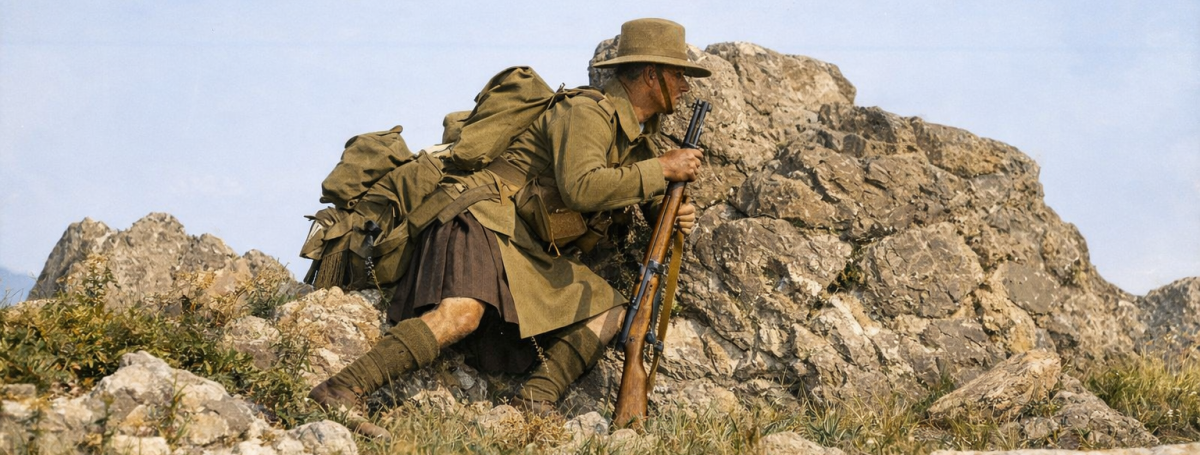
I’ve just come across this fascinating story related to 9/Border Regiment (Pioneers), although it pre-dates their time with the BSF (22nd Division):
Continue reading “RIP Harlequin”Category: Mule Lines
Inspired by Muffin, the Salonika Campaign Society’s adopted mule, these posts relate to animals in the campaign.
Happy Birthday, Muffin!
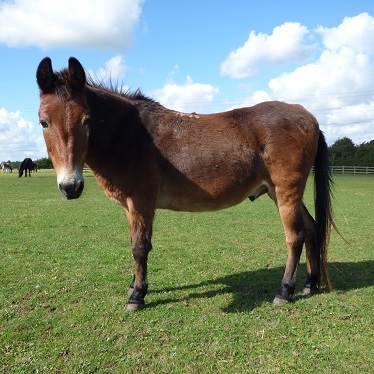
Today, Redwings Adoption Star (Ret’d) Muffin celebrates his 34th birthday. Muffin has been an Honorary member of the SCS – with the special membership number ‘Salonika 4’ – since the centenary, so we send him very best wishes for his special day.
Continue reading “Happy Birthday, Muffin!”The Burma Mule
Having recently read two books about the second Chindit expedition in Burma (March-August 1944) I was delighted – if a little surprised – to come across a living history group, The Burma Mule, at a ‘Desert Rats’ commemorative event in Thetford Forest.
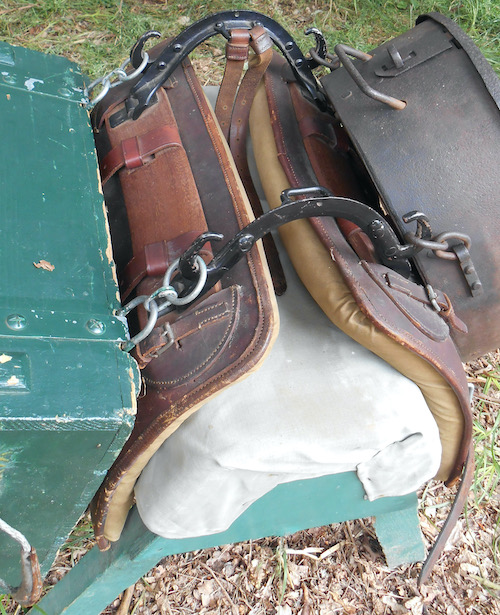
Unfortunately there were no mules present as their two 16 year old mules are now largely retired, but there was still much of interest. I was especially pleased to see mule saddles up close. Of relevance to the Salonika campaign is the one shown below, which is very similar to those used in the First World War. This could carry a variety of loads and you can see, here, a portable forge. Although date stamped ‘1940’ it is likely that similar kit – including a small anvil – was in use by earlier generations of mule transport units. Keeping the feet of mules and ponies in tip-top condition is, of course, vital for their well-being and efficiency.


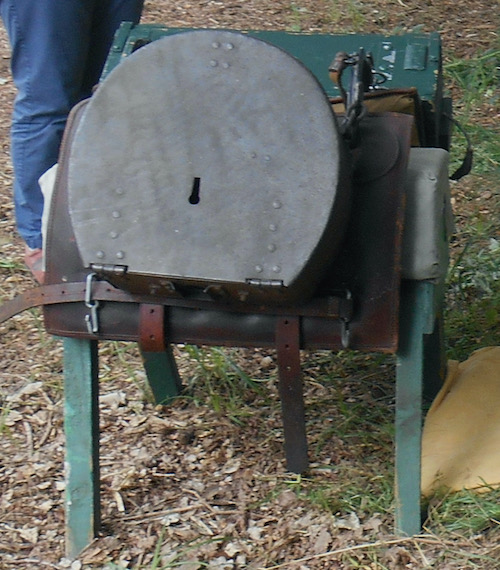
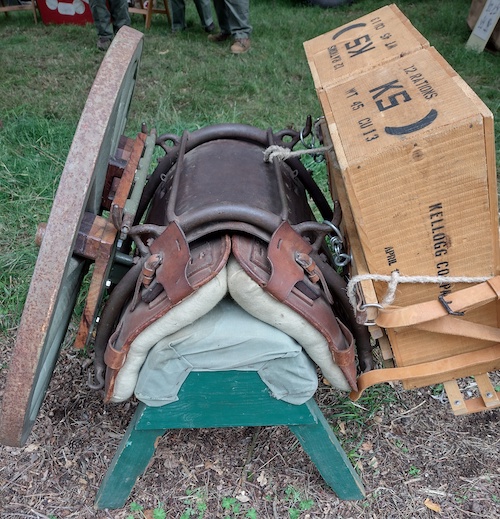
Their other saddle was of a later pattern with a rigid metal frame and was, apparently, less popular than the previous one. Whether this was with the mules or muleteers wasn’t clear! The load shown is illustrative only and, in reality, would have been more balanced, i.e. a pair of howitzer wheels or two loads of ‘K ration’ boxes.

You can find out more about The Burma Mule on their Facebook page.
To read more about the use of mules by the British (and Indian) Army, from the Peninsular War to 1975 – including detailed chapters on both world wars – I heartily recommend The Mule in Military Service, a slim paperback by distinguished military historian and SCS member, Anthony Clayton (The Book Guild Ltd, 2017). It looks like it is out of stock, so you may have to hunt for a secondhand copy.
If you’re interested, the books on the Chindit expedition that I read were:
- Chindit by Richard Rhodes James (1980)
- The Road Past Mandalay by John Masters (1961)
Well, it can’t all be about Salonika can it?
More military mules
Military mules may be history for the British Army, but their versatility in tricky terrain means that they are still valued by some armed forces around the world. Back in March I shared a video from the US Marine Corps about Alice, a mighty military mule who was described – unfairly in my opinion – as the meanest mule in the USMC. I’m pleased to say that the good people at the 2nd Marine Logistics Group have shared a further video of their wonderful mules.
Meet Alice, a mighty military mule
 Muffin – who has been sponsored by the Society since 2015 in recognition of the vital role of mules in the campaign – is a gentle little chap who has the build of his donkey father so would have been too small for the mule lines in Salonika.
They had no choice …
In this remembrance season it is appropriate to also remember those animals that served – and suffered – without which the BSF could not have functioned. Mules and horses are the most obvious, but there was also the humble, but vital, carrier pigeon.
Muffin and company
Last weekend Mrs Braysher and I slipped across the border into Suffolk. On our way we took the opportunity to visit the Redwings Horse Sanctuary visitor centre at Caldecott, to visit the Society’s mule, Muffin. Continue reading “Muffin and company”
Martina the Mule – TV Star!
Mules don’t feature on television very often, so what a joy it was to see Martina in Gary Lineker: My Grandad’s War on BBC1 on Monday 11th. A lovely Italian mule, Martina – in an all too brief appearance – explained to Gary (yes, that Gary Lineker) the important role mules played in supply and casualty evacuation on the mountainous front line of the Italian campaign during the Second World War. In the programme, Gary followed the route of his late grandfather from Salerno to Monte Cassino to understand his experiences as a member of the Royal Army Medical Corps and why British troops in Italy came to be known as ‘D-Day Dodgers’.
It’s impossible not to see parallels with the Macedonian campaign: a Mediterranean front with challenging terrain and climate, overshadowed by the main fighting in north-west Europe and considered a ‘cushy number’ by those not there; of course, the Italian campaign was a far bloodier business. The programme will be available on the BBC iPlayer for the next month or so and you can read about it here.
 INVASION OF ITALY : EIGHTH ARMY – Original wartime caption: To defeat the demolition menace, the 8th Army have once againresorted to the mule. These pictures show an RASC pack transport company trekking through the mountains with stores and ammunition for our forward patrols. The mules are able to avoid normal diversions and travel by way of the tortuous mountain paths.© IWM (NA 6748)
This is one of an impressive collection of photos in the excellent IWM online collection showing mules in Italy (search: mules Italy). Searching ‘mules Salonika’ will find photos of British military mules from a generation earlier.
Charlie Bailey: muleteer and black Welsh miner
My thanks go to Ben Franks for sharing with us this fascinating blog about Charlie Bailey, who served with 22nd Division in Salonika:
Birthday wishes to Muffin!
 This week Redwings Adoption Star Muffin celebrated his 32nd birthday. I’m ashamed to say that I am late with this news as the actual celebration was on Sunday 14th April. I hope he will accept these belated best wishes from the SCS. We hope he had a good party and enjoyed his cake. Continue reading “Birthday wishes to Muffin!”
 Salonika Campaign Society, 1915-1918