
This photo depicts a young signaller posing in a Salonika photographer’s studio in May 1916, showing off his new slouch hat.
Blog
International Nurses Day
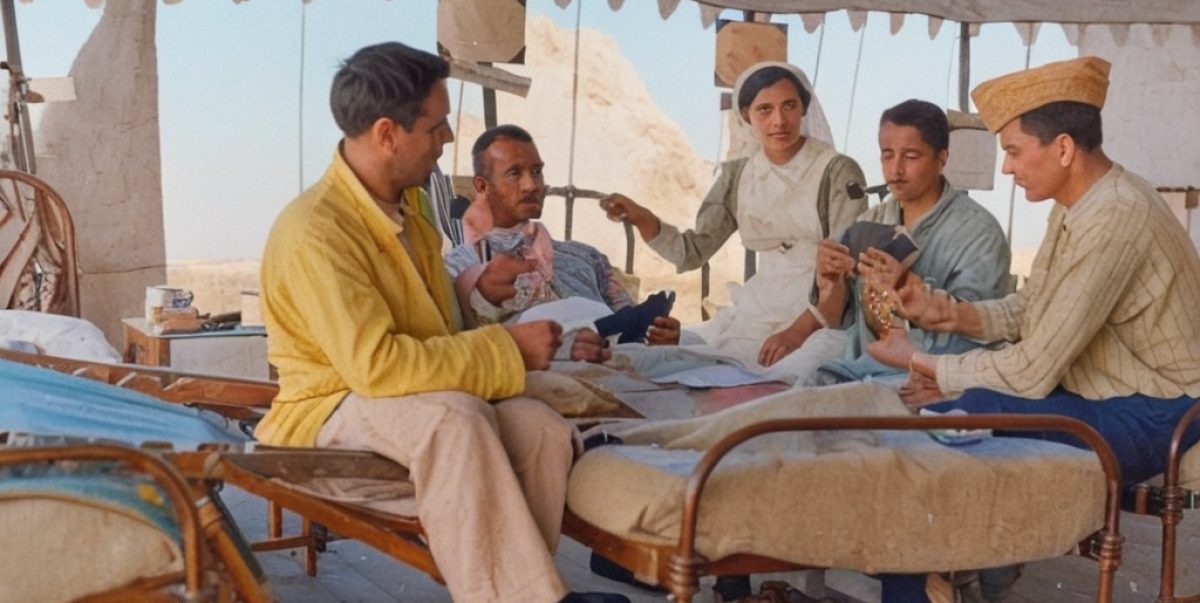
Here are some pictures for International Nurses’ Day …
Free access to National Archives digital records
If you have the extra time and inclination for researching the Salonika campaign you may find this news from The National Archives of interest:
We are making digital records available on our website free of charge for as long as our Kew site is closed to visitors.
Registered users will be able to order and download up to ten items at a time, to a maximum of 50 items over 30 days. The limits are there to try and help manage the demand for content and ensure the availability of our digital services for everyone.
Find out more at The National Archives website.
 Entrance to a house used as a staff mess, possibly in the village of Guvesne where British Salonika Force Advanced Headquarters was located from 1916. THE MACEDONIAN CAMPAIGN, 1915-1918 (click on the image to see full size) © IWM (Q 31609)
22 April 1915 at 5pm: Gas!
From Before Endeavours Fade, by Rose E. B. Coombs, MBE (An After the Battle Publication).
[Steenstraat], lying amid the rich fields, was at the western end of the French line on April 22 1915. Their line ran eastwards to a point south of Poelcappelle where it joined the sector held by the Canadian Corps with the British 27th and 28th Divisions beyond them east of Zonnebeke and Polygon Wood.
Lt Vincent Drew
My thanks go to Ben Drew who, some months ago, sent us this fascinating account of his great uncle’s service in the Salonika campaign.
Away from the Western Front and the ‘Turin men’
By Keith Edmonds
Many of you will be familiar with ‘Away from the Western Front’ (AFTWF), which was a First World War centenary project funded by the Heritage Lottery Fund and was supported by the expertise of the Salonika Campaign Society. Salonika featured as a campaign in several of the AFTWF sub-projects including their work with homeless veterans and the Sandham Memorial Chapel and also Castle Drogo where one of their stonemasons, Pte WG Arscott, fought and died in Salonika with the 10th (Service) Battalion, Devonshire Regiment. Continue reading “Away from the Western Front and the ‘Turin men’”
The BSF and PPE
By Alan Wakefield
Apologies for a heading with not one but two acronyms. However, with your interest in the Salonika Campaign and the national news coverage since the outbreak of the Coronavirus pandemic, both should be well known to you. We currently hear every day about the lack of sufficient Personal Protective Equipment for NHS and care workers in the front line of the fight against COVID-19. Back in 1916, soldiers of the BSF faced a similar lack of PPE when about to face their first summer in Northern Greece, an area known for endemic malaria, especially the Struma Valley. By the end of the campaign, two years later, the BSF had suffered a total of 162,517 malaria cases, a third of all its hospital admissions during the war.
 Despite the War Office knowing of the malarial threat and sufficient notice being given by BSF GHQ of its equipment needs for summer 1916, the men serving under Lt Gen George Milne suffered severe shortages of vital equipment, chief amongst which were mosquito netting and sun helmets. At this time the BSF’s administration came under GHQ Egypt. Under these arrangements ships carrying equipment and stores for the BSF sometimes came out to Salonika via Alexandria and it was not unknown for material considered vital to the needs of the Egyptian Expeditionary Force (EEF) to be unloaded before the ships sailed on to the Aegean.
 Although the missing sun helmets were replaced by slouch hats, making members of the BSF resemble ANZACs for their first summer campaigning, the lack of mosquito netting was not made up and adversely impacted on troops in the front line. Worst hit were the units of XVI Corps in the Struma Valley. Here, high daily sickness rates due to malaria, led to the formation of composite battalions at brigade level, with only enough men fit to form a single weak battalion from as entire brigade for front line service. All other officers and men were to be found somewhere on the medical chain or forming a cadre to keep alive the original units. By July 1916, 10th (Irish) Division was suffering a sick rate of 150 men per day and 28th Division was not far behind.
In July 1916, unable to provide his men with sufficient protective equipment, Milne ordered General Briggs to withdraw his troops from their line along the River Struma between Orlyak and Lake Tahinos. This summer withdrawal into the foothills, to protect the health of the front line soldiers, became routine for the BSF for the remainder of the campaign.

Once the War Office directly devolved administration of the campaign to Milne’s GHQ on 21 September 1916, the commander of the BSF was better placed to ensure the maximum available anti-mosquito equipment arrived for summer 1917. Unfortunately, delays in procurement led to continued shortages during the opening months of the BSF’s second malarial season. In December 1917, Sir Ronald Ross, one of the world’s leading authorities on malaria, visited the Salonika Front and produced a report for the War Office on the effects of and potential counter measures to malaria in northern Greece. This expert medical advice, along with the War Office decision to send minimal additional manpower to Salonika, ensured the flow of PPE reaching Milne’s troops reached adequate levels for the final summer of the campaign.

The PPE included the mosquito net head cover shown in the accompanying photographs. This piece of equipment was worn tucked into the shirt or tunic. In combination with specially designed shorts, the legs of which could be unbuttoned and rolled down and wrapped into puttees, and a pair of gloves, no skin was left exposed to potential mosquito attack. This equipment was generally worn by those on night duty, when mosquitoes were at their most active. Second Lieutenant Richard Skilbeck-Smith (1st Leinsters) likened the look of a soldier wearing the equipment to a cross between a scarecrow and a beekeeper. Even nurses found themselves required to wear such unwieldy PPE whilst making night rounds at hospital.
Along with this specialist personal equipment, all bivouacs, tents and huts and hospital beds were equipped with mosquito netting. Training in the use of all anti-mosquito equipment was rolled out across the BSF and medical officers and sanitary sections made spot checks to ensure troops were making correct use of their nets so as to keep malaria infection rates as low as possible. Even so, by 1918, there were 15,000 chronic malaria sufferers in the base hospitals around Salonika. These men were debilitated by the disease and were of little military value, a factor always borne in mind by Milne and his subordinate commanders when planning military operations. It is no wonder then, as Cyril Falls records in volume 2 of the Official History of the campaign, that Milne declared the mosquito net to be ‘as important as a rifle.’
Message from the Chair
Dear Members and Friends,
As I sit writing this over Easter, the world is in the grip of the coronavirus COVID-19 pandemic. I hope you and your families are keeping well and that you are getting used to the social and commercial lock-down that is currently in place. Like many of you, I’ve been working from home since mid-March and coming to terms with only seeing work colleagues, friends and family online. Thankfully we live in an age of remarkable communications technology enabling us to maintain instant contact across the globe from our living rooms. One can only imagine what the men and women of the BSF would have given for anything approaching this level of modern comms.
Bon courage, mes amis!
To all our members and friends …
I wish you all the very best at these strange and difficult times – wherever you find yourselves. Continue reading “Bon courage, mes amis!”
Muffin and company
Last weekend Mrs Braysher and I slipped across the border into Suffolk. On our way we took the opportunity to visit the Redwings Horse Sanctuary visitor centre at Caldecott, to visit the Society’s mule, Muffin. Continue reading “Muffin and company”
 Salonika Campaign Society, 1915-1918