
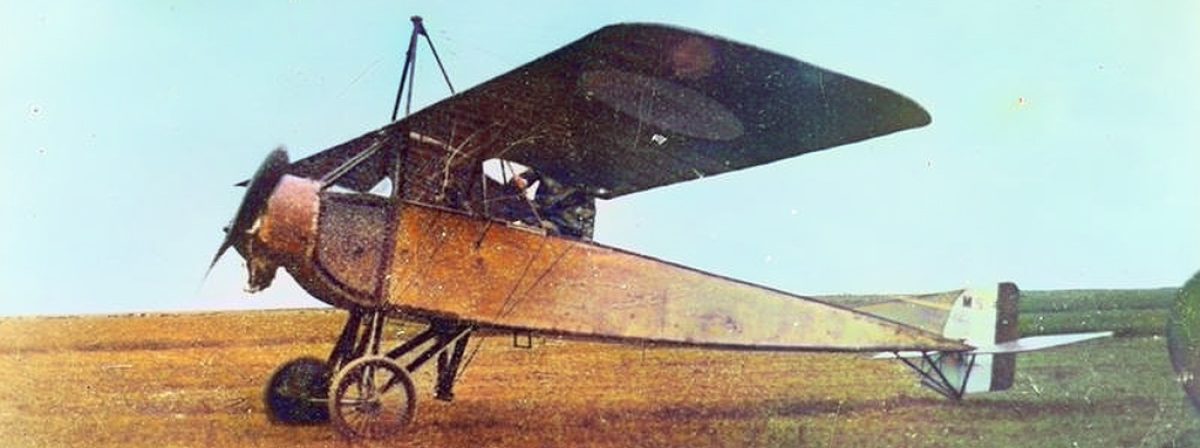
The Victoria Cross was first introduced on 29th January 1856 to honour acts of valour during the Crimean War. Two VCs were awarded in the Macedonian campaign, one in 1916 and one in 1918. It’s the first of these, to Private Hubert William Lewis of 11/Welsh, that I want to celebrate today.
Continue reading “Celebrating a Salonika VC Winner”Blog
The Jews of Salonika
Modern Thessaloniki seems a quintessentially Greek city but, during the First World War, it was a multi-ethnic and multi-cultural city which, just a few years before, had been part of the Ottoman empire. It was especially a Jewish city.
Continue reading “The Jews of Salonika”A little bit of Salonika in … Brussels
Taking advantage of a Eurostar ticket sale, Mrs B and I recently enjoyed a jaunt to Belgium, with a few days in Brussels and a few in Ieper (Ypres). Our last night found us in a hotel close to Bruxelles-Midi (Zuid) station, where we would be taking the Eurostar home the next day, and where we had ended our train journey from Ieper (train from Poperinge, changing at Gent-Sint-Pieters for Brussels).
Continue reading “A little bit of Salonika in … Brussels”New Book Out Today!
You may recall that back in September I alerted you to the promised publication of a new book about the Macedonian campaign, written by Jon Lewis and published by Helion & Company. I am pleased to say that, since then, I have been in touch with Jon who is a member of the Society. Jon tells me that the book is being released today. We congratulate him on the culmination of many years of research and hard work and wish him well with the book.
Continue reading “New Book Out Today!”Swindon soldiers from Salonika Campaign set to be remembered
Working with the Society, Swindon Borough Council intends to commemorate the role of Swindonians in the Salonika Campaign. We are grateful to the Swindon Advertiser for allowing us to reproduce this article which explains the Council’s plans.
“The men of Swindon and Wiltshire who fought in a long and bitter, if often forgotten, campaign in World War I will be remembered by a plaque or some other memorial.
Members of Swindon Borough Council voted unanimously to approve a motion brought by Conservative councillor Jake Chandler.
He said he had been set on the way of researching the Salonika campaign by his great-grandfather and he had learned of significant links to Swindon and Wiltshire and the fighting which took place in Greece and what is now North Macedonia in the southern Balkans between allied forces and The Bulgarian army with support from Germany, Turkey and Austria-Hungary.
Coun Chandler added: “I have been in contact with the Salonika Campaign Society and there are 41 pages of names about 900 military personnel from Swindon.”
The link with Swindon is so strong because the 7th Battalion of the Wiltshire Regiment, the 79th Infantry Brigade of the 26th Division, which had many men from Swindon in its ranks was one of the allied units, fighting on the front there for three years from 1915.
Also operating in the theatre were the Royal Engineers, and Swindon’s railway works and the skills of the men meant many of them fighting in that regiment and in the Salonika campaign were responsible for laying miles of new railway track.
The presence was such that landmarks in the area were given names such as Swindon Hill, Rickley Hill and the names of other villages around north Wiltshire.
Coun Chandler said: “There is a unique connection to this episode in history.”
The motion was seconded by the council’s Military Champion, Coun Lawrence Elliott.
He said: “Many from Swindon made the ultimate sacrifice out in the Balkans, far from home, and did not come back to a hero’s welcome.
“My grandfather came from Australia to do his bit and he lasted about three weeks in France. His sacrifice is marked on the Menin Gate, and my family can remember him.
“But many from Swindon and around have nowhere to remember those who fought and dies in this campaign.”
As Armed Forces Champion, Coun Elliott will “investigate the commissioning of a commemorative plaque or other memorial in partnership with the Salonika Campaign Society to be completed by 2025, in time for the 110-year anniversary of the start of the conflict”.
There will also be documents photographs and maps relating to the campaign put on display in the museum and art gallery when it puts on exhibitions and Swindon’s role in the First World War.”
Featured image, Swindon Hill. Source: Imperial War Museum
Happy New Year!
We wish all our members, friends, their families and loved ones all the very best for a happy and healthy 2023. And we send special Hogmanay greetings to our Scottish members and friends.
Continue reading “Happy New Year!”“Now, Dasher! now, Dancer!
Continue reading ““Now, Dasher! now, Dancer!”… now Prancer and Vixen!
On, Comet! on, Cupid! on, Donner and Blitzen!
To the top of the porch! to the top of the wall!
Now dash away! dash away! dash away all!”
A Christmas Card from France
This Christmas card was sent by my Grandfather in France to his younger sister in Gloucestershire. Shortly after, he was on his way to Salonika…
It’s Panto time again … Oh! yes it is!
This year I have been to a pantomime for the first time in about 25 years. We bought tickets last year but Covid meant that we didn’t get to use them. This year’s offering was Robin Hood and the Babes in the Wood by the Littleport Players. Not one of the more common productions – and not one I’ve come across in Salonika – but I do recall going to see it with my grandfather when I was a nipper. For many years he and I went to East Barnet Royal British Legion Hall to see the show put on by – I think – the Warren Players and Concert Party. You don’t hear of concert parties these days, so that makes me feel very old.
Continue reading “It’s Panto time again … Oh! yes it is!”Rough Riders Remembered
Whilst in London recently we were passing through Smithfield on our way to St Paul’s, when I came across a hidden church: St Bartholomew the Great. It was open so we couldn’t resist going in for a nosey around and I’m very glad we did. It was especially atmospheric as it had some lighting on (it was going dark outside), a choir was practising for a concert and I’m sure there was a lingering smell of incense. With a long history – founded in 1123 – there is much of interest inside, but the item that especially caught my eye was comparatively recent: a memorial to the fallen of the City of London Yeomanry (Rough Riders) in the world wars.
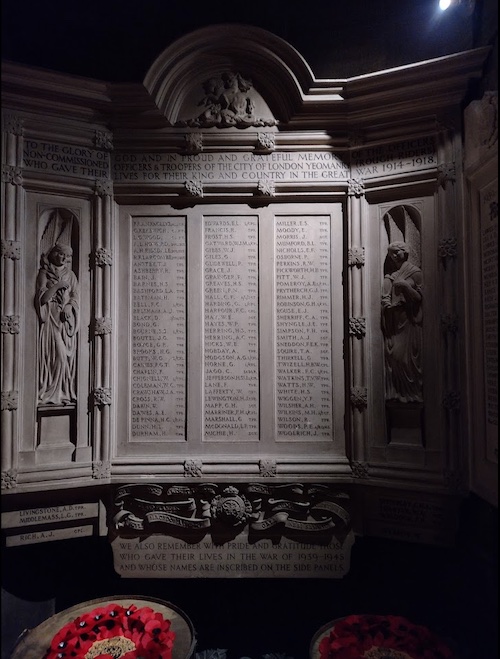
One of the Regiment’s battle honours is ‘Macedonia 1916-17’.
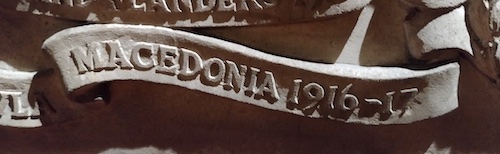
1/1st City of London Yeomanry (Rough Riders) arrived in Salonika from Egypt – having earlier been in Gallipoli – in November 1916 as part of 8th Mounted Brigade. Its sojourn in Macedonia was relatively brief and the Brigade returned to Egypt in June 1917, where it became part of the Yeomanry Mounted Division which took part in the campaign in Palestine. In mid-1918 the Regiment moved to France as part of the Machine Gun Corps.
These are most of the dead from the First World War – several more are on a side panels:

According to the CWGC website, just five are buried in Greece. All are described as ‘died’, which suggests to me that the cause was disease or accident, but I know that’s not conclusive. From the dates of death, just one of the casualties is from the time the Regiment spent in Macedonia:
Two are casualties from the Gallipoli campaign, buried on the island of Lemnos
- 24 October 1915 – 2240 Private Horatio Cortissos De Pinna, aged 27; buried at East Mudros Military Cemetery (III.C.67);
- 1 December 1915 – 2824 Private Y F Wiggen; buried at Portianos Military Cemetery (V.A.83).
Just one is from the regiment’s time in Macedonia:
- 4 March 1917 – 3178 Private Thomas Victor Wilmott Watkins, aged 29; buried at Salonika (Lembet Road) Cemetery (937).
The other two died after the regiment left for Egypt, so stayed on in Macedonia for some reason:
- 13 October 1917 – 41436 Private W R S Wybrow, aged 45 (possibly a victim of influenza); buried at Kirechkoi-Hortakoi Military Cemetery (21);
- 15 March 1918 – 7436 Private W Laffeaty, aged 36; buried at Mikra British Cemetery, Kalamaria (232).

To find out more, please visit:
- The Yeomanry pages on The Long, Long Trail website
- The Inns of Court and City Yeomanry website (which includes the museum)
 Salonika Campaign Society, 1915-1918