Directory of WW1 Websites


Canada’s contribution to the First World War cannot be underestimated. More than 650,000 Canadians and Newfoundlanders served in the war with 66,000 killed and over 172,000 wounded. Such was the contribution, Canada had its own signature on the Treaty of Versailles. In Salonika, Canadian medical services provided care at Nos. 4 and 5 General Hospitals, and Nos. 1 and 3 Stationary Hospitals (see this earlier post).  It’s of no surprise therefore that Canadians continue to research this significant period of their history.

One such research group is the CEF Study Group – an Internet discussion forum for the study, sharing of information and discussion related to the Canadian Expeditionary Force (CEF) in the Great War.

The CEF Study Group has just published its 2022 ‘List of Recommended Great War Websites’. Our own site is included among a directory of 2000+ websites, grouped into 31 logical sections. We are described thus: “This very detailed and multi-layered Blog site has numerous theme ‘buttons’ which take the reader deeper into the topic. Site is mature and very well organized.” (A recognition of former editor Robin Braysher’s work, I should add).

Readers may well find this a useful resource for research. The directory can be downloaded here.

Winter Webinars 2 – with Alan Wakefield

Online Talk and Live Q&A with Alan Wakefield
‘Britain’s Forgotten Army in Salonika’

Streaming Live: 7pm, 27th October 2022

Alan Wakefield’s talk will focus on two battalions of the Oxfordshire and Buckinghamshire Light Infantry which gained for the Regiment the battle honours Doiran 1917-18 and Macedonia 1915-18. Using first-hand accounts, Salonika Campaign Society Chair Alan Wakefield will paint a vivid picture of life for the British Army in Salonika.

This talk is hosted by the Soldiers of Oxfordshire Museum. It is free to view, but please consider making a donation to support the work of the museum.

Click HERE for the talk – 7pm on Thursday 27th October 2022.


Featured image source: Soldiers of Oxfordshire Museum. Men of 8th (Service) Battalion Oxfordshire and Buckinghamshire Light Infantry, photographed while building a POW camp, shovels still in hand.

Winter Webinars

Now that winter evenings are setting in, why not watch and participate in an online webinar? The Western Front Association (WFA) and The Gallipoli Association are offering the following online talks in October and November:

1. The Western Front Association

Monday 31 October – The Flying Sikh – Hardit Singh Malik, the RFC and the First World War
From his arrival in the UK alone in 1908 as a fourteen-year-old, to Balliol College, Oxford and into the Royal Flying Corps during the First World War, Hardit Singh Malik lived an extraordinary life, often in the face of great adversity, yet always with charm and good humour. He played cricket for Sussex and was an Oxford blue in golf, playing with the Prince of Wales.
This presentation by Stephen Barker describes Hardit Singh Malik’s fascinating story.
To register for this webinar, click here: The Flying Sikh

Monday 7 November – The Coal Black Sea: Winston Churchill and the Worst Naval Catastrophe of the First World War
On the morning of 22 September 1914, just six weeks into the First World War, three Royal Navy armoured cruisers were sunk by a German U-boat in the southern North Sea. The action lasted less than 90 minutes but the lives of 1,459 men and boys were lost – more than the British losses at the Battle of Trafalgar or in the sinking of RMS Lusitania. Yet, curiously, few have ever heard of the incident.
Using a range of official and archival records, Stuart Heaver exposes this false narrative and corrects over a century of misinformation to honour those who lost their lives in the worst naval catastrophe of the First World War. 
To register for this webinar, click here: The Coal Black Sea

Monday 14 November – Investigating the Australians at Pozieres
The victorious capture of the village of Pozieres on 23 July 1916 won the 1st Anzac Corps a reputation as a competent and polished formation, but a closer examination of ongoing activity along the Pozieres Ridge indicates that this is anything but the case. The lessons learned were deeply flawed, and indicative of the desperate nature of fighting on the Somme.
Dr Meleah Hampton was until recently a historian in the Military History Section, Australian War Memorial. She is a graduate of the University of Adelaide and completed her PhD with a thesis on the 1916 battles for Pozières and Mouquet Farm. Her primary interest is in the operational conduct of the First World War on the Western Front. 
To register for this webinar, click here: Investigating the Australians at Pozieres

Monday 28 November  – The Searchers: The Quest for the Lost of the First World War
By the end of the First World War, the whereabouts of more than half a million British soldiers were unknown. Most were presumed dead, lost forever under the battlefields of northern France and Flanders.
In this webinar, Robert Sackville-West brings together the extraordinary, moving accounts of those who dedicated their lives to the search for the missing. These stories reveal the remarkable lengths to which people will go to give meaning to their loss and the exhumation and reburial in military cemeteries of hundreds of thousands of bodies.
To register for this webinar, click here: The Searchers

To participate in the WFA webinars, you will need to register via the links above.

2. The Gallipoli Association

Wednesday 26 October – Gallipoli gallantry: Consistent courage, inconsistent recognition
In re-examining some of the most celebrated Victoria Cross actions of the 1915 Dardanelles campaign Stephen Snelling will look at the bureaucracy behind some of the awards as well as the erratic nature of some of the medals distributed. What his research has revealed is that bravery was not enough on its own to earn the highest honour. Determination and persistence on the part of those seeking to recognise acts of valour was often equally important.
Based in Norfolk, Stephen been a writer/ journalist for nearly 50 years, working variously as a sports editor, features editor and magazine editor. He is the author of eight books including one on the Victoria Cross recipients of the Gallipoli campaign and, most recently, a study of the V Beach landings, The Wooden Horse of Gallipoli.

Tuesday 29 November – 42nd Division at Gallipoli
A talk by author, Paul Knight on the 42nd Territorial Division at Gallipoli, and their exploits at Helles.

Gallipoli Association talks are free to GA members, but guests and the general public are encouraged to join the Association or make a small donation. To reserve a place, please email: education@gallipoli-association.org or warwickfus@btinternet.com


Featured image source: IWM – Lives of the First World War

Malta – the ‘Nurse of the Mediterranean’

According to one contemporary writer, Malta “…assumed the role of nurse, and her breakwaters seem like arms stretched out to receive her burden of suffering. Once the hospital ship has passed within their shelter the rolling ceases, and the wounded feel that they have reached a haven of rest.” So wrote the Rev. Albert MacKinnon in 1916 in “Malta: The Nurse of the Mediterranean” – an early reference to the soubriquet by which the island came to be known during the First World War.

As the war in France began to grind into stalemate, other fronts opened in the Dardenelles and Gallipoli, with disastrous consequences for the allied forces. The scale of casualties was unprecedented and required an urgent response,

“That Malta should become the home of one of the British Empire’s largest systems of war hospitals was not anticipated in the early months of the war. It was not until May 1915 that the first badly wounded casualties from the Gallipoli campaign started to pour into Malta. The first convoy of 600 patients arrived on May 4, followed by a further 400 a day later, and on May 6 another 600 cases were brought ashore. Before the end of May, upward of 4,000 casualties from the Gallipoli campaign had reached Malta…The end of May saw the number of hospital beds catering for the sick and injured rise to over 6,000 in 14 hospitals spread all over the island.” Source: Times of Malta

In Salonika, a hostile climate and serious illness – mainly malaria – were the principle cause of casualties. Malta again provided an immediate solution,

“After January 1916, the number of sick and wounded fell very considerably with the scaling down of the Gallipoli campaign, only to rise again with a vengeance in the summer of 1916, as the Salonika campaign proceeded. However, the number of hospital beds remained in the region of 25,000, and reached a maximum of 25,522 housed in 27 hospitals by April 1917. The number of sick patients, suffering mainly from “dysentery and enteric group of diseases”, always exceeded the number admitted with war wounds. With the end of the Gallipoli campaign and the start of the Salonika campaign in October 1915, this trend in admissions became even more marked as a result of a rush of malaria cases from Salonika. Up until April 30, 1917, Cottonera, a mixed hospital catering for both the sick and injured, received 2,867 sick but only 308 wounded.” Source: Times of Malta

Malta’s strategic location in the Mediterranean – and its history as a British Protectorate – made it an important naval base for the British and, together with its climate, also an important place of rest and healing. But it was also hundreds of miles from Salonika and by April 1917, increasing submarine attacks on hospital ships made it unsafe to continue evacuating casualties to Malta from Salonica. Five General Hospitals, Nos 61, 62, 63, 64 and 65 were therefore mobilized at Malta for duty in Salonica, arriving on 11 July 1917. Malta’s role as the ‘nurse of the Mediterranean’ had, effectively, ended. Source: MaltaRAMC

Further Reading


Featured image: Times of Malta

Ludwik and Hanka Hirszfelds’ Remarkable Medical Research at the Salonika Front

Almost every week, for me at least, a new insight about the Salonika Campaign presents itself. In this case how the campaign, in bringing together forces from Europe, Africa, and Asia, gave an opportunity to continue the study of blood types and distribution. So my thanks go to Harry Fecitt for bringing to attention this interesting article about the work of Ludwik and Hanka Hirzfeld during the campaign years.


Featured image: Doctors Ludwik and Hanka Hirszfeld in the Balkans. Source: here

Members’ Area – coming soon, with your help.

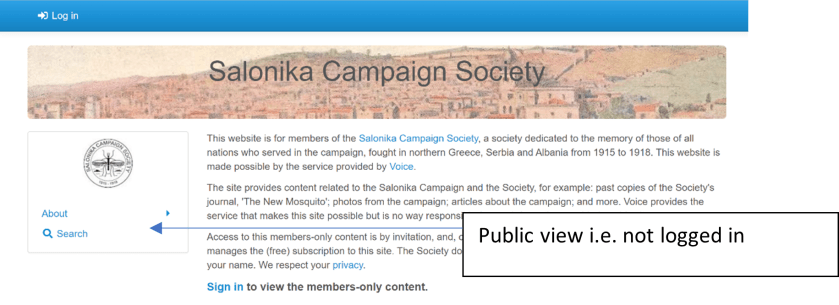
One of the items discussed at the recent online AGM was the introduction of a new private ‘members only’ website. The site will provide content related to the Salonika Campaign and the Society, for example: past copies of the Society’s journal, ‘The New Mosquito’; photos from the campaign; contemporary documents; Society proceedings; and more.

The Members’ Area is provided by Voice, an independent service providing free websites for hundreds of charity, not-for-profit, and voluntary groups in the UK.

Access to this members-only content is by invitation from the Society. Once invited, members will need to register with Voice. Voice  then manages the (free) subscription to this site. The process for registering is much the same as for many other sites.

The immediate plan for the site is to gather feedback about its organisation and content before going fully live to all members in the Spring of 2023. In the meantime, we welcome members of the Society to request an invitation to join the site, to try it out, and help us develop the area.


AGM forced to go online!

UPDATE – FRIDAY 30th SEPTEMBER
Emails with details of how to join the online AGM have been sent out to members today. If you have not received the email, do please get in touch and we will email the details in time for the meeting on Saturday.

The rail strike announced for Saturday 1st October makes it very difficult, or near impossible, for many members of the Society and of the committee to attend. Regrettably, therefore, the AGM will now be taking place online and not in London. In addition, the preceding ceremony at the Cenotaph will not take place this year.

Details on how to join the online meeting will be sent out to members.

Please accept our sincere apologies for this but the committee believes that this is the only appropriate option given the circumstances, which are beyond our control.


Featured image by Alexandra_Koch from Pixabay

Heritage Open Days 9-18 September 2022

Many readers will know of Sandham Memorial Chapel and Stanley Spencer’s stunning paintings reflecting his experiences of Salonika. If you haven’t visited before, there is a great opportunity to do so this September as part of a programme that offers over 3,000 free in-person or virtual visits to sites in the UK.

The sites open this September include several military museums and other sites of relevant interest. For example, the Commonwealth War Graves Commission has created a number of open days and tours across the country.

To find out more about the sites open across the UK, use these links:
https://www.heritageopendays.org.uk/
https://discovernorthernireland.com/things-to-do/arts-culture-and-heritage/european-heritage-open-days
https://www.doorsopendays.org.uk/
https://cadw.gov.wales/visit/whats-on/open-doors-events


Featured image: Commonwealth War Graves Commission

Can you help the Society’s AGM go online?

On Saturday October 1st, the Society is holding its Annual General Meeting. The location, at the Civil Service Club is close to the Cenotaph where earlier in the day a short service of commemoration will be held. We hope that you will be able to travel to London to join us.

However, for many, making such a journey is not possible. Train and other travel issues, cost, travelling times, domestic/work responsibilities, or even continuing worries about COVID may make the trip unfeasible for many. Which is a shame as we would like as many as possible to participate in the AGM.

To that end, we have been exploring ways in which we could live stream, or web cast, the meeting. Our research shows that it would come at a cost – if done professionally. That cost is not extortionate – after all, a camera operator must earn a living, pay for equipment, and so on – but the likely cost is too high for a small society such as ours.

However, if we were to manage things ourselves, using one of the many free or low-cost services (for example, streaming live via Facebook) turning the AGM into an online event becomes much more of a possibility.

We are therefore throwing the net out to members and asking for help. Do you have experience in this area? Are you technically minded, willing to travel to London, and able to set up a streamed event? Do you have a friend, son, daughter, grandchild, niece or nephew who could help out?

If so, do please get in touch by emailing us at scswebeditor@gmail.com to discuss things in more detail. We would of course help to meet any necessary travel and other expenses.

Thanks for taking the time to read this and, with luck, we will meet each other both in person and online at the AGM.

Featured image by JB_Home from Pixabay