
Continue reading ““Now, Dasher! now, Dancer!”… now Prancer and Vixen!
On, Comet! on, Cupid! on, Donner and Blitzen!
To the top of the porch! to the top of the wall!
Now dash away! dash away! dash away all!”
Author: Robin Braysher
Robin's interest in the campaign comes from his grandfather, Fred, who served as a cyclist with the BSF from 1915 to 1917, mainly in the Struma valley where he caught malaria and dysentery. Robin joined the SCS in 2003 and served on the committee for 18 years as journal and then web editor. Opinions expressed in these posts are his and do not necessarily reflect the views of the Society.
It’s Panto time again … Oh! yes it is!
This year I have been to a pantomime for the first time in about 25 years. We bought tickets last year but Covid meant that we didn’t get to use them. This year’s offering was Robin Hood and the Babes in the Wood by the Littleport Players. Not one of the more common productions – and not one I’ve come across in Salonika – but I do recall going to see it with my grandfather when I was a nipper. For many years he and I went to East Barnet Royal British Legion Hall to see the show put on by – I think – the Warren Players and Concert Party. You don’t hear of concert parties these days, so that makes me feel very old.
Continue reading “It’s Panto time again … Oh! yes it is!”Rough Riders Remembered
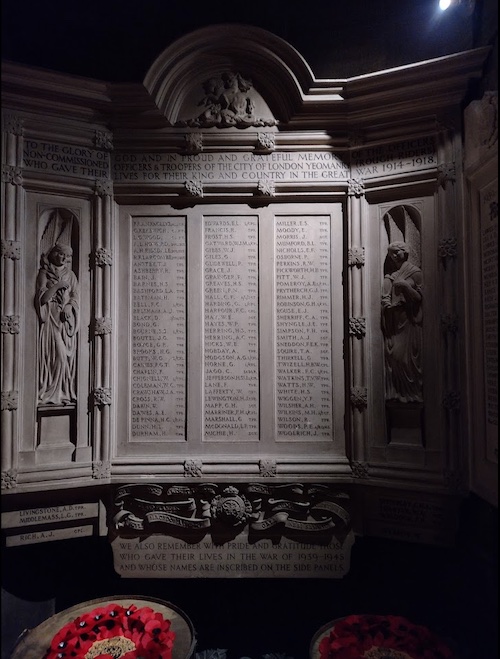
Whilst in London recently we were passing through Smithfield on our way to St Paul’s, when I came across a hidden church: St Bartholomew the Great. It was open so we couldn’t resist going in for a nosey around and I’m very glad we did. It was especially atmospheric as it had some lighting on (it was going dark outside), a choir was practising for a concert and I’m sure there was a lingering smell of incense. With a long history – founded in 1123 – there is much of interest inside, but the item that especially caught my eye was comparatively recent: a memorial to the fallen of the City of London Yeomanry (Rough Riders) in the world wars.
One of the Regiment’s battle honours is ‘Macedonia 1916-17’.
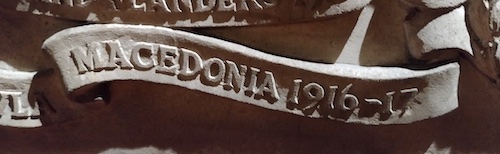
1/1st City of London Yeomanry (Rough Riders) arrived in Salonika from Egypt – having earlier been in Gallipoli – in November 1916 as part of 8th Mounted Brigade. Its sojourn in Macedonia was relatively brief and the Brigade returned to Egypt in June 1917, where it became part of the Yeomanry Mounted Division which took part in the campaign in Palestine. In mid-1918 the Regiment moved to France as part of the Machine Gun Corps.
These are most of the dead from the First World War – several more are on a side panels:

According to the CWGC website, just five are buried in Greece. All are described as ‘died’, which suggests to me that the cause was disease or accident, but I know that’s not conclusive. From the dates of death, just one of the casualties is from the time the Regiment spent in Macedonia:
Two are casualties from the Gallipoli campaign, buried on the island of Lemnos
- 24 October 1915 – 2240 Private Horatio Cortissos De Pinna, aged 27; buried at East Mudros Military Cemetery (III.C.67);
- 1 December 1915 – 2824 Private Y F Wiggen; buried at Portianos Military Cemetery (V.A.83).
Just one is from the regiment’s time in Macedonia:
- 4 March 1917 – 3178 Private Thomas Victor Wilmott Watkins, aged 29; buried at Salonika (Lembet Road) Cemetery (937).
The other two died after the regiment left for Egypt, so stayed on in Macedonia for some reason:
- 13 October 1917 – 41436 Private W R S Wybrow, aged 45 (possibly a victim of influenza); buried at Kirechkoi-Hortakoi Military Cemetery (21);
- 15 March 1918 – 7436 Private W Laffeaty, aged 36; buried at Mikra British Cemetery, Kalamaria (232).

To find out more, please visit:
- The Yeomanry pages on The Long, Long Trail website
- The Inns of Court and City Yeomanry website (which includes the museum)
A Date With Destiny …
Whilst looking through ‘The Mosquito’ – an excellent resource and good value, too! – I came across a recipe for a date and walnut cake from June 1939 (No. 46, page 49). I’m no baker, but I do like pottering in the kitchen. Admittedly it’s mainly to listen to history podcasts, but I can turn out a reasonable tea loaf, so thought this would be within my capabilities. The opportunity came when we were given a bag of fresh walnuts so, with just some stoned dates to buy, I was off!
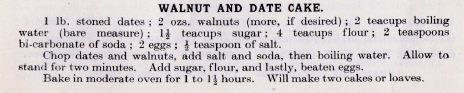
I know the recipe says ‘Walnut and Date Cake’ but I think ‘Date and Walnut’ trips off the tongue more readily!
Ingredients
- 1 lb stoned dates;
- 2 ozs walnuts – I put in 3 ozs as I had them and 2 ozs didn’t look much next to a pound of dates!
- 2 teacups of boiling water (bare measure) – I have no idea what this means but two measures of one of our posh teacups did the trick!
- 1½ teacups of sugar – I don’t have a very sweet tooth and given that a pound of dates is rather sweet I put in a little under a teacup of Demerara, which was fine;
- 4 teacups of plain flour – I ended up shaking in a bit more because the mixture looked rather gloopy!
- 2 teaspoons of bicarbonate of soda;
- 2 beaten eggs;
- ½ teaspoon of salt.
Method
- Chop dates and walnuts – I went quite small; this was the most tedious part of the operation but, with a good podcast to listen to, the job was soon done;
- place the dates and walnuts in a bowl and add salt, bicarbonate of soda, then boiling water;
- allow to stand for two minutes;
- add sugar, flour and the beaten eggs – stirring thoroughly;
- ‘Will make two cakes or loaves’ – not very precise guidance from the recipe so I got out a selection of baking tins and guessed how far the mixture would go – greasing them with butter and lining with greaseproof paper before pouring in the mixture; these are the sizes I ended up with …
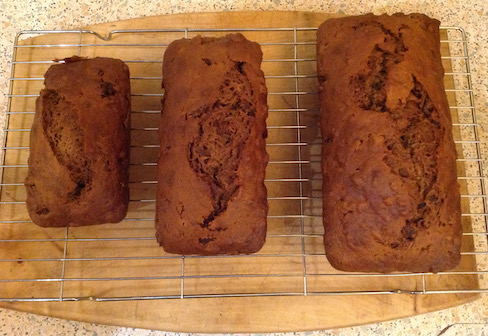
Pip, Squeak and Wilfred!
- ‘Bake in moderate oven for 1 to 1½ hours’ – our fan oven did them in about 45 minutes at 180℃; I checked they were done by poking with a skewer to see if there was any uncooked mixture lurking (thanks for the tip, Mrs B!).
I have to say they were a great success and there is very little left after a week. I shall definitely be making this again.
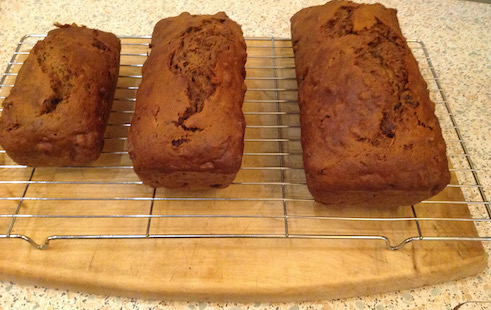
So, thanks to the Salonika Reunion Association and, especially, Aileen H. Moore (late of QAIMNS (R)) for a super little recipe shared in the ‘Women’s Pages’ of ‘The Mosquito’ over 70 years ago!
Remembered
At the Cenotaph in Whitehall …

(Photo by Keith Roberts)
At the Field of Remembrance (2021), by Westminster Abbey …
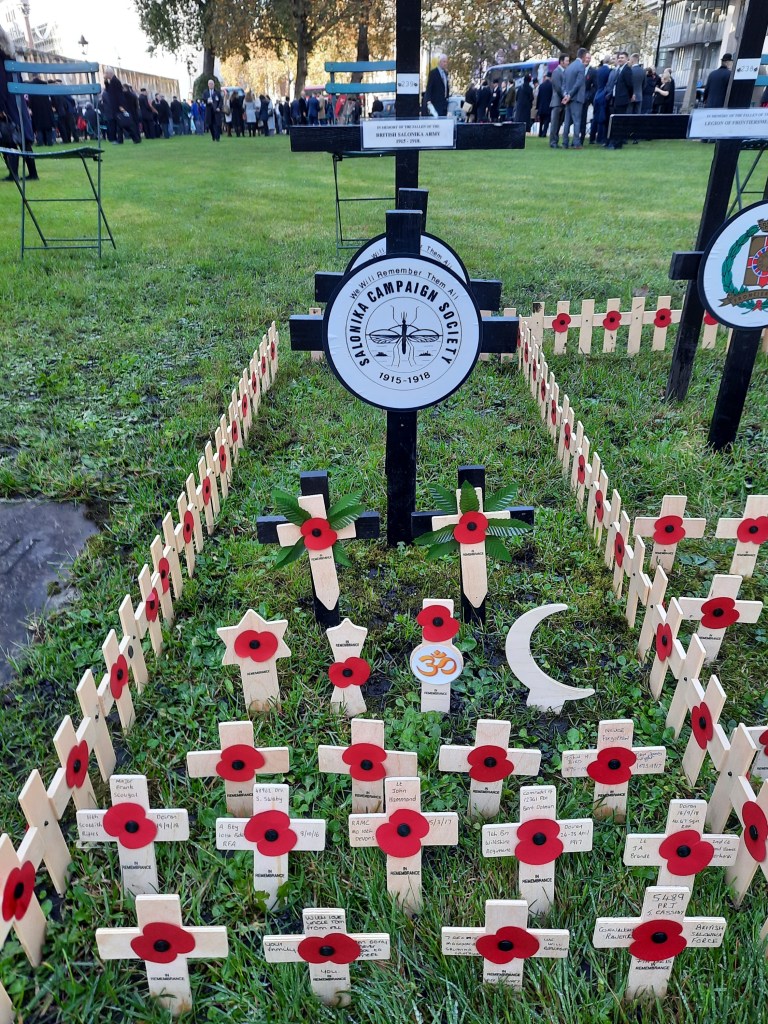
At Sandham Memorial Chapel (2021) …
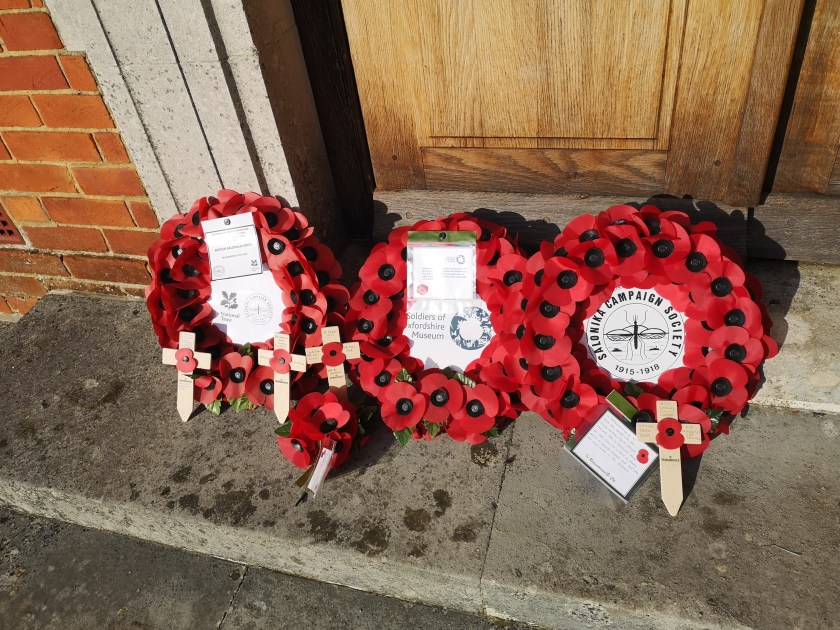
At Polykastro, Greece (2010) …

They shall grow not old …

Pillar Hill Cemetery, Doiran Front, Salonika. © IWM Q 64343
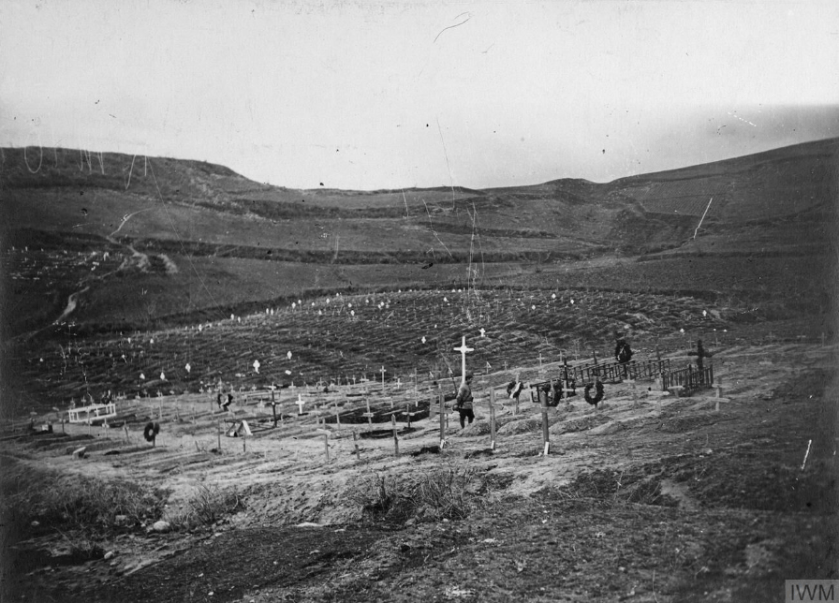
Allied war cemeteries at Monastir, the cemetery in the foreground is French, 17 January 1917. © IWM Q 78321
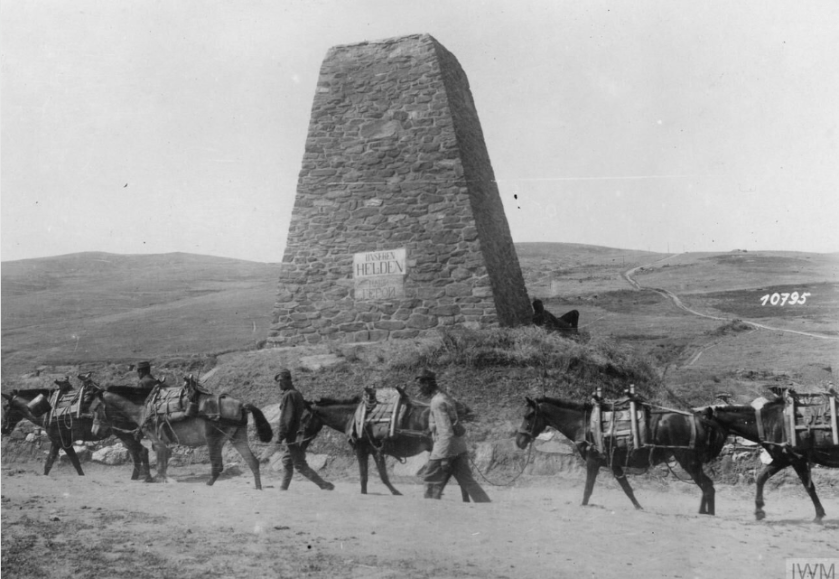
An Austro-Hungarian mule train passing by a monument to German and Bulgarian dead. The inscription reads “Our Heroes” in German and Cyrillic alphabet. © IWM Q 86225
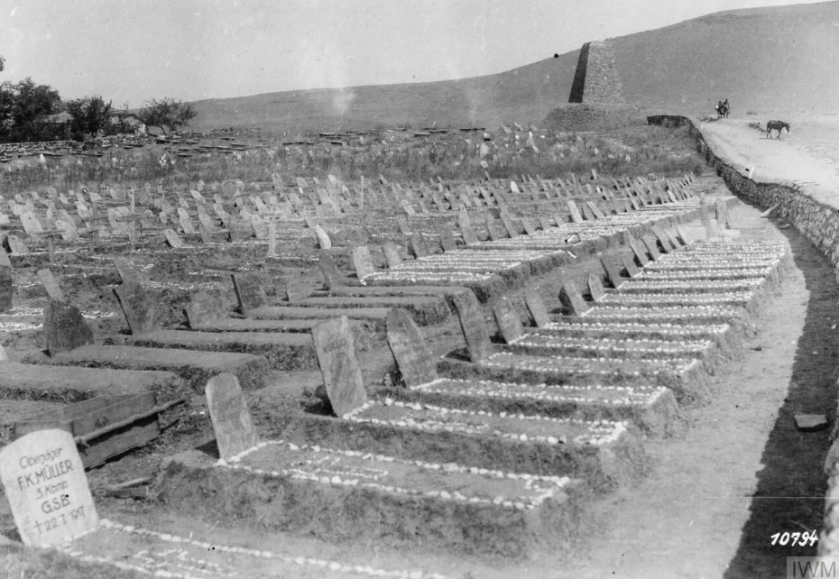
A German military cemetery near Cericani, Bosnia and Hercegovina, 1917. The nearest grave belongs to Oberjager F. K. Muller of the 3rd Company, Guard-Schutzen Battalion, died on 22 July 1917. © IWM Q 86565

A military cemetery of Austro-Hungarian prisoners near Uskub (Skopje), 1917. Note a cross with a word “Swabia”, frequently written on other crosses. © IWM Q 86467
… we will remember them!
Remembrance
With Bonfire Night a rather damp memory we are now very firmly in the season of remembrance, although for our Society remembrance of the achievements, suffering and sacrifice of the British Salonika Force – and associated organisations, individuals and even animals in the campaign – is ongoing and not restricted to a specific time of year. Even so, members and friends will be gathering at war memorials across the country and at CWGC cemeteries further afield in the coming week.
I’ve long been fascinated by war memorials, which come in different shapes and styles: the one where I grew up (Barnet) has a splendid ‘winged victory’, but as she’s topless it was a bit embarrassing!; my local one (Dereham, Norfolk) is a sober Cenotaph lookalike; Bishop’s Stortford memorial once caught my eye because it has items of soldiers’ kit carved in stone; I rather like the one in Cambridge, showing a fully equipped ‘Tommy’ swinging along in fine style with victors’ laurels slung on his rifle. I think, though, that my favourite is in Rawtenstall, Lancashire.
I have mentioned it before, but make no excuse for including it again. What makes it so interesting is that it isn’t just about the army, or even the wider armed services in the First World War, nor is it dedicated to ‘The Glorious Dead’ alone, but has a much wider dedication. Entitled Tribute of Honour, it reads as follows:
To the men who made the supreme sacrifice, to the men who came back and to those who worked at home to win safety for the Empire. 1914-1918.
No mention of women specifically in the dedication, but they certainly feature in the friezes around the base of the memorial, which I shared with you on an International Women’s Day. For this remembrance season here are all the friezes, showing many aspects of the war effort at home and overseas.
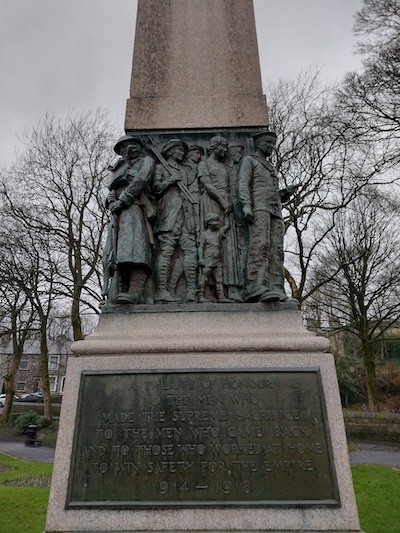
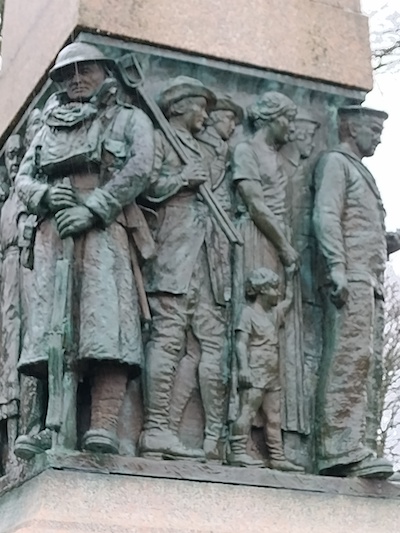
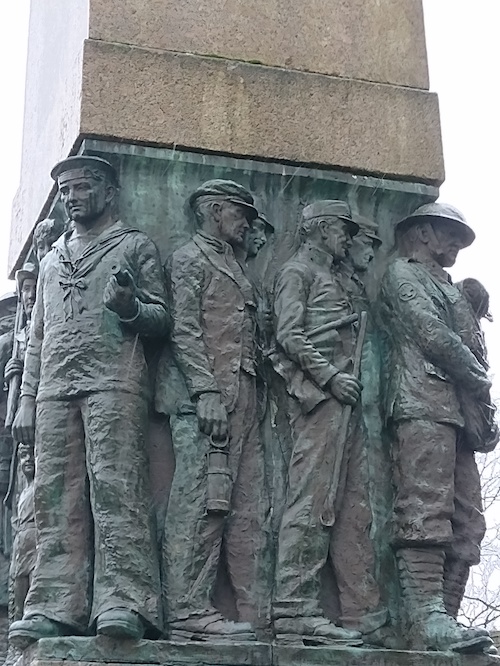

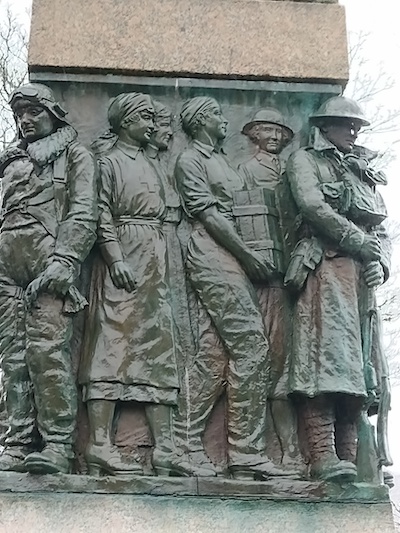

We will remember them all.
A new book on a forgotten front
Whilst browsing wistfully through the Helion & Company website – they have so many books on military history, some of which are intriguingly ‘left field’ – I came across a book on the Macedonian campaign to be published this autumn:
Continue reading “A new book on a forgotten front”A malaria vaccine at last!
We all know that malaria was a terrible scourge of the BSF during the Macedonian campaign. It says something for the tricksy nature of the disease that it has taken over one hundred years for a reliable vaccine to be developed – and it still needs to be approved and manufactured:
BBC: New malaria vaccine is world-changing, say scientists
Continue reading “A malaria vaccine at last!”The Italians are here!
On Friday 11th August 1916, Italian troops landed in Salonika to bolster the allied effort. Fortunately for us, the event was captured on film. Not only do we see troops of the Italian 35th Division, but there are also other allied personnel and – best of all – we get to see central Salonika in its heyday, before the catastrophic fire that destroyed so much of the city just a year later. And there is much more besides. So, sit back and enjoy 36 minutes of fascinating vintage film footage.
If you want to know more about the Italian role in the campaign, be sure to attend the Society’s annual meeting on 1st October 2022, where Jake Gasson will be presenting a talk on the Italian experience of the Macedonian Front.
Continue reading “The Italians are here!” Salonika Campaign Society, 1915-1918