
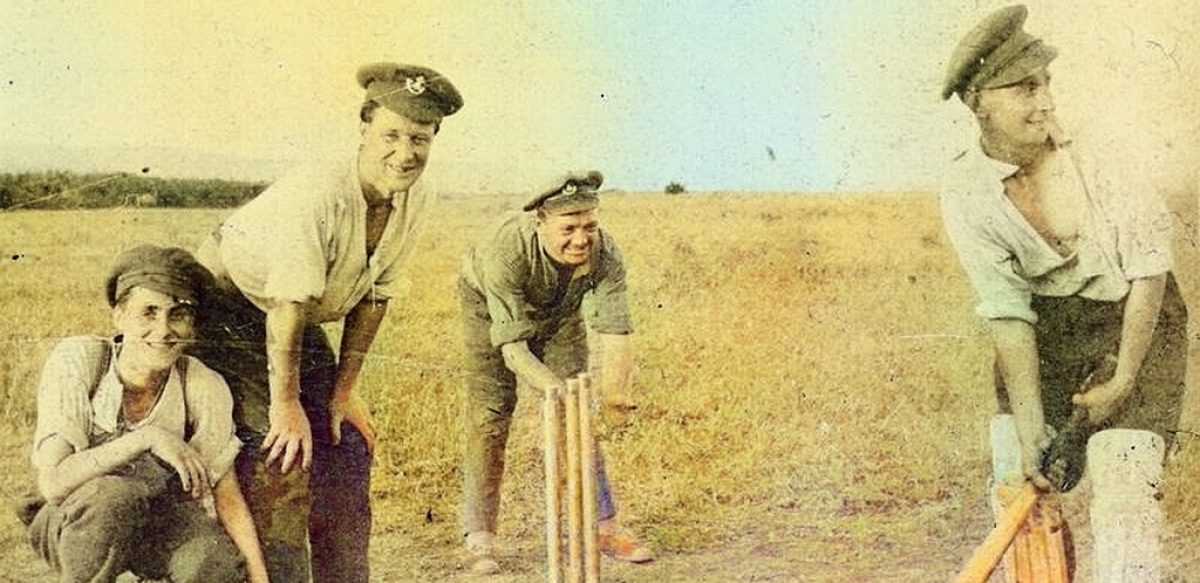
No, this isn’t a sudden cri de couer after twenty years of reading about and studying the Salonika campaign, but rather an acknowledgment of the tedium experienced by many of those who served in Macedonia between 1915 and 1919. This was the subject of a fascinating podcast I recently came across.
Continue reading “The Salonika campaign’s so boring!”Author: Robin Braysher
Robin's interest in the campaign comes from his grandfather, Fred, who served as a cyclist with the BSF from 1915 to 1917, mainly in the Struma valley where he caught malaria and dysentery. Robin joined the SCS in 2003 and served on the committee for 18 years as journal and then web editor. Opinions expressed in these posts are his and do not necessarily reflect the views of the Society.
On Yer Bike!
With my particular interest in the Army Cyclist Corps in the Macedonian campaign, I could hardly let ‘World Bicycle Day’ go unnoticed!
Continue reading “On Yer Bike!”Tiny Takes Tea!
On International Tea Day, here’s a cute photograph of Tiny, the donkey mascot of the 26th Divisional Train, drinking tea.
“Tiny”, a small donkey, was found dying by the roadside by men of 26th Divisional Train. They took care of him and he became their mascot. “Tiny” would walk into any tent – including the officers’ mess – and help himself to any dainty lying about. As can be seen from the photo, he liked his tea from a mug, and was known to take as many as take nine mugs in succession! I hope they also treated him to ginger biscuits.
Continue reading “Tiny Takes Tea!”Happy Easter!
We wish all our Orthodox friends and visitors a very happy Easter! Sorry to be late with these good wishes, but I only realised yesterday evening.
Continue reading “Happy Easter!”Ribbit! Ribbit!
When I discovered that today is World Frog Day, I doubted that I could find any frogs with a Salonika connection. Then a memory stirred of a story read in The Mosquito – the journal of the Salonika Reunion Association – but would I find it again … ?
Continue reading “Ribbit! Ribbit!”Remembering Samuel Jenkins and 6/Royal Inniskilling Fusiliers
My thanks go to David Jenkins who – rather longer ago than I am prepared to admit – shared the story of his grandfather, along with some fascinating photos.
Samuel Jenkins enlisted in the 6th (Service Battalion), Royal Inniskilling Fusiliers on 1 September 1914, the Battalion having been raised in Omagh during the previous month. Samuel’s service with The Skins is a little hazy, but we know he sailed from Liverpool in early July with the rest of 10th (Irish) Division, with his overseas service commencing with his disembarkation on 11 July 1915, probably on Lemnos. One (!) of his National Archive medal index cards give this date with the note ‘(2B) Balkans’, meaning ‘Balkan Theatre – Gallipoli and Aegean Islands’. This made him eligible for the 1914/15 Star. Four weeks later, the Division landed at Suvla Bay, Gallipoli.
Continue reading “Remembering Samuel Jenkins and 6/Royal Inniskilling Fusiliers”Soles of boots were tied on with rags
Although women who had served in Salonika – in whatever capacity – were eligible to join the SRA from the very start, they didn’t gain their own specific section in The Mosquito until September 1931 (issue 15), with Eileen Moore’s ‘Woman’s Page’. Later, this was expanded to ‘Women’s Pages’ and continued for the rest of The Mosquito’s long existence. So it was only right and proper that the final issue in May 1969 – a longer, glossier souvenir album, entitled Salonika Memories 1915-1919 – included it’s own ‘Women’s Pages’. By now this was edited by Miss N. M. Simcox. In her final editorial, she had this to say:
Continue reading “Soles of boots were tied on with rags”Handbags At Dawn!
Continue reading “Handbags At Dawn!”“What did you do in the Great War, Daddy?”
“Well, when I wasn’t fighting Johnny Bulgar I dressed up as a lady … it was a tough job, but someone ‘ad to do it!”
Remembering Great Uncle David and 11/Welsh
Continue reading “Remembering Great Uncle David and 11/Welsh”It was five o’clock in the morning on the edge of hell. Captain Jimmy Eynon looked up through the goggles of his gas mask at Grande Couronne, cursed savagely, and kicked a rugby ball high into the air. Before it fell, a Welshman had been shot to pieces … and another … and another.
from ‘Now the Agony!’ by Gareth Bowen in ‘The South Wales Echo‘, 1964
William Richmond and 10/Black Watch (4)
William Richmond was demobbed in 1919; his medal index card in The National Archives shows that he entered the ‘Class Z Reserve’ on Valentine’s Day. This allowed him to return to civilian life, but there was an obligation to ‘return to the colours’ if necessary, an obligation which was not abolished until 31 March 1920. The card also shows that he was eligible for the famous trio of Great War campaign medals known as Pip, Squeak and Wilfred, named after cartoon characters: the 1914/15 Star (for his service overseas before 31 December 1915), the British War Medal and Victory Medal.
Continue reading “William Richmond and 10/Black Watch (4)” Salonika Campaign Society, 1915-1918