
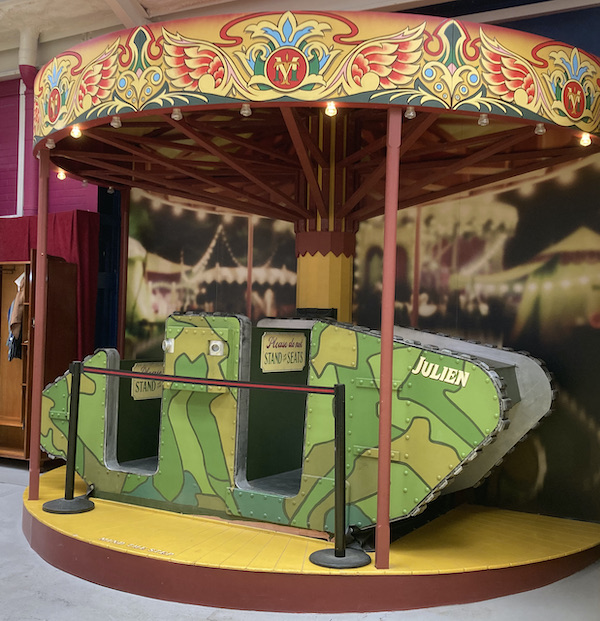
A recent holiday in Dorset gave me the opportunity to visit the Tank Museum at Bovington, something I haven’t done for more than 50 years. It was very exciting, although a little alarming to find myself older than some of the exhibits! Although I did have a quick look at the First World War monstrosities (and took a few photos, below), they were not the reason for my visit. What I wanted to see were tanks from the Second World War: Matildas, Valentines, Churchills, Shermans – especially ‘The Funnies’ – and, my all time favourite, Cromwells … but that’s what happens when your formative years were spent with war comics, classic war movies and Airfix kits … lots of Airfix kits! Anyway, I wasn’t disappointed, but this is not the place to discuss my favourite tanks.
In all my years in the Salonika Campaign Society I don’t think the subject of tanks has ever come up. The obvious response to that is they weren’t used by the BSF, so why would it? But could they have been … ?
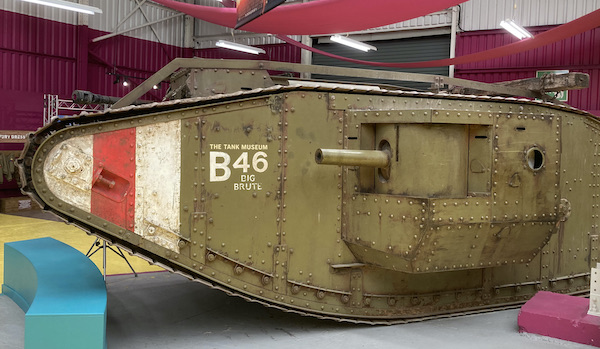
A detachment of eight Mark I tanks fought at Gaza in 1917 on the Palestine front, so they were used away from the Western Front. Gaza – and the Western Front – were considerably flatter than Macedonia and even then tanks often struggled, so was it realistic to consider their use with the BSF? Somebody certainly thought so because, on 24 August 1918, Captain Mackay of the Tank Corps arrived in theatre. Mackay’s visit is described in Volume II of Cyril Falls’ Official History of the campaign (pp120-121). Discussions with GHQ identified parts of the British front where cooperation with tanks could be useful and Mackay went to work.
The Doiran-Vardar front was divided into three sectors for assessment:
- “P” Ridge – out of the question!
- the centre – Selimli Deresi – sector had good approaches and presented an opportunity for taking the Machukovo Salient, but required an advance of 1½ miles in the open, tanks couldn’t pass through the Bulgarian lines in extended formation and the country beyond was unsuitable;
- the left bank of the Vardar also presented a long, open approach, with tanks two abreast, or even in single file to cope with ravines, and ended with a steep gradient before the Piton des Mitrailleuses, so was also considered unsuitable.
The Struma valley offered flatter ground and trench lines that could be overrun, but tanks could not then operate against the main lines in the hills beyond; however, the main difficulty was getting the tanks to their start line along 60 miles of Macedonian road!

In his report Captain Mackay wrote:
Taken altogether, tanks would be faced with too many difficulties to render their employment profitable on the British Balkan front.
This was dated 14 September 1918, just as the French and Serbians started their final offensive and days before the British attacks at Doiran, which brought about the Bulgarian armistice. Even if he’d recommended tanks, it was too late!
In the opinion of Cyril Falls, the most suitable part of the front for tanks was to the west of the British sector, between Monastir and the River Crna. A battalion of French light tanks was sent for use there, but arrived too late for action.
Discover more from Salonika Campaign Society, 1915-1918
Subscribe to get the latest posts sent to your email.
 Salonika Campaign Society, 1915-1918