
Have you been to Zeitenlik? Even if the name doesn’t ring any bells, if you’ve been to the CWGC Lembet Road Cemetery – and the neighbouring allied cemeteries – then you have been to Zeitenlik. Don’t laugh, but I’ve often wondered why this part of Salonika has such a Germanic-sounding name – even allowing for the cultural and ethnic mix of the Balkans. It hasn’t kept me awake at night, nor have I been so bothered that I’ve asked Google, but it has crossed my mind more than once. I suppose this shows that a smidgin of half-remembered O’ Level German is – if not actually dangerous – at least unhelpful!
Earlier in the year I was lucky enough to have a holiday in Turkey and, whilst visiting a vineyard for some wine-tasting, I noticed a map of the local area. This showed local villages, one of which was called Zeytenlik which was helpfully translated as ‘Olive Grove’. Doh! So it’s a Turkish place name, not German at all, which is hardly surprising given Salonika’s history. The spelling is simply a matter of how it was transliterated from the Ottoman Turkish Perso-Arabic script for maps using the Latin alphabet. Turkey did not adopt a Latin script until 1928.
An example is on this undated map, published by the newspaper, L’Independant (from the excellent SCS map collection). This shows the road out to Zeitenlik from the Vardar Gate, passing the Turkish cemetery.

These days, of course, Zeitenlik is very much part of the city, but then it was outside. We can see on this charming panorama (an extract from a postcard in my collection) the Seres road rising out from the Vardar Gate with the Turkish cemetery on the right. Zeitenlik may well be in the trees to the left.

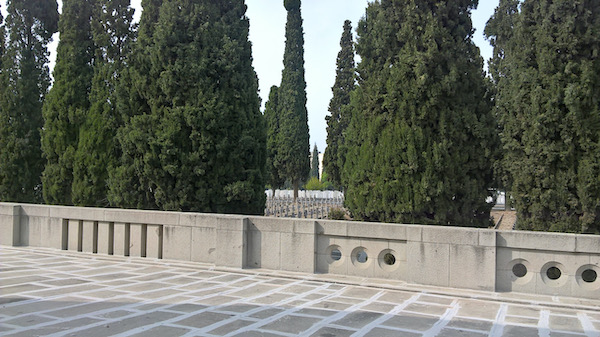
Although Zeitenlik is now part of the city, it is still an oasis of calm and reflection, as I found on a visit in 2016.
And finally …

Discover more from Salonika Campaign Society, 1915-1918
Subscribe to get the latest posts sent to your email.
 Salonika Campaign Society, 1915-1918