
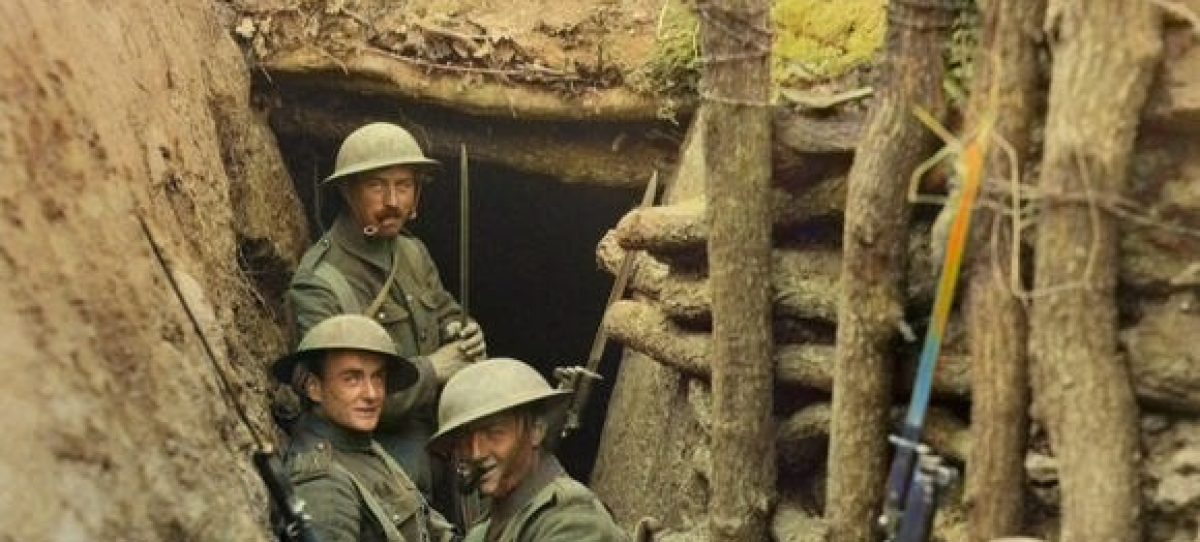
I don’t think I have ever written here on Gallipoli, except in passing about those troops who went on to Salonika. I mean no disrespect to those of all nations who fought and died in the Gallipoli campaign but, with no family connections to the campaign, as with so many other areas of the First World War, I have had no more than a passing interest. I will admit, too, to a little irritation that with the landings in Gallipoli coming so hard on the heels of the start of the Second Battle of Ypres, this latter battle is so often overlooked (see Tuesday’s post). However, I have now had to revise my opinion.
I have discovered a family link to Gallipoli. It is rather tenuous – only being through marriage – but nonetheless it is there. Furthermore, it may lead to another connection with the BSF, in addition to my grandfather who I have mentioned many times in these posts.
The individual in question is George Wilson Clark who was born in Kilmarnock in the 1880s and studied medicine in Glasgow from 1902 to 1905. We next find him as a Lieutenant with 7th (Service) Battalion, Royal Munster Fusiliers. Part of 10th (Irish) Division, the Battalion sailed from Liverpool on 09/07/1915 and landed at Suvla Bay on 07/08/1915.
Eight days later, with the Battalion under fire and officers killed, the War Diary (WO 95/4296) records that:
Capt. & Adj. M. WACE was wounded just in front of the small hill presumably taking orders to the leading platoons. He was brought down to the beach under a hot fire by stretcher bearers, having been attended to by LIEUT. CLARKE [sic] RAMC.
Just a few days later the diary records that Lieut. G. W. Clark RAMC was himself admitted to hospital, having to be relieved by a Captain from 32nd Field Ambulance. The reason for George’s admission is not given, but he was back with the Battalion by the end of the month. As far as I can see, that is his final mention in the war diary, so the implication is that he continued to serve with the Battalion until it left Gallipoli for Mudros. During October 1915, 10th (Irish) Division – including 7/RMF – landed in Salonika. But was George with them?
The next place I can definitely locate him is Bradford where, on 04/07/1916, he married Janet Lawson Martin, describing himself as a ‘physician and surgeon’. So, did he return to the UK from Gallipoli – maybe as a result of poor health – and entirely miss 10th (Irish) Division’s advance into Serbia and the Battle of Kosturino? Or was it because of that bitter winter campaign that he returned to the UK? Intriguingly he was back in uniform in late 1918, serving briefly as a Medical Officer with the RAF.
I clearly have more digging to do. Of course, life would be much easier if the war diaries for Salonika were available online, like those for Gallipoli (I’m not bitter!); however, I am sure I will find an opportunity to visit the National Archives in Kew before too long. That’s not a hardship. If, though, you’re an expert on 7/RMF and know that George Wilson Clark was their MO at the start of the campaign or, conversely, that he definitely wasn’t, I’d be delighted to hear from you!
Discover more from Salonika Campaign Society, 1915-1918
Subscribe to get the latest posts sent to your email.
 Salonika Campaign Society, 1915-1918