

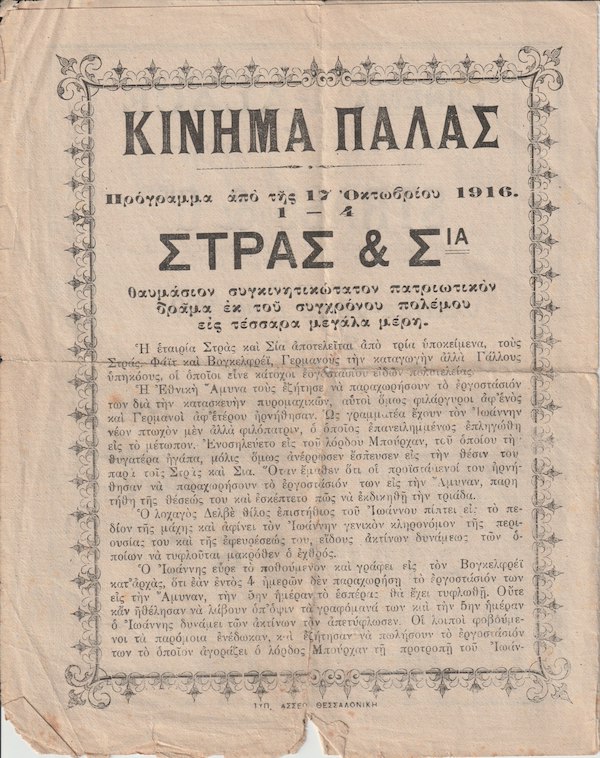
Amongst the souvenirs of the campaign collected by Private Herbert Price of the ASC Supply Department is a rather fragile flyer for Salonika’s Palace Cinema for the week beginning Monday 30 October 1916. Two films were on offer, the first a French silent film from the previous year, Strass & Compagnie, described as ‘a grand patriotic and poignant drama … in four long parts’, which doesn’t seem a great choice for men seeking escapism from war. In which case, maybe Herbert’s preference was for the 1912 American short, A Millionaire for A Day. Described by one US paper as ‘a screaming comedy’, this 1912 American silent short – based on a true story – is about a mechanic who goes to New York City and squanders his inheritance in a single day, returning home broke but wiser (Wikipedia). On the coming Friday, the film Pont du Diable (Devil’s Bridge) was promised, although this sounds uncomfortably like a location in the Struma valley!
As well as being a fascinating snapshot of the delights on offer in wartime Salonika, it also reminds us of the cosmopolitan nature of the city and the allied forces. I imagine the cinema did a roaring trade and with silent films there was no need to worry about dubbing or subtitles! The first page is in French and English …

… with the middle pages (and much more detail) patriotically in Greek …
… with the Italian contingent not forgotten…

… and, on the back page, Cyrillic text (let me know if you can identify the particular language here) and, finally, Hebrew …

The Hebrew text is a reminder of what a vibrant Jewish city Salonika was at the the time and had been for centuries. I don’t know where the Palace Cinema was, but I imagine it was in the city centre and was destroyed along with much of the city in the catastrophic fire of August 1917. This included most of the Jewish quarter and was a shock from which the Jewish community did not recover. The Greek government passed laws to Hellenize the city, making Jews second class citizens which, in turn, encouraged anti-Semitic activities and a pogrom which saw many Jews emigrate. Worse was, of course, to come with the Nazi occupation from 1941, with 96.5% of the city’s Jewish population killed in the death camps.
Also amongst Herbert’s souvenirs is a snap he took of the devastation caused by the fire. Did he, I wonder, look at the ruined Palace Cinema and recall his night at the pictures in October 1916?

Discover more from Salonika Campaign Society, 1915-1918
Subscribe to get the latest posts sent to your email.
 Salonika Campaign Society, 1915-1918
According to Chat Gpt the Cyrillic language is Serbian.
Close, but no cigar!
Thanks for checking, Alister. That seemed most likely, but there were Russians in town at that time as well.