

South Asian Heritage Month seems as good a time as any to consider the, often overlooked, South Asian contribution to the Macedonian campaign. Indeed, had the campaign continued into 1919, this contribution would have been even greater as plans were well underway to “Indianize” the BSF as had already happened in Palestine, but on an even greater scale.
Capt. Cyril Falls writes in the second volume of his official history of the campaign (1935; pages 121-122):
Beginning in November 1918 with 12, a total of 36 Indian battalions would eventually be sent from India. Each infantry brigade would then consist of one British and three Indian battalions, which would enable 24 British battalions from the four divisions to be sent to France. In the field artillery the gunners and gun-team drivers would remain British; the other personnel would be replaced by Indians. In the heavy artillery 75 per cent of the gunners would be British and 25 per cent Indian. British mountain batteries and ammunition columns would be “Indianized”. Thirteen field companies and seven Army Troops companies R.E. [Royal Engineers] would be replaced by companies of Sappers and Miners. In machine-gun companies the gunners would remain British and the drivers would be Indian.
As it was, only part of the policy was completed before the end of hostilities, with the replacement by Indian drivers of British drivers in ammunition columns; the latter moving to divisional artillery batteries. In the month after the armistice, five Indian infantry battalions landed at Salonika and were posted to the 22nd Division (three battalions) and the 28th Division (two battalions):
- 2/6th Gurkha Rifles
- 24th Punjabis
- 2/2nd Rajputs
- 31st Punjabis
- 2/39th Garwhal Rifles
There were others, but these are the only ones listed in the Official History and I don’t have a definitive list.
Other Indian troops, though, had been in theatre since the early days of the campaign. In April 1916 an Indian transport company had arrived with small mule carts which proved ideal for carrying loads on rough tracks where lorries could not operate, as seen in the official photo, below (author’s collection).

Troops from at least four Indian transport units served with the BSF, coming from the Indian Army and State Forces:
- 3rd (Cavalry Brigade) Mule Corps
- 31st Mule Corps
- Bharatpur Imperial Service Corps Transport Troops
- Indore Imperial Service Transport Corps
The IWM’s impressive online collection of photographs from the campaign includes some fascinating images of Indian troops at work, playing sports and relaxing off-duty.
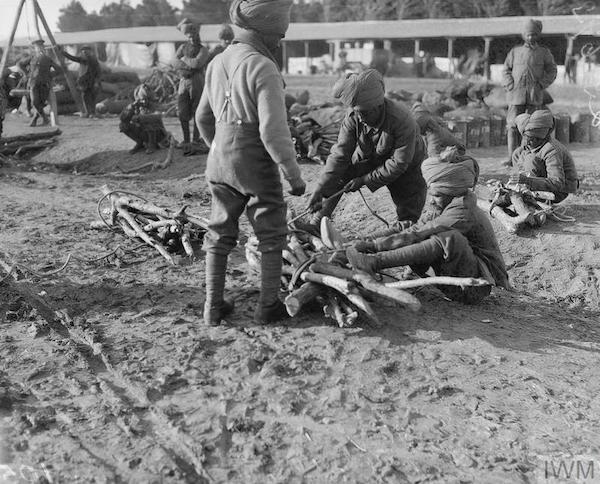
Indian troops from the Supply and Transport Corps tying firewood into bundles, Salonika, 1916. © IWM (Q 31673)
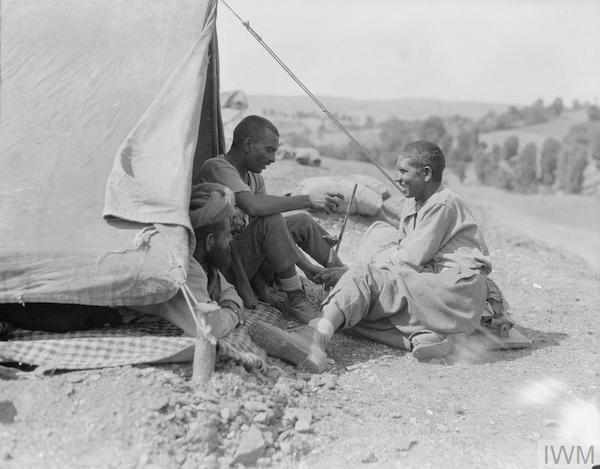
Indian troops smoking at the entrance to their tent, Salonika, September, 1916. © IWM (Q 32322)
Of the six mule-borne mountain artillery batteries that served with the BSF, four came from the UK establishment with all British personnel, but two (2nd and 5th) came from the Indian establishment, so the ‘drivers’ – who made up at least half of the battery manpower – were Indian. The details of transport and mountain artillery units are taken from an excellent article on the BSF’s pack transport, by Vivian John in The New Mosquito (no. 36, Sept. 2017).
A further contribution from India was in surveying. On arrival in Macedonia the BSF was reliant on unreliable Austro-Hungarian General Staff maps and commenced its own surveying but – with several false starts and slow progress – it soon became apparent that this could take years. India had many highly qualified surveyors so the War Office was persuaded to apply to the Survey of India, although it wasn’t until October 1917 that a survey detachment arrived at Salonika. Comprising a British officer, nine Indian surveyors, with orderlies and followers, the detachment took over the survey entirely. Captain Falls describes later British mapping (Official History Volume II, p21) as:
… at least equal in accuracy to the French; in clarity it was superior, and some of the sheets were really handsome examples of the draughtsman’s art.
358 South Asian military personnel are buried or commemorated (having been cremated) in the CWGC Monastir Road Indian Cemetery – 3km from the centre of Thessaloniki – with a further 150 who have graves which could not be moved or marked, remembered. Others are to be found in other CWGC cemeteries in northern Greece.

“We will remember them all.”
Discover more from Salonika Campaign Society, 1915-1918
Subscribe to get the latest posts sent to your email.
 Salonika Campaign Society, 1915-1918