
William Richmond was demobbed in 1919; his medal index card in The National Archives shows that he entered the ‘Class Z Reserve’ on Valentine’s Day. This allowed him to return to civilian life, but there was an obligation to ‘return to the colours’ if necessary, an obligation which was not abolished until 31 March 1920. The card also shows that he was eligible for the famous trio of Great War campaign medals known as Pip, Squeak and Wilfred, named after cartoon characters: the 1914/15 Star (for his service overseas before 31 December 1915), the British War Medal and Victory Medal.
On a recent visit to the excellent Cartoon Museum in central London, I was delighted to see an original pen and ink drawing of them by their creator, Austin Bowen Payne (1876 to 1956), having often wondered what they looked like, and share a picture here:
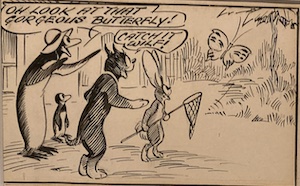
This shows Squeak the penguin, Pip the Dog and Wilfred the rabbit in a comic strip from 1932. They were a long-lived feature in the Daily Mirror, from 1919 to 1953.
But back to William …
I mentioned in a previous post that the 10/Black Watch Old Comrades Association became affiliated to the Salonika Reunion Association in 1938 – the SCS has been given a collection of correspondence relating to this (more of that another day) – but there is no evidence that William was ever a member of either organisation; given the mementoes he saved from his army service, it seems likely that he would have kept something if he had been. However, we do know that from time to time he would meet up with old friends and comrades to talk about Salonika.
In the late 1920s William acquired a pub, The Eagle Inn in Coatbridge, Lanarkshire (which is still there!) and Iain was told by his father that reunions would be held there. Our last picture of William Richmond shows him looking very dapper behind the bar of The Eagle Inn:

My thanks go to Iain Richmond for sharing with the Society these mementoes and stories of his grandfather – and for his patience in waiting for me to make use of them!
Discover more from Salonika Campaign Society, 1915-1918
Subscribe to get the latest posts sent to your email.
 Salonika Campaign Society, 1915-1918
I’m no military buff so I don’t understand the reference to Z Reserve being extinguished in 1920. In this case he would have only been a reservist for a matter of weeks.
I was serving in Gibraltar in 1956, the time of the Suez Crisis and I remember what seemed to me, a twenty year old, loads of older men on their way to Egypt, i.e. Z reservists.
Hello Terence, thank you for your comment. I have to admit I knew little about the ‘Z Class Reserve’ until I looked it up for this post. William was a reservist for 13 months, from 14 February 1919 to 31 March 1920. 11 November 1918 was only an armistice (one of several) and there was a fear that hostilities could resume if the peace negotiations didn’t work out, hence the need to retain men with an obligation to ‘return to the colours’. The armistice had to be extended three times during negotiations, but the Treaty of Versailles was signed on 28 June 1919 and finally came into force on 10 January 1920. The risk of the war resuming had gone and the Army no longer needed these pesky civilian soldiers and could get back to proper soldiering!
Hello Robin,
It would seem from what you say that the class, Z Reserve was ended and revived at some point maybe after the Second World War which indeed it was, I just took a look on Wiki.
Yes, some of the Z reservists, colloquially “Z men” called in at Gibraltar en route or going home, I thought them quite aged.
Terry Gurney.
If you signed up to fight in the Great War you would – understandably – be miffed to be recalled to the colours in 1956 for Suez! My grandfather was 66 by then so hardly fit for service. 🙂
Anyway, it was the ‘war to end all wars’, wasn’t it, so why would Britain need a large reserve army after the Treat of Versailles had come into force …? :-O
I assume ‘Z Class’ (after both world wars) indicates those men to be called up as a last resort, once all other eligible classes were in uniform.
Thanks again for your comments. Cheers, Robin