
In January 1918 General Headquarters (GHQ) in Salonika felt the need to issue memoranda reminding commanders of formations that they were responsible for the efficiency of their units and for the training of all officers and men in them. In certain technical fields training had to be done at army schools but, generally, the purpose of these schools was to support units by training the trainers who would share, what we would now call ‘best practice’, within them. By this time GHQ Salonika had a number of schools under its control, covering subjects such as infantry training, artillery, signals, the Lewis Gun and anti-gas precautions. A School of Physical and Bayonet Training was also set up, with an Assistant Superintendent authorised by the War Office to coordinate and supervise this training, with a staff of 10 NCOs from the Army Gymnastic Staff (Official History vol. 2, chap. III). Our next sight of William Richmond is as a student at this School.
In April/May 1918 William, who was now a Corporal – so getting the pay to go with the responsibility – attended a 12 day course on Physical and Bayonet Training which, although it was doubtless strenuous, must have been a welcome change from life on the Doiran front.
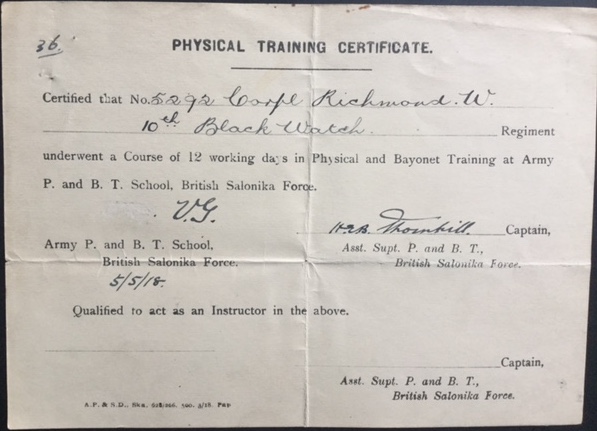
Corporal William Richmond’s certificate of attendance on the P. and B.T. training course in which he was rated ‘Very Good’ by Captain Thornhill, the Assistant Superintendent.
Not long after this, William gained more responsibility – but no extra pay – with his promotion to Lance Sergeant, which he recored in his pay book on 20 June 1918, ‘in the field’. His daily pay was now the princely sum of 2/8, 6d of which was ‘Proficiency Pay’, although we don’t know what this was for.

William’s pay book, showing him to have been a pattern maker before the war and that he was now to be found in ‘B’ company, the sort of detail that can be difficult to find from the limited official records that survive.
At this time the BSF was undergoing something of a shake-up, which included the unwelcome loss of 12 infantry battalions to reinforce the BEF on the Western Front. 26th Division lost three battalions, including 10/Black Watch. The journey back to France was made rather easier by the short sailing from Itea to Taranto in Italy – 3 small French transports shipped them all over in about a fortnight – then by train to France. Although welcome reinforcements, the high rates of malaria amongst the troops caused alarm in the BEF!
Given special treatment on arrival in the form of ‘a liberal diet’, rest and then a programme of training and sport, with lectures on malarial treatment, the troops soon took their place in the line (Official History, vol. 2, chap. V). 10/Black Watch found themselves in 197th Brigade of 66th (2nd East Lancashire) Division which, having suffered heavy casualties, had been reduced to a training cadre and then rebuilt and reconstituted during June to September 1918. 10/Black Watch may well have been similarly reduced and was disbanded on 15 October 1918. William soldiered on until his demob in 1919, but what he did and where he went is not recorded. We do, though, have this splendid photo showing him (on the left) with two fellow sergeants, who both look very young and chipper – perhaps at the time the photo was taken, the war was over!

William and his other standing friend are both wearing the cutaway jacket worn by Scottish regiments and kilts. On William’s sleeve we can see three blue service chevrons for three years overseas service (authorised in December 1918) and a brass wound stripe (introduced in August 1916) is visible on the man’s cuff on the far right.
Discover more from Salonika Campaign Society, 1915-1918
Subscribe to get the latest posts sent to your email.
 Salonika Campaign Society, 1915-1918