
I’m grateful to a recent correspondent with the Society for bringing to attention (to me at least!) the work of artist Henry Lamb. In 2014, the Whitworth Art Gallery in Manchester had an exhibition, The Sensory War, to mark the 100th anniversary of WW1. One of the works exhibited was by Lamb: Advanced Dressing Station on the Struma 1916
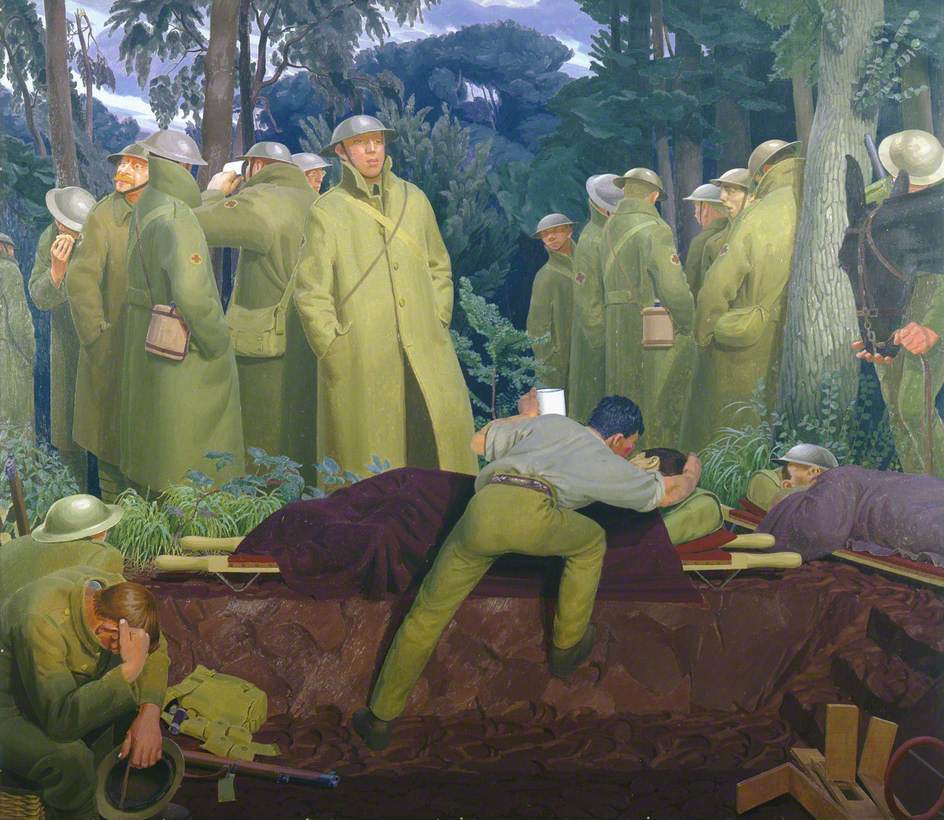
Ana Carden-Coyne, who co-curated the exhbition Visions of the Front 1916-18, for the Somme centenary also featured the painting and describes it in this way:
“The scene of a dressing station focuses on the relationship between a wounded man and a stretcher-bearer, who attends him with a cup of water, a great relief that many soldiers wrote about as the comfort given between men. Thirst and cold were understood much later in the war as signs of hemorrhage and shock. The bearer’s hand gently touches the wounded man’s head, providing comfort symbolic of the pietà (Christian iconography of Mary cradling Jesus’ corpse). Indeed, the pietà was often used in war-time humanitarian images of nurses caring for wounded men. But Lamb transforms the theme into an effigy of masculine care and the intimate brotherhood of shared suffering. Placed on the ledge of a shallow trench, the stretcher resembles an altar. In the right hand corner is a Thomas splint used for compound fractures, from which soldiers could die. Pathos is also created by the figure on the left, head in hand, perhaps affected by malaria, a common disease of this front, or perhaps a reference to psychological suffering. The central figure stands over the patient, staring pensively into the distance. Made three years after the end of the war, the composition of this painting symbolises the pain and succour of the entire conflict.”
There’s also discussion of the painting by one of the team at The Whitworth here:
Henry Lamb was born in Australia in 1883 and educated at Manchester Grammar School, before studying medicine at Manchester University Medical School and Guy’s Hospital in London. He abandoned medicine in 1906 to study painting at the Chelsea School of Art but “with the outbreak of the first world war Lamb returned to his study of medicine and served as a doctor in the Royal Army Medical Corps in France, Salonika and Palestine where he was awarded the Military Cross. He was not an official war artist but was always sketching and drawing in spare moments. These sketches with memories from his time on the Macedonian Front and the Palestine campaign formed the basis of large-scale paintings made after the war. ‘Irish Troops in the Judaen Hills’, now in the Imeperial War Museum, and ‘Advanced Dressing Station on the Struma’ for Manchester City Art Gallery are amongst the most extraordinary of his career. In 1928 he married Lady Pansy Pakenham and moved to the quiet Wiltshire village of Coombe Bissett where they would remain for the rest of their lives. Lamb was appointed an official war artist for the second world war and after first wanting to document the war cabinet decided on portraits of soldiers and studies of servicemen at work across the South of England. At the same time as his appointment as a war artist Lamb was elected as an associate of the Royal Academy and a Trustee of both the National Portrait Gallery and the Tate. He was finally awarded full membership of the Royal Academy in 1949.” Sources here and here.
- https://messumslondon.com/artists/henry-lamb-ra/
- https://medhumlabmanchester.org/tag/visions-of-the-front-1916-18/
- https://aboutmanchester.co.uk/the-sensory-war-1914-2014/
Discover more from Salonika Campaign Society, 1915-1918
Subscribe to get the latest posts sent to your email.
 Salonika Campaign Society, 1915-1918