
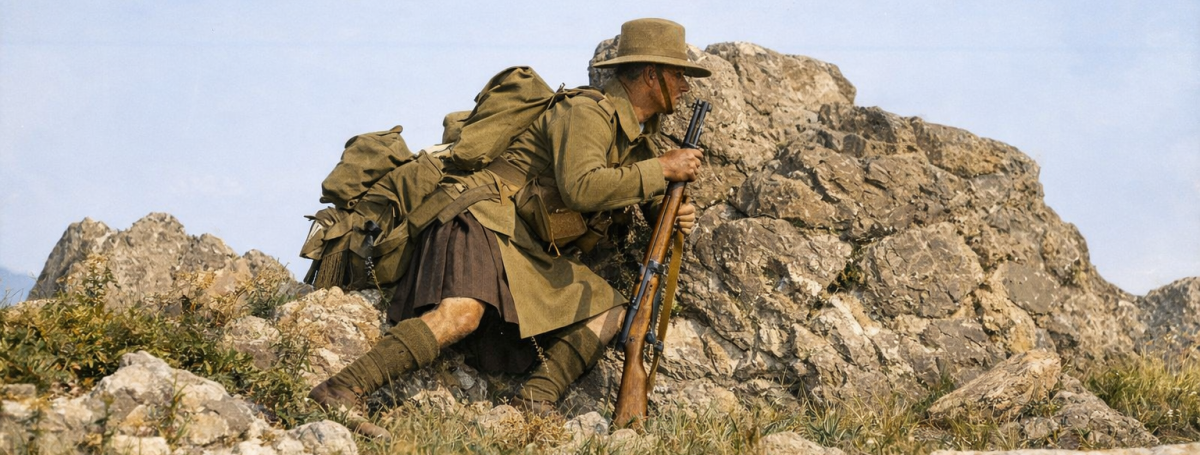
Having celebrated the Welsh battalions of the BSF on St David’s Day and the Irish ones on St Patrick’s Day, how should I mark St George’s Day? I feel writers’ cramp coming on just thinking about typing out the names of the 52 or so English battalions of the BSF (see NM 11, April 2005) so, instead, will go for an easier option. The Royal Regiment of Fusiliers was formed on 23 April 1968, celebrates St George’s Day and, indeed, has an image of St George slaying the dragon on its cap badge. It was created by amalgamating four English fusilier regiments: Royal Northumberland Fusiliers, Royal Warwickshire Fusiliers, Royal Fusiliers (City of London Regiment) and Lancashire Fusiliers. Three of these regiments provided battalions for the BSF.
Two regular, English fusilier battalions served in 28th Division, which I specifically mention, because yesterday was the anniversary of the German gas attack on 22 April 1915 which opened the bloody Second Battle of Ypres, in which the Division suffered the heaviest casualties of the all the British, Dominion and Empire troops engaged: 15,533, of whom over 3,000 were killed. A Division and a sacrifice that are largely overlooked. The two battalions are:
- 2nd Battalion, Northumberland Fusiliers – 28th Division, 84 Brigade
- 3rd Battalion, Royal Fusiliers (City of London Regiment) – 28th Division, 85 Brigade

Troops of the 3rd Battalion, Royal Fusiliers, 85th Brigade, 28th Division manning a trench near Bairakli Jum’a, May 1917. © IWM Q 32896
The third English fusilier battalion with the BSF was 12th (Service) Battalion, Lancashire Fusiliers, which was formed in Bury in September 1914. It was part of 22nd Division, 65 Brigade.
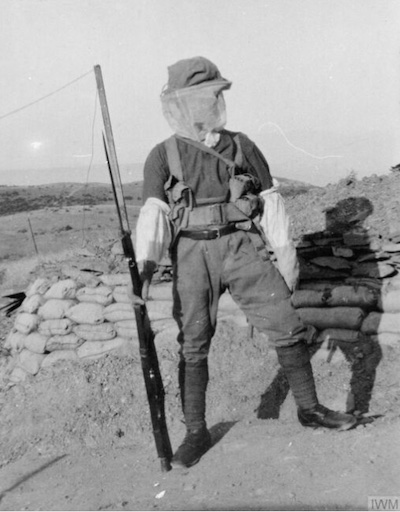
Lance Corporal Harrison, 12th Battalion, Lancashire Fusiliers, wearing protective anti-mosquito clothing as issued to troops on night duty during the summer months. Photograph taken at Bowls Barrow, 2 June 1918. © IWM HU 82035
Happy St George’s Day!
Featured image: Troops of the 3rd Battalion, Royal Fusiliers, 85th Brigade, 28th Division manning a trench near Bairakli Jum’a, May 1917. © IWM Q 32896
Discover more from Salonika Campaign Society, 1915-1918
Subscribe to get the latest posts sent to your email.
 Salonika Campaign Society, 1915-1918