
Many thanks to Society member Keith Roberts for the following reviews:
As a result of working on the SCS bibliography I have arguably parted with too much money purchasing books about the campaign for myself. Some, in fact most, of the books published in the aftermath of the Great War are now both rare and expensive. Only a limited number have been reprinted but quite a few are available to download free of charge from the ‘Internet Archive‘, and a few at modest cost, as Kindle ebooks, but I’m still happier with a real book in my hands. Not long ago I came upon a couple of closely related privately-published items…
1914-1919 Memoirs of the 32nd Field Ambulance, 10th Irish Division
The first item was 1914-1919 Memoirs of the 32nd Field Ambulance, 10th Irish Division by C, (Charles), Midwinter who was a sergeant in that unit. The booklet was published in 1933 and described his time in the unit from the outbreak of war to November 1918 by which time the unit was in Palestine. The only copies that I have been able to trace are in the libraries of The Imperial War Museum, and Leeds University.
The content is a well-written narrative describing the unit’s experiences, from formation, via Gallipoli and Macedonia to Palestine. After the introductory pages and the unit’s experience of the Gallipoli campaign, the author describes their part in the Salonika Campaign in pages 40-56.The text names some members of the unit, and draws frequently upon the recollections of Sgt Midwinter. 32 FA, a Territorial unit, landed in Salonika on 10 October 1915 and, after a short interval, deployed behind the positions held by part of the 10th Irish Division at Kosturino. Subsequently they occupied a number of locations during the remainder of their time in Salonika, before moving to Egypt and Palestine in late 1917. Written by a soldier rather than a medically qualified individual the narrative has little to say about the medical part of the unit’s work, describing rather their movements, and locations.
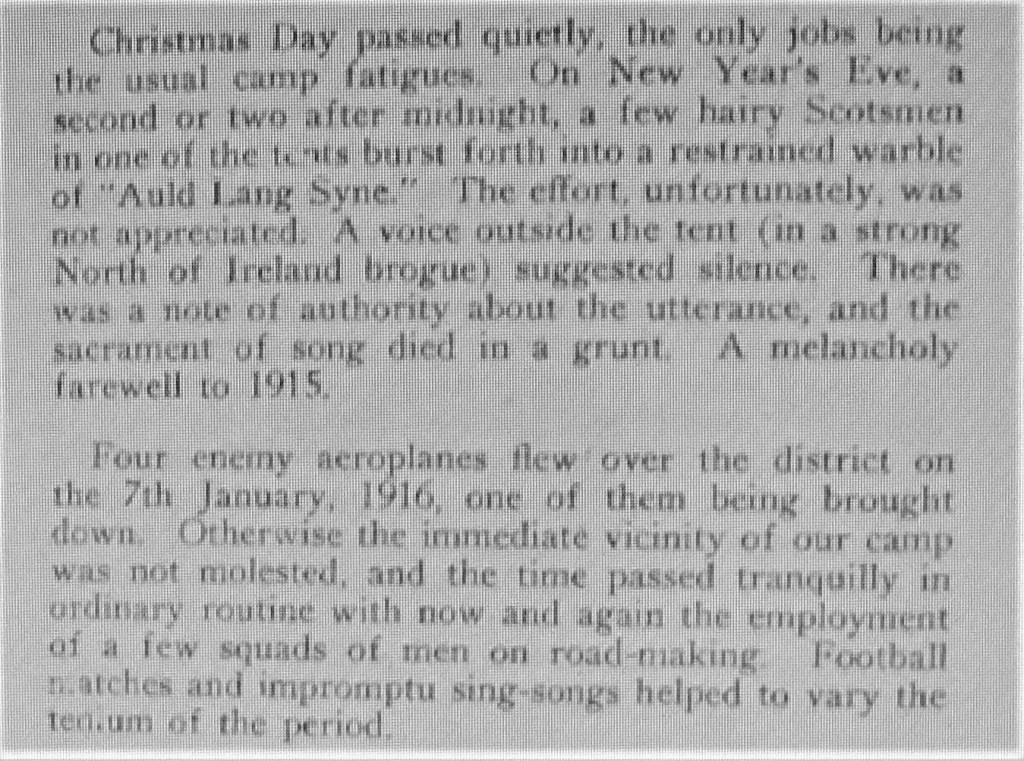
December 1915/January 1916
The Badge of Honour
The second booklet, which I stumbled upon more recently, is The Badge of Honour edited by Godfrey A Gill, who published three other booklets on Cornish subjects. This is another privately published work, printed in 2015. It is well presented with a small number of photographs. This book is very different, and is built entirely around a transcription of the diary kept by a Plymouth man, Private Tom Wherly describing his personal experience of service in 32nd. Field Ambulance.
The style is quite different, being a record of his diary entries (with some gaps), from his enlistment until 11 September 1918. It records some of his experience at various locations, the weather, his ailments and his food, the things that he thought his family might like to know about as it is made clear that he wrote these comments for the benefit of his family. They were identified in this new century by a family member and after some time this volume emerged in 2015. There are few comments about military events as a result of which the editor inserted several appendices in which he addressed the background and current events of the time. The editor is not a military historian, but his comments are generally well founded, apart from referring to the ‘Field Ambulance Corps’ rather than to the Royal Army Medical Corps.
The descriptions of Tom Wherly’s life, especially while serving in the Salonika theatre of war give an interesting perspective of the thoughts and experience of a man serving in a non-combat role in a very human way, describing the aspects of his military life that he thought would give the best description of his experience. As such it is a very human document, and enables the reader to get a sense of the daily life of one of the many members of the BSF whose service was essential, but entirely behind the front lines.
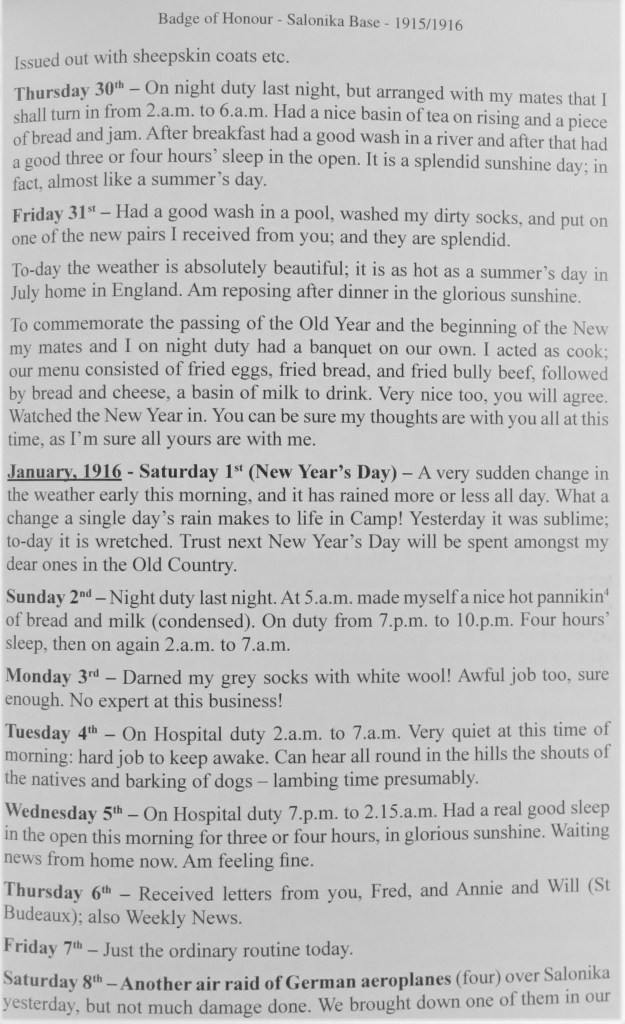
also December 1915-January 1916
The Badge of Honour is nicely printed with stiff card boards and glossy paper and a small number of photographs. There are 106 pages but the editor is responsible for a number with his explanatory appendices and notes. I have discovered that just 18 original copies of The Badge of Honour are still available at the original price of £7.95 plus postage. I plan to purchase a small number for friends I will be meeting either during our next tour in September, or at the AGM October 2023. The remainder can be purchased from The Mayflower Studio, Fore Street, East Looe PL13 1AE, email at mayflower.looe@btconnect.com
Two tales of two men
Both men received the 1915 Star, in addition to the Victory and the British War Medal. Beyond his medal record almost all we know about Charles Midwinter is that he started the war as a private, and ended a sergeant.
We know quite a lot more about Samuel Thomas Pawley Wherly, because this diary was in the hands of his descendants, and some of his army records survived the 1940 bombing of Arnside Street. Like Charles Midwinter, he joined up at the beginning of the war, and his service was continuous from 28 October 1914 until 13 May 1919 when he was discharged as no longer fit for war service. His attestation form states that he has four years previous experience as a volunteer with the Devon Royal Garrison Artillery. Like many others he was issued with the (Silver) War Badge and the few surviving pages of his service record show that he served for four years and 198 days before his discharge in 1919, and that he was discharged with a 50% degree of disability on the grounds of Melancholia with a pension of 13s 9d weekly to be reviewed after 52 weeks. His role in the RAMC is described as “Nursing Duty Orderly”.
Keith Roberts
Discover more from Salonika Campaign Society, 1915-1918
Subscribe to get the latest posts sent to your email.
 Salonika Campaign Society, 1915-1918